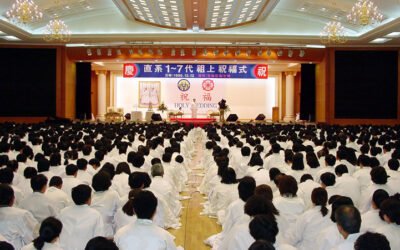
The action to dissolve the Family Federation and the indoctrination of unpopular minorities’ second-generation children in schools violate international law.
by Patricia Duval*
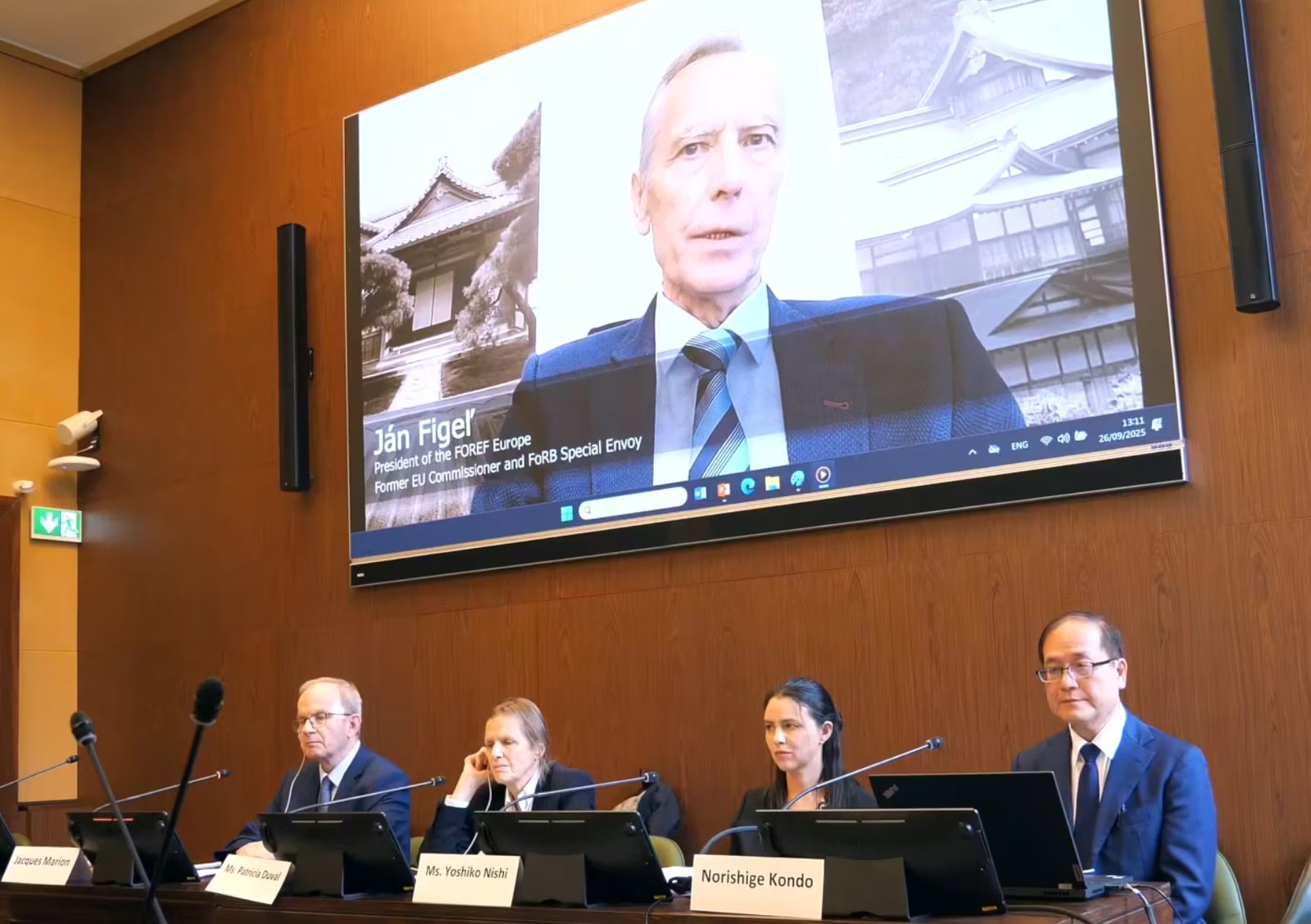
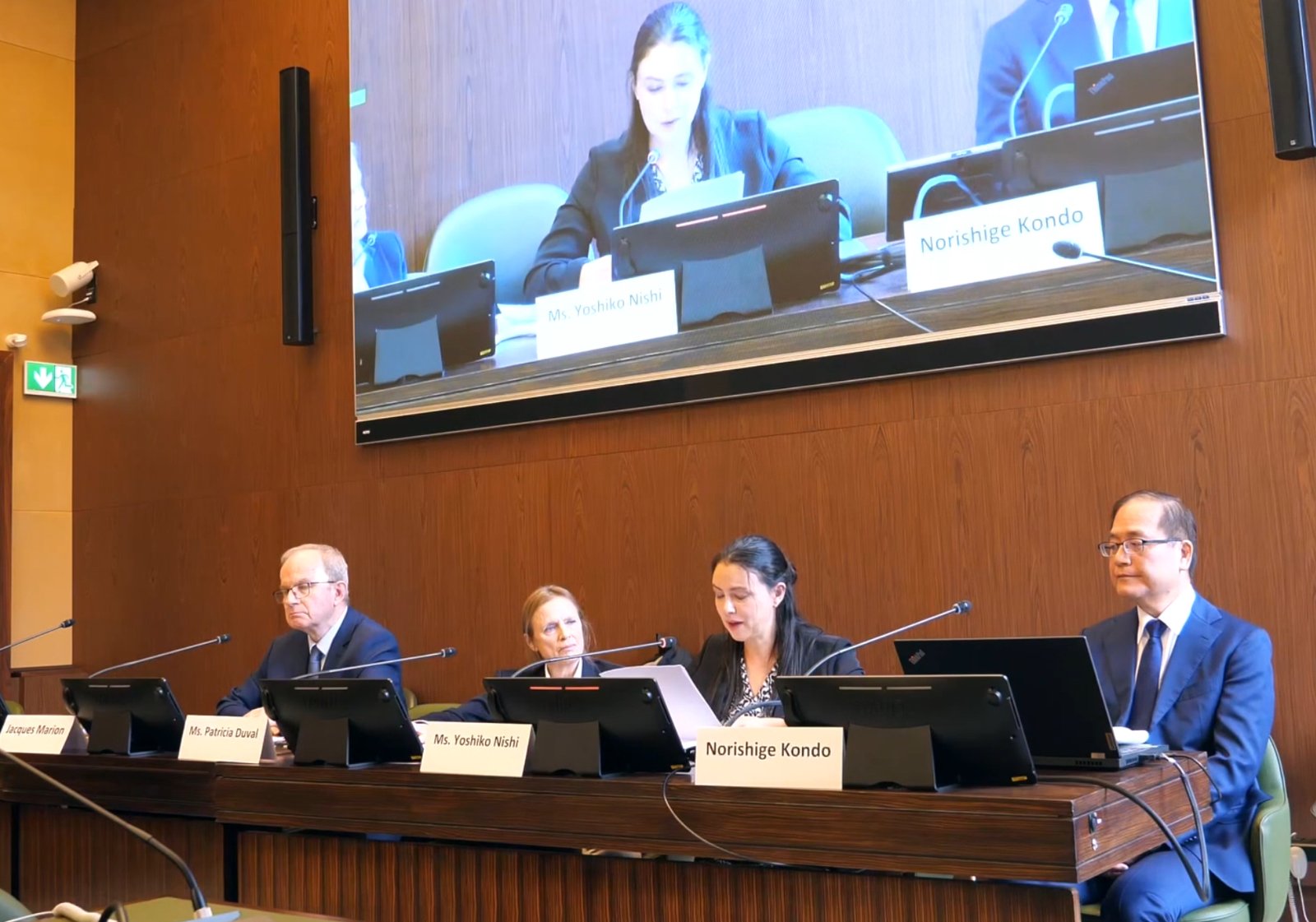
*A paper presented at the side event “Human Rights in Japan. Religious Cleansing in Japan: Eradication of an Entire Faith Community” 60th Session of the United Nations Human Rights Council, Geneva, 26 September 2025.
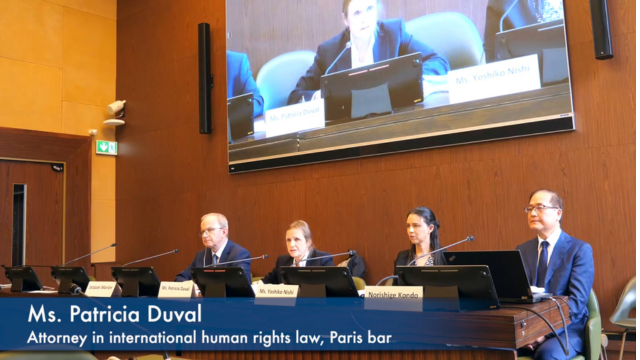
I want to address two points today that are of serious concern under United Nations standards.
1) The illegality of dissolution under international human rights law
The dissolution of the Unification Church is based on Article 81 of the Religious Corporations Law, which provides that a court may order dissolution if: “(i) in violation of laws and regulations, the religious corporation commits an act clearly found to harm public welfare substantially.”
In the present case, the Ministry that oversees religious matters filed a request for a dissolution order from the Tokyo District Court and maintained the following: “From around 1980 to 2023, Unification Church believers caused significant damage to many people by making them donate by restricting their free decision and preventing their normal judgment [accusation of brainwashing], which resulted in disrupting the peaceful lives of many people, including family members.”
However, as Dr. Figel stated [in this event], Article 18 of the International Covenant on Civil and Political Rights, which Japan has committed to, does not allow for such a limitation of the right to manifest one’s religion or belief.
Disturbing many people’s lives is “not” a motive of public order, making state interference necessary to limit this right. Displeasing some people is called freedom of belief.
I want to underline here that for all the period of time that the Ministry is relying on in its claim, the government has given carte blanche to extremist lawyers and consensual religions to “deprogram” Unification Church members by force: kidnappings by trickery and illegal confinements by families, and imposed indoctrination against their Church’s beliefs, mostly by Protestant pastors.
So, my question is: who disturbed whom exactly?
Those deprogrammers and their supporters broke families by the thousands. Around 4,300 members were coercively subjected to “deprogramming” over the four decades mentioned by the Ministry, with the government’s blessing and voluntary inaction, which resulted in thousands of families being devastated and unable to repair.
Thousands of parents were abused and talked into submitting their adult children to deprogramming.
The government should actually be held accountable for family breaking.
In its claim of “disturbance,” the Ministry relied on thirty-two adverse civil court decisions in cases filed by former members some twenty to forty years before, after their “deprogramming.” Those members were coerced by their deprogrammers and lawyers to file financial claims against the Unification Church to prove their real intention to abandon the faith and to be released from confinement.
In these civil cases, the courts found torts against the Church based on the allegation that it violated so-called “social norms.”
But “social norms” and “public welfare” are vague and arbitrary concepts that have no place in matters of religious beliefs and practices and violate Japan’s duty of neutrality in religious matters and its commitment to abide by the International Covenant on Civil and Political Rights.
The UN Human Rights Committee, created by the Covenant to monitor its implementation by State parties, has consistently urged Japan to stop using the notion of “public welfare” to limit freedom of religion or belief.
Japan ratified the Covenant in 1979 and accepted the Committee’s monitoring authority.
Since 1980, so one year later, the Committee has denounced the inclusion in Japanese law of the concept of public welfare to limit civil liberties and made the following recurrent demand: “The Committee reiterates its concern that the concept of ‘public welfare’ is vague and open-ended… and urges the State party to refrain from imposing any restriction on the right to freedom of thought, conscience, and religion unless they fulfill the strict conditions set out in article 18.”
It can be concluded that the Japanese authorities have known for forty-five years that they had to review their internal laws to conform to the Covenant. However, they have consistently refused to do so under a fake pretense and violated their international commitments.
They are about to eliminate an entire religion on this illegal basis.
Additionally, the concept of “social appropriateness” opens the door to discrimination and domination by consensual religions (like what happened with the Protestant deprogrammers).
It directly conflicts with the Human Rights Committee’s standards in its Comment n° 22 on article 18: “The terms ‘belief’ and ‘religion’ are to be broadly construed. Article 18 is not limited in its application to traditional religions or to religions and beliefs with institutional characteristics or practices analogous to those of traditional religions. The Committee therefore views with concern any tendency to discriminate against any religion or belief for any reason, including the fact that they are newly established, or represent religious minorities that may be the subject of hostility on the part of a predominant religious community.”
Therefore, without any statute law’s violation or crime, public opinion hostility can never justify courts to limit the right to manifest one’s religion or beliefs based on religious practices lacking “social appropriateness.”
Yet, this has been the basis for the thirty-two civil tort decisions based on which the dissolution order was issued.
2) Second point of concern: The government’s plan to re-educate the children against their parents’ faith
After Prime Minister Abe’s assassination, the anti-Unification Church network of lawyers published various Opinion Papers in 2023 to push for repressive measures to be adopted by the government against the Church.
They issued one in particular on the issue of “Second-Generation Members,” which inspired a subsequent plan adopted by the government at a Cabinet meeting in January 2024, to “re-educate” the children of members of the Unification Church and other unpopular religions within the Japanese public school system.
Based on a twisted and malicious re-interpretation of the Convention on the Rights of the Child, which protects the right of children to freedom of religion or belief, those lawyers have determined that children from minority religious groups have to be rescued from their parents’ faith, since, they allege, “children may not necessarily be practicing religion out of their own free will.”
Therefore, they maintain that children should be instilled with “critical thinking” about their parents’ faith.
The lawyers justify it by stating that “individuals who grow up in such environments during the formative years of their personality often remain unable to break away from the religious doctrines instilled in them, even after adulthood.”
This explanation clearly reveal that the purpose is to prevent the children of members of specific religions from becoming believers and followers of that religion in the future.
The plan adopted by the government provides for widespread education of children who have not expressed any requests or problems, on potential abuses they could be the victims of due to their parents’ religious beliefs.
This includes a wide range of distribution of cartoons, featuring imposed religious education and verbal reprimands or mentions of hell as psychological abuse. It is coupled with the distribution of “SOS mini letters,” where children can ask for free information and counseling through hotlines.
The teachers are requested to identify and single out the children belonging to the Unification Church community who would need specific “counseling” even “in the absence of explicit statements from the child.”
Then, for this counseling to be effective, the government plan provides that hostile former members will train counselors to utilize their “knowledge and expertise” concerning the religion they have left.
Thus, the government is using former members hostile to the Unification Church as training instructors for counseling the children of current members, once these have been singled out from the rest of the pupils.
This constitutes a blatant violation of Japan’s duty of neutrality in religious matters and an impermissible interference with parents’ right to ensure their children’s religious and moral education in conformity with their own convictions, as protected under the Covenant and the Convention on the Rights of the Child.

Patricia Duval is an attorney and a member of the Paris Bar. She has a Master in Public Law from La Sorbonne University, and specializes in international human rights law. She has defended the rights of minorities of religion or belief in domestic and international fora, and before international institutions such as the European Court of Human Rights, the Council of Europe, the Organization for Security and Co-operation in Europe, the European Union, and the United Nations. She has also published numerous scholarly articles on freedom of religion or belief.