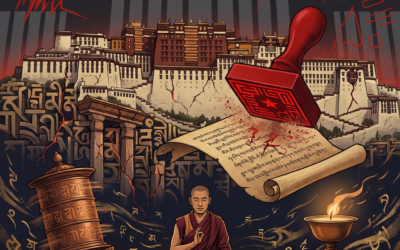
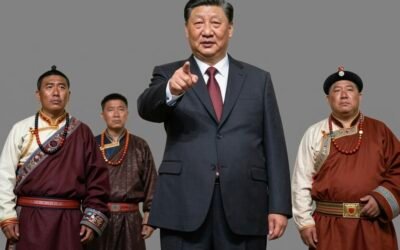
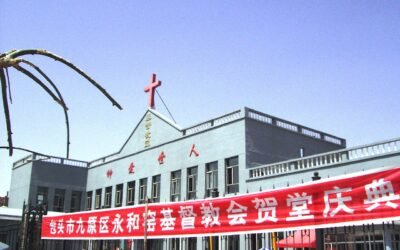
The socialist reporter claims that freedom of religion reigns in East Turkestan (Ch. Xinjiang). He just repeats Chinese propaganda.
by Kok Bayraq
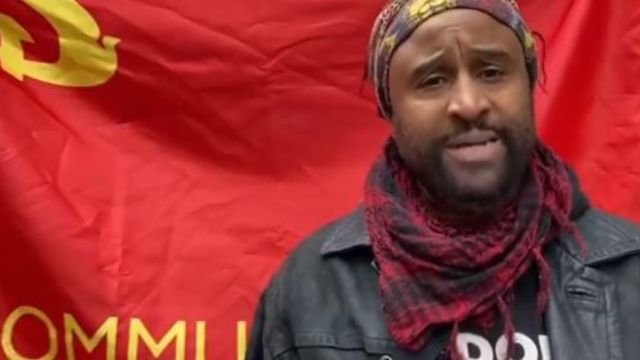
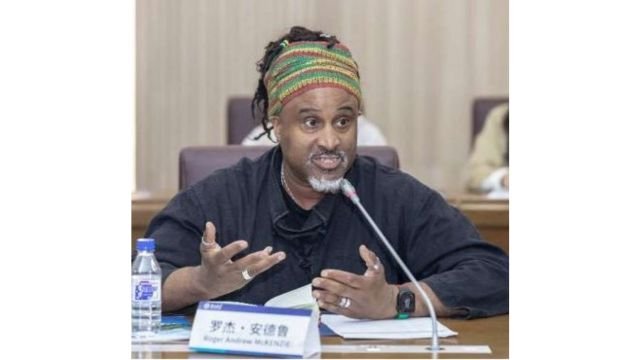
Roger McKenzie, a well-known journalist from the British “Morning Star,” which styles itself “the only English-language socialist daily newspaper in the world,” visited my home region, East Turkestan (Xinjiang to China), where I have not been able to talk to my family members for seven years. Even if what to expect from his article was obvious from the title, “The Xinjiang I Saw Was a Hub of Diversity, Not Oppression,” I had the patience to read it.
I finished the first part of the article, which will continue in three parts, as if I was reading China’s annual “White Book.” The findings and praise regarding the situation were no different from Chinese propaganda and in some places even seemed to surpass the prose of Xinhua News Agency.
To me, Roger comes off more as an ardent red activist than an independent journalist due to his tone in the article, and as evidenced by his previous writings as well. However, I decided I should say something about his report.
To claim that there is “freedom of the speech” in the region, Roger wrote, “I spoke with lots of people in private with no restrictions placed on me whatsoever… I was a target of curiosity, especially among the young, many of whom wanted to come and chat and have a photo taken with me!”
It seems that he expected from Uyghurs, if they were unhappy with the CCP, to cry about their problems or harshly criticize the government, when they met with him at what he believed were “private places.” He continued, “I heard no criticism of the government over religious persecution from senior religious figures or anyone else I met during my visit.”
Today, among the three million Uyghurs in prisons and camps, just a small part are detained for speaking against the government, while the absolute majority are detained because of the mere “possibility” of uttering such criticism. To know this reality, there is no need to go to “Xinjiang.” The 300,000+ personal records in the Xinjiang Police Files fully reveals it. Besides that, the well-known professor Ilham Tohti is in prison with a life sentence, not because of any violent act, just for criticizing the government. This being the case, who can expect members of this society to talk freely about the problems of the people?
Roger, who wrote that there are twenty million Muslims in the region, was excited to see 1,000 students in a single Islamic institute there. He was not surprised that government propaganda was being carried out inside the mosque. He regarded it as normal when he witnessed the imams in the mosques praising the CCP instead of God.
The basic standard of journalism is, when investigating an issue, those on both sides of the issue should be heard; and both parties being heard must be in an equal position to express their opinions.
Before his trip to Xinjiang, Roger should have visited the Uyghur activists in the diaspora who claim a genocide is going on and added their opinions to his article. If Rebiya Kadeer, whom many regard as the spiritual mother of the Uyghurs, was too distant for him because she lives in the USA, he should have listened to Gülbahar Jelilova and Gülbahar Haitavaji, who survived the camps and live in Europe, in the Netherlands and France, and could have found believable members of the Uyghur diaspora in the UK too.
He didn’t do that, however, maybe because they couldn’t cover his visit budget or organize banquets in Urumqi.
Throughout his article, Roger expressed his skepticism towards the West as much as he showed his love for China. In my opinion, it looks like he came to the Uyghur region not to understand the situation, but to express his anger towards the West or to protect China from criticism.
He tried to hide this reality by stating, “I can already hear some saying that either I wasn’t looking hard enough, or I was having the wool pulled over my eyes. I did look hard, and I don’t believe an elaborate hoax was being played on me.”
My word to Roger is this: “The wool has closed your heart: this wool, built with boundless love of China and hatred of the West, has not given your eyes the chance to see the truth.”
I do assume that the source of Roger’s love for China is his hatred of the West. There is a saying among Uighurs: “Love is blind.” Roger, who loves China so much, is blind to the situation of the oppressed Uyghurs. It is also true that, when your heart boils with hatred, your mind cannot make the right judgments and you lose control of your tongue.
That the truth is being hidden is evident from the oath-like adjectives, “I honestly say,” “I honestly believe,” “To be crystal clear,” which Roger uses repeatedly to convince the readers of his sincerity.
Some of the facts he reports contradict his own statements. He wrote that he did not hear a single word against the government during the ten days in which he visited five cities. Is this normal? Is a society where nobody criticizes the government and all praise it a normal society? I don’t think any other evidence was needed to realize that the society is under pressure. Perhaps Roger lived in England for so long that he either does not appreciate the free-thinking environment or does not recognize a non-free society when he sees one.
He invited people to visit Xinjiang by using quotes from the speeches of local authorities: “There is only one way to counter Western propaganda, let the people come and see!” But people would come and see what the CCP wants to show them, and the authorities they would meet would not have been democratically elected and would not represent the Uyghurs.
In short, Roger McKenzie went to the Uyghur region rushing after his political ideas and the goals he believes in and did not have time to think about concepts such as human rights, human nature, and international humanitarian law.

Shohret Hoshur (who until 2025 used the pseudonym of Kok Bayraq) is a political émigré from East Turkestan (Ch. Xinjiang) and an opponent of the Sinicization of his homeland. He left China in 1995 when his journalism got him “into trouble with the authorities,”and is now living in Washington, D.C.. His unique thoughts and feelings published in Taipei Times and Global Voice comment on the ongoing Uyghur genocide.