CAP Freedom of Conscience warns the Human Rights Council about the fate of Shincheonji’s leader.
by Massimo Introvigne
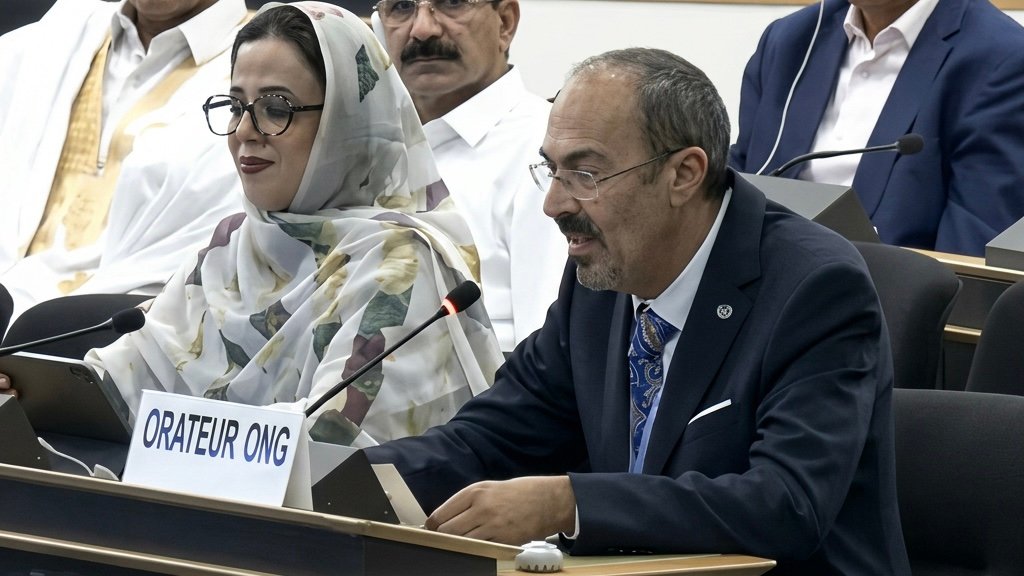
The hall in Geneva was still carrying the echo of earlier interventions when, on 18 September 2026, CAP Freedom of Conscience took the floor during the general debate under Item 3 of the sixty‑third session of the United Nations Human Rights Council. The organization spoke of a man whose life spans the Korean War, the rise of South Korea’s democracy, and the creation of one of the country’s most successful religious movements. Chairman Lee Man‑hee, a Korean War veteran and founder of the Shincheonji Church of Jesus, is ninety‑five years old. He now spends his days in pretrial detention at the Seoul Detention Center, accused of non‑violent offenses.
The statement delivered in Geneva described a situation that has unsettled observers of religious freedom in East Asia. It noted that Chairman Lee, despite having a fixed residence and posing no flight risk, “was held in cells without air conditioning during Seoul’s most severe heatwave, raising grave concerns for the health of a 95-year-old detainee.” CAP Freedom of Conscience denounced what it regards as a politically driven and discriminatory investigation targeting a religious minority. It warned that the conditions of detention fall short of the standards the Republic of Korea has pledged to uphold.
The organization reminded the Council that Article 9 of the International Covenant on Civil and Political Rights requires detention to be necessary and proportionate, while Article 10 guarantees humane treatment. The Nelson Mandela Rules demand healthcare equivalent to that available in the community. The Tokyo Rules establish pretrial detention as a last-resort measure. Article 18 protects freedom of religion or belief. CAP Freedom of Conscience urged the Council “to call on the Republic of Korea to honor its treaty obligations by offering alternatives to detention, allowing an independent medical assessment, and ensuring a fair and impartial trial.”

The accusations against Chairman Lee revolve around the claim that he encouraged followers to join an opposition political party. Other allegations, including tax‑related ones, have appeared as auxiliary charges. None of these justify keeping a ninety‑five‑year‑old religious leader in a detention center during a heatwave. The influential “Korea Times,” in an op‑ed published on 3 September, observed that Korean law punishes religious leaders who influence the political choices of their devotees, while leaders of labor unions and several civic groups may do so without fear of imprisonment. The article described this asymmetry as a residue of the country’s authoritarian past, a legacy that still singles out religious leaders for special scrutiny.
Chairman Lee’s case exposes a tension between democratic institutions and old reflexes. South Korea has built a reputation for constitutionalism and human rights, yet the treatment of this elderly detainee raises questions that cannot be dismissed. His age, his long and distinguished public life, and the non‑violent nature of the allegations call for restraint. While amending Korean election laws to align with international law’s provisions on the rights of religious leaders and organizations to be active in politics is a long-term project, Chairman Lee’s detention conditions, as described in Geneva, raise an urgent problem.
CAP Freedom of Conscience’s intervention reminded us that the dignity of a frail old leader should not be entangled in the machinery of political suspicion. The Council heard a voice asking that the Republic of Korea reaffirm the principles it has endorsed: proportionality, fairness, and the humane treatment of all detainees. In the case of Chairman Lee, those principles matter more than ever.

Massimo Introvigne (born June 14, 1955 in Rome) is an Italian sociologist of religions. He is the founder and managing director of the Center for Studies on New Religions (CESNUR), an international network of scholars who study new religious movements. Introvigne is the author of some 70 books and more than 100 articles in the field of sociology of religion. He was the main author of the Enciclopedia delle religioni in Italia (Encyclopedia of Religions in Italy). He is a member of the editorial board for the Interdisciplinary Journal of Research on Religion and of the executive board of University of Pennsylvania Press’ Nova Religio. From January 5 to December 31, 2011, he has served as the “Representative on combating racism, xenophobia and discrimination, with a special focus on discrimination against Christians and members of other religions” of the Organization for Security and Co-operation in Europe (OSCE). From 2012 to 2015 he served as chairperson of the Observatory of Religious Liberty, instituted by the Italian Ministry of Foreign Affairs in order to monitor problems of religious liberty on a worldwide scale.