The newly approved statute institutionalizes the CCP’s harsh attitude toward minorities and their languages and cultures.
by Matthew Omolesky
![Xi Jinping indicating the road to “ethnic unity” [AI-generated].](https://bitterwinter.org/wp-content/uploads/2026/03/1-2.jpg)
“Learn Chinese and become a civilized person.” This slogan, employed during China’s 2020 sinicization campaign in Obor Mongol—Southern or Inner Mongolia—signaled the central government’s determination to reinforce the primacy of Mandarin Chinese, as part of an overall effort to boost “national unity.” From television screens to public notices to classrooms, the message directed at the people of Southern Mongolia was clear: assimilate, and quickly. Government propagandists issued calls to improve “the mutual interaction, mutual exchange, and mutual assimilation of all ethnic groups to firmly establish the Chinese national common identity.” Local level cadres undertook “Special Training for Inculcating the Sense of Chinese Nationality Common Identity.” Public signage provided a “Gentle Reminder—Speak Mandarin in Public.” Schoolchildren were discouraged from referring to “Mongolian culture,” in favor of something called “Chinese grassland culture.” Televised presentations of Tsagaan Sar, the Mongolian lunar new year, started featuring Peking opera performances and Chinese suona horns, rather than traditional tsam dances and morin khuur fiddling.
It was in these ways, with their varying levels of subtlety, that the government hoped to instill a “strong sense of Chinese national common identity,” though for Enghebatu Togochog, director of the Southern Mongolian Human Rights Information Center, the goal of this campaign of ideological education was really “to completely eradicate Mongolian language, culture and identity.” Such is the so-called civilizing mission of the CCP, perhaps best summed up by another sinister slogan: “Break lineage, break roots, break connections, and break origins.” Those lineages, roots, connections, origins, languages, and customs are allegedly what are preventing ethnic minority groups in China from becoming “civilized.” Communities that speak Mongolic languages, or write in the Hudum Mongol Bichig vertical script, have supposedly failed to attain a proper state of civilization, just as the speakers of Uyghur, Tibetan, Kazakh, Zhuang, Yi, and other non-Putonghua (Standard Chinese) languages have likewise fallen short of Chinese civilizational standards.
One cannot help but be reminded of the imperial Chinese conception of civilization and barbarism, predicated on the notion that the central state (Zhongguo), suffused with superior virtue (de) and benevolence (ren), would employ royal power (wanghua) and higher education (jiaohua) to bring barbarians into the civilized fold (guihua). The barbarians themselves were divided into the categories of “raw” (sheng) and “cooked” (shu)—a binary opposition that has endlessly fascinated anthropologists—with the emperor’s civilizing agents serving as cultural chefs, as it were. This curious sort of culinary symbolism is unintentionally revealing, implying as it does that “raw” cultures are simply waiting to be harvested, processed, butchered, cooked, digested, and absorbed, presumably via sinicization, lest they spoil and perish.
That one must learn Mandarin Chinese to attain a true state of civilization is part of what the Australian Sinologist James Leibold has called “a Han male, Beijing-centric definition of what it means to be Chinese.” And while it might seem strange that a regime ostensibly based on scientific socialism and international proletarian revolution would adopt such a nationalistic and ethnocentric view, we should remember that even Lenin warned that “scratch some communists, and you will find Great Russian chauvinists,” a state of affairs with continuing relevance in modern-day China. What is more, the attitude Leibold described is now being enshrined in law. On March 12, 2026, China’s National People’s Congress (NPC) adopted the Law of the People’s Republic of China on Promoting Ethnic Unity and Progress (中华人民共和国民族团结进步促进法), codifying General Secretary Xi Jinping’s doctrine of “Important Thinking on Improving and Strengthening Ethnic Work.” The law begins with a lengthy preamble describing China as “a community of common destiny bound by intertwined bloodlines, common beliefs, cultural similarities, economic interdependence, and close emotional ties,” before proceeding to its various goals of “Building a Shared Spiritual Home,” “Facilitating Interactions, Interchanges, and Intermingling,” and “Promoting Common Prosperity and Development.” The goal of the legislation, we are told, is to foster identification with “the great motherland, the Chinese nation, Chinese culture, the Communist Party of China, and socialism with Chinese characteristics” through patriotic education and the promotion of “the fine Zhonghua traditional culture,” centered on “Chinese cultural symbols and image of the Chinese nation.”
Chapter IV, “Promoting Common Prosperity and Development,” stresses the need for “civic and moral development,” which can only be attained by “transforming outdated customs and traditions” and “promoting a new culture of civility and progress.” Thus do we encounter, yet again, the spurious distinction between the raw and the cooked, the uncivilized and the civilized, the outdated and the modern, the regressive and the progressive. Ethnic minority groups, who have been accused of harboring “narrow national sentiments,” are to be sinicized and made to join the “Chinese Cultural Garden” (the title of an Inner Mongolia TV news program). Minority languages and texts are treated as museum pieces, with Chapter II, Article 15, Paragraph 5 of the law making allowances for the standardization, digitization, and preservation of minority languages, but only to “protect languages from being completely forgotten rather than protecting their ongoing, everyday use by living people.” The researchers Jesse Segura and Filka Sekulova, in their investigation into “Inner Mongolian poetry and song as a form of resistance,” warned of the “erasure and museumification of the Mongolian culture,” and here we see the government’s cultural endgame hardly being disguised.
China’s new Law on Promoting Ethnic Unity and Progress is fundamentally precatory, heavy on generalized policy statements, and surprisingly light on substance. However, Chapters V and VI do address enforcement mechanisms. Chinese citizens are urged to report activity that “undermines ethnic unity and progress,” and state procuratorates are empowered to pursue public-interest litigation when conduct in the cultural sphere is found to undermine national interests. Still, for the most part, the actual imposition of the law will be handled by pre-existing provisions in the criminal code. Interestingly, Article 63 of the law provides for jurisdiction over foreign organizations or individuals deemed to have committed “acts targeting the PRC that undermine ethnic unity and progress or create ethnic division,” something which may affect the work of international human rights activists in the future.
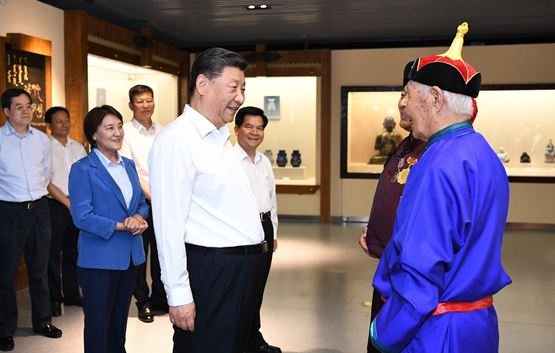
What makes this new piece of legislation significant is not its statutory language and enforcement mechanisms, but its ideological components. It has enshrined Xi’s ethnic policy, with its conception of a Han-centric Zhonghua culture serving as China’s trunk, and the 55 other ethnic minority groups as “branches and leaves” in dire need of pruning. We all know by now what “civic and moral development” means when it comes to Southern Mongolia, Tibet, East Turkestan, and elsewhere. In recent days, in these very pages of “Bitter Winter,” we have seen reports of a Kazakh scholar, Adil Semeykhanuly, sentenced to six and a half years in a Xinjiang prison, on the absurdly vague charges of having “negatively propagated the teachings of [the Kazakh poet Abai Kunanbaev]” and “formed a separate public opinion.” The Law on Promoting Ethnic Unity and Progress mobilizes every aspect of Chinese society, from individuals and families to businesses and mass organizations, from neighborhood committees and religious institutions to the military and the press and the military, to promote integration and prevent the spread of “information containing ethnic hatred, ethnic discrimination, or other content that undermines ethnic unity and progress.” How many more will find themselves in a similar plight as Adil Semeykhanuly, accused of “forming separate public opinions” and of “undermining ethnic unity and progress,” owing to this new enactment?
In the early days of the crackdown on the use of the Mongolian language in Southern Mongolia, a protest poem in the traditional Mongolian script was posted on the facade of an electric welding shop in Xilinhot, reading as follows:
We prefer a burning death over a lukewarm living,
Why must we stay alive, bending our backs?
Why must we live an undignified life?
If we must burn, let us set ablaze to finish ourselves instead of flickering weakly.
If we must disappear, let us boil to vanish instead of evaporating slowly.
Another poem, written around the same time by the pseudonymous Hariin Ejin, urged those forced to comply with the stifling linguistic and cultural regulations not to “blame yourself, because you kneeled in front of a tough choice,” but nevertheless proclaimed:
You need to tell your kids
Don’t make the same mistakes
even if you sacrifice your life
Don’t forget your language.
Understandable sentiments, given Beijing’s cynical attempts to stamp out the Mongolian language and traditional culture in the region, which triggered an outbreak of protests and boycotts that in turn resulted in a fierce crackdown and enhanced surveillance, and provided the justification for a renewed push on the part of the central government to “strengthen ethnic work.” Now it will take an equally concerted effort of the part of activists inside and outside China to counteract the force of the Law on Promoting Ethnic Unity and Progress, to safeguard the languages and cultures of Chinese ethnic minority groups, and ensure that their age-old traditions may remain part of “everyday use by living people,” contrary to the express wishes of the regime.
While “lukewarm living” may be far from ideal, these communities are obliged to play the long game, and one is reminded of the words of the Austrian poet Rainer Maria Rilke, who posed the rhetorical question: “Wer spricht von Siegen? Überstehen ist alles”—“Who speaks of victory? To endure is all.” These cultures, these languages, these traditions have endured for centuries, and they will surely endure for centuries to come, no matter how many “gentle reminders” and heavy-handed laws are brought to bear against them. All the same, it will not be easy, given the government’s ongoing efforts to build what it calls a “shared spiritual home,” but which the people of China’s ethnic minorities might very well view as a veritable prison, whose foundations are being laid with the silenced tongues and buried memories of their ancestors.

Matthew Omolesky is a human rights lawyer and researcher in the field of cultural heritage preservation. Formerly a researcher-in-residence at the Institut za Civilizacijo in Kulturo (Ljubljana), he is a fellow of the Royal Anthropological Institute and a frequent contributor to The American Spectator and Quadrant.