In Yiwu, Zhejiang, participants in a sports event are indoctrinated against the “xie jiao” while cycling up the hills.
by Qi Junzao
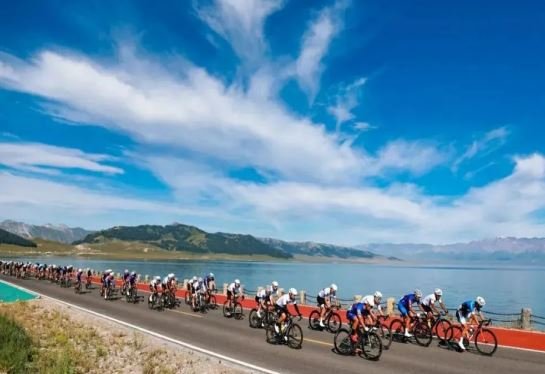
On December 14, the city of Yiwu in Zhejiang province hosted what might have been a perfectly ordinary sporting event: a cycling hill‑climb invitational. One thousand riders gathered at the scenic Shili Taohua Wu area to test their stamina on the winding Yan’kou Lake track. But in China, no public gathering is too innocent to escape the heavy hand of propaganda.
Suddenly, the event was transformed into a “sports + anti-xie‑jiao extravaganza.”
For readers unfamiliar with the term, “xie jiao” is often translated as “cults” or “evil cults,” but this is not accurate. It designates in China since the Middle Ages “organizations spreading heterodox teachings,” and the powers that be decide which teachings are “heterodox.” Today, it is a deliberately broad and elastic label wielded by the Chinese Communist Party to criminalize “illicit religion.” Groups so designated range from Falun Gong to perfectly orthodox Christian churches whose only “crime” is refusing to register under Party-controlled religious associations.
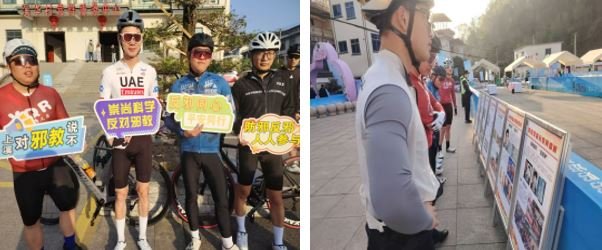
At Yiwu, the local Political and Legal Affairs Commission and the township “Peace and Rule of Law Office” seized the opportunity to set up propaganda booths, unfurl banners, distribute leaflets, and hand out “fun quiz” prizes—all while cyclists strained up the hills. Spectators were instructed on “the essence of xie jiao, their harms, and their deceptive tricks.” Officials even offered “personalized guidance” on how to stay calm when encountering believers and how to call the police promptly.
One spectator dutifully declared, “I never realized xie jiao were so harmful. From now on, I will report them immediately.” A female competitor from Jiaxing chimed in: “Combining cycling with anti‑xie‑jiao propaganda is very meaningful.”
In Xi Jinping’s China, even a bicycle race becomes a stage for ideological policing. The message is clear: exercise is good, but only if paired with denunciations of “illicit religion.”
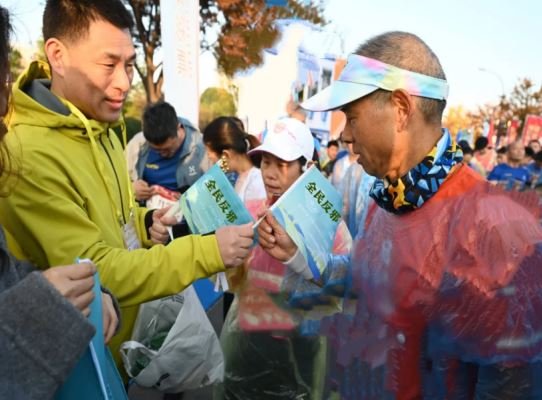
The official report concludes triumphantly that the event “created a strong anti-xie‑jiao atmosphere” and contributed to building a “Peaceful Yiwu” and a “No‑xie‑jiao Yiwu.” One imagines the cyclists pedaling furiously not only against gravity, but against the specter of unauthorized faith.
In the end, the propaganda stunt reveals more about the Party’s obsession than about any supposed danger. If the CCP feels compelled to lace even sports competitions with warnings against Falun Gong practitioners or unregistered Christians, it suggests that the real endurance test is not on the hills of Yiwu, but in the Party’s relentless race to control belief itself.

Uses a pseudonym for security reasons.