Longfu Temple in Hezhou, legally rebuilt in 2024, was destroyed despite local villagers’ protests and resistance.
by Liang Changpu
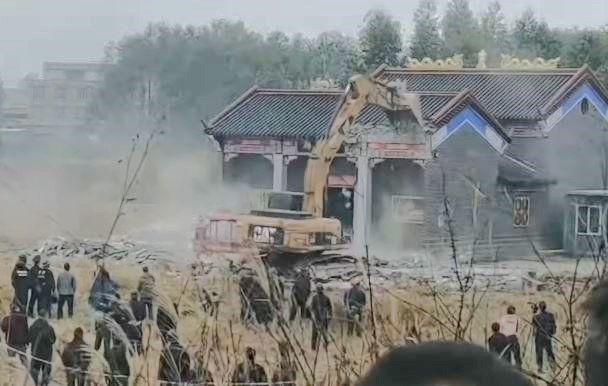
On December 23, in Xinglongzhai Village, Zhongshan County, Hezhou City, Guangxi, the Chinese Communist Party once again demonstrated its unique interpretation of “religious management”: if it exists, demolish it; if villagers resist, gas them; if anyone films it, arrest them.
This time, the target was Longfu Temple, a modest folk‑religion shrine rebuilt by villagers with their own savings after decades of neglect. The temple had stood in the area for generations, long enough that locals cannot even remember when it first appeared. But in today’s China, longevity may be a liability.
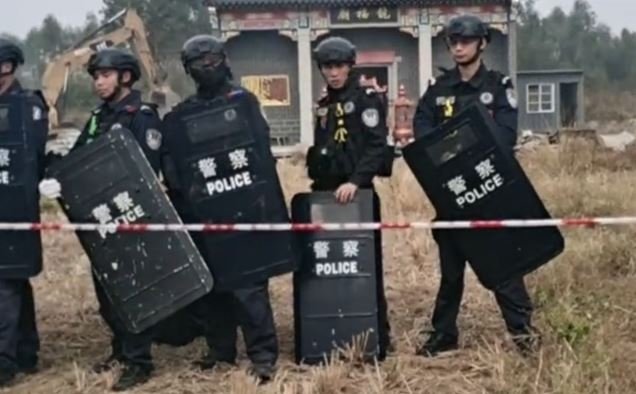
As villagers reported, the local government dispatched more than 100 personnel, including police, firefighters, and medical staff, to carry out a “forced demolition operation.” One might think such a large team was preparing to rescue earthquake victims or contain a chemical spill. Instead, they were mobilized to destroy a village temple rebuilt with donations of a few hundred yuan from elderly farmers.
Longfu Temple had collapsed from age long ago. In 2024, villagers pooled their savings to rebuild it, completing the project in April 2025. At the time, the government raised no objections: no warnings, no notices, no bureaucratic thunderclouds on the horizon.
Then, suddenly, officials declared the temple an “illegal construction” and claimed it was “too close to the ring road.” The same ring road that had apparently posed no danger during the entire reconstruction process.
Villagers were stunned. One elderly resident wrote online: “It was here when I was a child. Now I am old, and only last year did we finally rebuild it. We all donated what we could.” But in China, nostalgia is no defense against a demolition order.
When the demolition team arrived, villagers organized themselves with the kind of tactical clarity CCP members usually reserve for military parades. Men formed the first line of defense outside the temple. Women barricaded themselves inside, guarding the entrance.
It was a scene straight out of a folk epic—except the heroes were unarmed villagers, and the villains carried riot shields.
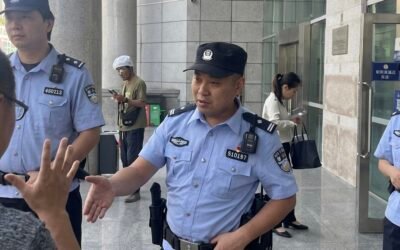
Clashes erupted almost immediately. Police, wielding batons and shields, pushed forward; villagers were knocked to the ground. At least four villagers were arrested. Videos show bodies falling under police blows, a grim reminder that “maintaining stability” in China often means destabilizing the lives of ordinary people.
Inside the temple, women held the doors against repeated attempts by police to ram them open. When brute force failed, officers resorted to a tactic customarily reserved for hostage situations: they fired an unidentified irritant gas into the temple.
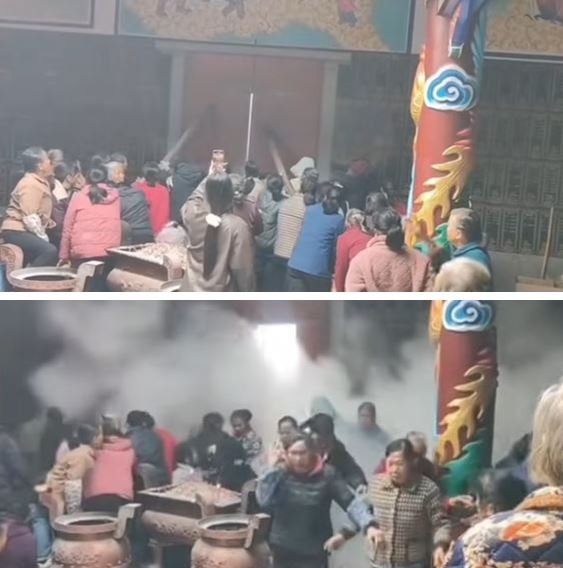
White smoke filled the hall. Women choked and stumbled back. The door fell. The temple fell. And with it, another piece of China’s folk heritage was erased.
Within hours, Longfu Temple was reduced to rubble. A villager watching the destruction shouted bitterly: “When we built it, everything was fine. Now they say it’s illegal. The temple we worked so hard to rebuild is gone in an instant.”
The official excuse—proximity to a ring road—would be amusing if it weren’t so tragic. China is full of buildings far closer to roads than Longfu Temple ever was. But those buildings belong to developers, not deities.
The real reason is ideological. China is experiencing a wave of mass resistance incidents, with more than 30 large-scale clashes recorded in December alone. The CCP is nervous. Its economic model is faltering, unemployment is rising, and public anger is boiling over.
In such a climate, even a small temple rebuilt by villagers becomes a threat. Not because it blocks a road, but because it represents something the Party cannot control: faith, community, and memory.
Folk religion is especially dangerous in the eyes of the CCP because it is decentralized, deeply rooted, and impossible to eradicate through propaganda alone. You can bulldoze a temple, but you cannot bulldoze the stories, rituals, and ancestors that live in people’s hearts.
So the Party does what it always does when confronted with something it cannot understand: it destroys it.
The demolition of Longfu Temple is not an isolated incident. It is part of a nationwide campaign targeting churches, mosques, ancestral halls, and folk temples. The logic is simple: if it gathers people, it must be controlled; if it cannot be controlled, it must be eliminated.
In Guangxi, Hainan, Guangdong, and beyond, temples are being razed with increasing frequency. The tools vary—legal pretexts, administrative orders, bulldozers, gas canisters—but the goal is the same: to ensure that no belief competes with the Party’s belief in itself.
Behind these demolitions lies a profound insecurity. The CCP knows that its ideological narrative no longer convinces anyone—not even those paid to repeat it. When a regime loses confidence in its own story, it begins to fear every dissenting narrative, no matter how small.
A village temple rebuilt by retirees becomes a threat. A folk deity becomes a rival.
A ritual becomes a rebellion.
And so, the Party sends a hundred men to crush a handful of villagers. It fires gas into a temple defended by women. It destroys what people love, then wonders why people resist.
Longfu Temple is gone. But the story of its destruction will spread far beyond Zhongshan County. It will join the growing archive of injustices that define the CCP’s relationship with religion: fear, violence, and the relentless erasure of cultural memory.
The Xinglongzhai villagers rebuilt their temple once. They may rebuild it again. And even if they cannot, the temple now lives in a different place—on the internet, in testimonies, in the outrage of those who watched it fall.
The CCP can demolish buildings. It cannot demolish the human need for meaning.

Uses a pseudonym for security reasons.