The first book-length study of the institution founded by IMboni iNkosi YamaKhosi oMoya Radebe will shape academic discussion for years to come.
by Karolina Maria Kotkowska*
*A paper presented at the 2025 CESNUR Conference, Cape Town, South Africa, November 19, 2025.
Cambridge University Press’ “The Revelation Spiritual Home: The Revival of African Indigenous Spirituality” by Massimo Introvigne and Rosita Šorytė (Cambridge 2025) is a landmark contribution to the study of contemporary African religiosity, the sociology of religions and spirituality, and the analysis of new spiritual institutions. The book fills an extraordinary gap in the existing scholarship. Until now, the rapidly expanding pan-African institution known as The Revelation Spiritual Home (TRSH) had not been the subject of any systematic academic investigation. Given the institution’s scale—over seventy branches across Southern Africa and an expanding international presence—the absence of previous academic work is striking. Introvigne and Šorytė’s book thus represents the first comprehensive attempt to situate The Revelation Spiritual Home within the broader context—a complex revival of African Indigenous Spirituality (AIS), contemporary African institutions, and the flourishing of a new spiritual pluralism in Africa. From its emic perspective, TRSH rejects the label “new religious movement” as colonial and prefers to be called an “institution,” a choice the authors respect throughout the book. It also insists that AIS as spirituality is different from religion, and that religion was imposed on Africans by foreign, colonial forces.
Preparing such a publication constitutes a considerable challenge. The broader context of African spirituality within which it is situated demands substantial additional study and scholarly engagement. At the same time, an institution of this scale—active for more than two decades—has failed to attract sufficient attention from scholars of contemporary African spirituality to merit even a single dedicated academic article. The authors therefore undertake a double task, further shaped by important methodological and editorial considerations related to both the research perspective and the character of the publication. On the one hand, drawing on a series of ethnographic field studies conducted in several African countries, they present the first scholarly analysis of The Revelation Spiritual Home. On the other hand, they situate their object of study within the broad category of African Indigenous Spirituality, rooted in indigenous belief systems.
This framework is central to the group’s self-understanding and identity. From a scholarly standpoint, the category of AIS requires careful attention, nuance, and conceptual refinement. At the same time, the authors successfully demonstrate the institution’s functioning through the lens of researchers experienced in the comparative study of new religious movements (NRMs), across culturally distant and highly diverse contexts. The result is a study that addresses, on the one hand, a previously unexamined institution, and on the other, a group grappling with a range of challenges that recur across different geographical settings and are intrinsically linked to its organizational character.

For these reasons, this relatively concise study is not only foundational in providing basic descriptive characteristics but also pioneering in explicitly framing the institution within the analytical category of AIS. This perspective is consistent with the aims of the publication series in which the book appears, namely, “Cambridge Elements in New Religious Movements.” Both authors’ decades of deep involvement in research on NRMs and different spiritual groups, combined with extensive fieldwork and interviews, enable them to craft a study that is empirically rich, analytically precise, and theoretically sophisticated. The book’s structure—progressing from a mapping of AIS, through the origins of The Revelation Spiritual Home, its cosmology and ritual practices, its socio-economic networks, and finally the societal resistance it encounters—offers a clear and coherent roadmap for understanding the institution.
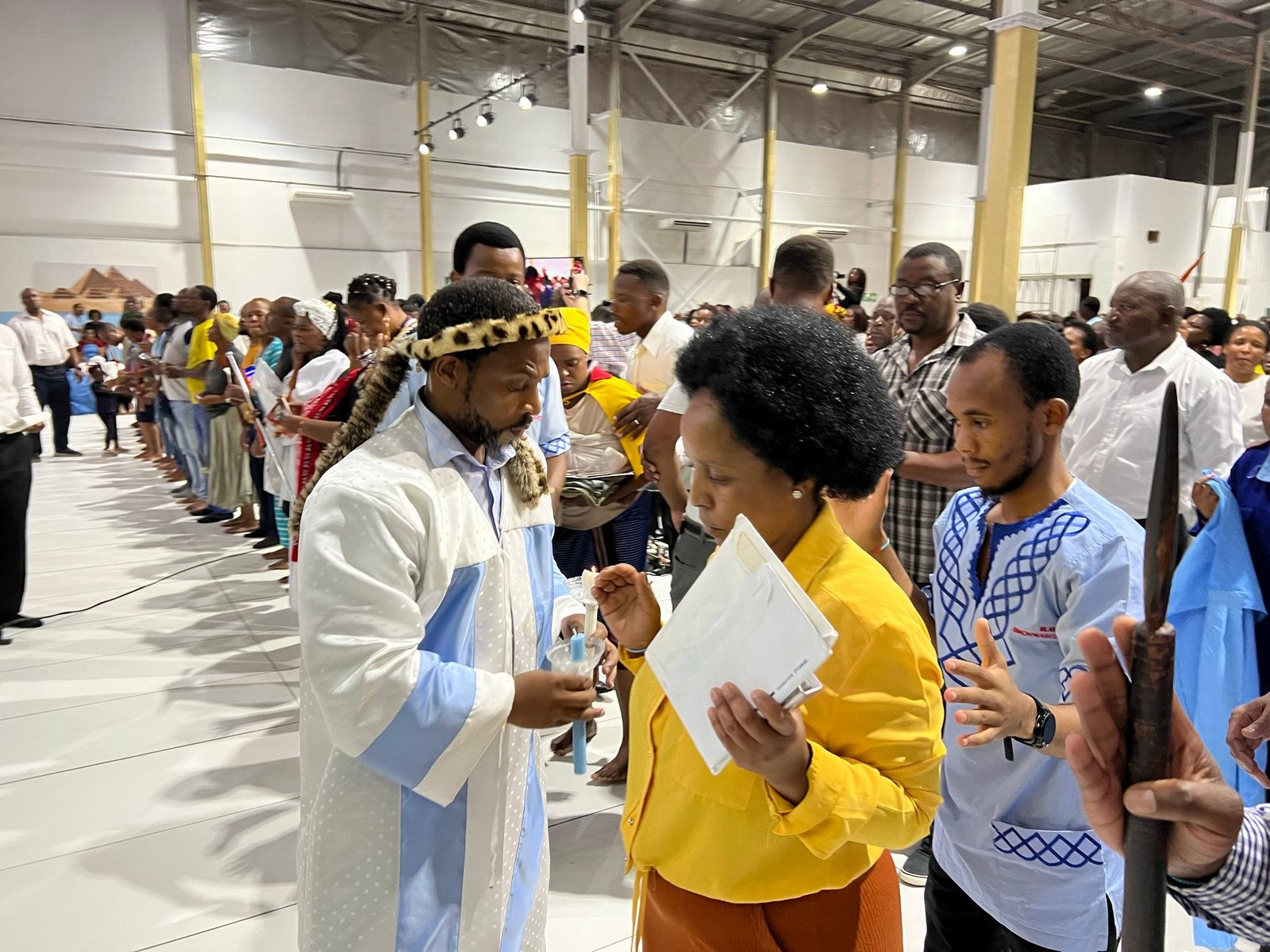
The volume opens with an ethnographically vivid description of The Revelation Spiritual Home service in Johannesburg, where the authors first encountered the institution. This scene is not merely descriptive; it serves as a methodological invitation. The researchers openly acknowledge that, at first glance, the aesthetic elements—music, dance, uniformed processions—could suggest a form of Pentecostalism or an African Initiated Church (AIC). But then, as authors continue, the subsequent appearance of the leader, IMboni uZwi-Lezwe Radebe (now called IMboni iNkosi YamaKhosi oMoya Radebe), richly adorned in leopard skins, and his proclamation of the primacy of ancient African spirituality, signaled a profound departure from Christian frameworks.
This opening positions The Revelation Spiritual Home not as a derivative Christian movement, but as an ambitious project of spiritual decolonization aimed at recovering Indigenous forms that predate both Christianity and Islam. Such positioning is crucial, as it challenges a long-standing academic bias that privileges African institutions of Christian origin over Indigenous ones. The introduction thus articulates the book’s central analytical move: treating the group as an Indigenous institution rather than interpreting it through inherited conceptual frameworks shaped by mission-defined African religiosity. At the same time, the authors problematize the very concept of African Indigenous Spirituality (AIS); while they approach The Revelation Spiritual Home as an exemplar of a broader spiritual trend, they avoid a reified or homogenized notion of AIS.
The first chapter provides a panoramic overview of AIS and those it recognized as its historical exponents (while scholars see in some of them merely the founders of AIC), including Isaiah Shembe, Simon Kimbangu, Beatriz Kimpa Vita, Mantsopa Anna Makhetha, Nongqawuse, Enoch Mgijima, Alice Lenshina, Alice Lakwena, Maphithini Thusi, and Credo Mutwa. This survey is indispensable: AIS is shown to be a vast, decentralized, internally diverse field that has often been studied only through anthropological fragments. One of the most substantial contributions of this chapter is its insistence on the elusiveness of AIS as an analytical category. The authors argue convincingly that it cannot be reduced to a single cosmology or ritual system. Instead, it comprises a constellation of traditions united by shared symbolic logics—ancestor veneration, spirit mediation, sacred geography, and a holistic cosmology linking human, natural, and spiritual realms. By constructing this conceptual backdrop, the authors prepare the ground for situating The Revelation Spiritual Home within a long historical continuum of Indigenous innovation and religious creativity. This alone represents a substantial scholarly contribution, as the prior literature cited in the book tended to treat Indigenous African groups as isolated or anomalous rather than as part of a broader revivalist pattern.
The second part is a short course in empirical sociology. Through interviews, participant observation, and detailed narrative reconstruction, the authors trace Samuel Radebe’s biography—from childhood visionary experiences to the founding and growth of The Revelation Spiritual Home (initially The Revelation Church of God). Particularly illuminating is the discussion of TRSH’s early years in Johannesburg’s inner city, where, in addition to local South Africans, migrants from Zimbabwe and other regions found in the institution not only spiritual healing but also dignity and belonging amid discrimination. The authors identify several sociologically salient features of the group, including its cross-national, cross-ethnic membership base, atypical in a region often marked by religious ethnocentrism; its rejection of the exclusivist Pentecostal demonology typical of the Universal Church of the Kingdom of God, which Radebe had joined (and then abandoned) as a young man, embracing instead an inclusive approach that welcomes people from diverse faiths; and its rapid expansion into a large-scale institution, signaling high levels of organizational competence. The invaluable chapter demonstrates how The Revelation Spiritual Home meets the criteria recognized by scholars as classical for an NRM—charismatic leadership, revelatory authority, institutional innovation, and a distinctive spiritual worldview—while also embodying features unique to the African indigenous and postcolonial context, which explains why it rejects the NRM label and insists it is not religious.

The third chapter examines the institution’s cosmology, ritual system, and epistemological foundations. The authors deliberately refrain from assessing the empirical validity of visionary experiences and revealed knowledge, instead adhering to the principle of interpretive neutrality that underpins contemporary sociology of religion. This methodological stance enables a nuanced, analytically disciplined account of the group’s internal logic, making the chapter one of the book’s most original and conceptually valuable contributions. The analysis demonstrates that The Revelation Spiritual Home explicitly advances a polytheistic model of AIS, thereby rejecting long-standing scholarly tendencies to interpret Indigenous cosmologies through implicitly monotheistic or Christian-derived analytical categories. Within this framework, spiritual hierarchy is articulated through an innovative numerological system that organizes both cosmological order and ritual authority. Ritual practices are deeply embedded in specific sacred geographies—including mountains, rivers, and oceanic sites—that function as focal points of collective memory and play a central role in shaping the group’s identity. While sangomas, understood as traditional healers, continue to occupy an important position within the institution, their role is reinterpreted and reframed within a broader pan-African cosmological vision rather than being confined to localized or ethnically bounded traditions. This chapter is especially significant because, before this book, only a few accounts of the doctrine or ritual of contemporary AIS groups existed. Introvigne and Šorytė thus establish the baseline for all future scholarly work on TRSH’s doctrinal system.
The fourth chapter examines The Revelation Spiritual Home as a socio-economic actor. The institution’s activities include the production of herbal remedies, a wide variety of business activities, youth programs, educational initiatives, and planned cultural and economic organizations such as the African Centre of Excellence. This aligns TRSH with global patterns in which spiritual groups function as hybrid institutions, offering alternative systems of welfare, healthcare, and identity formation. This insight can only be based on comparative research across various religions and spiritualities in different cultural contexts, and the authors accomplish this to a great extent. For scholars of contemporary African spirituality, this chapter offers a crucial insight: The Revelation Spiritual Home’s durability is tied not only to its spiritual message but also to its ability to provide comprehensive community support systems in contexts where state services may be insufficient or inaccessible.

The final substantive chapter analyzes the social resistance encountered by TRSH, including media hostility, imported anti-cult narratives, and governmental scrutiny following the 2017 Commission for the Promotion and Protection of the Rights of Cultural, Religious and Linguistic Communities (CRL) report. Drawing on broader scholarship about anti-cult movements, the authors demonstrate how the Western vocabulary of “cults” and “brainwashing” has been transplanted into African contexts, often with little cultural sensitivity and significant political consequences.
The case of TRSH’s confrontation with the CRL Commission is especially well-analyzed. The authors show that The Revelation Spiritual Home’s refusal to provide financial documents was framed as evidence of wrongdoing, illustrating how anti-cult discourses can produce self-fulfilling stigmas. This discussion greatly enhances our understanding of how independent spiritual institutions in Africa are regulated, perceived, and, at times, marginalized. The conclusion ties together the book’s core thesis: TRSH is a spiritual and cultural reclamation project that offers adherents a path back to an Indigenous identity suppressed by colonialism, missionary activity, and imported religious norms. The authors refrain from romanticizing the institution but emphasize its importance as an alternative framework of meaning for many contemporary Africans.
The combination of fieldwork, interviews, and sociological analysis makes this work exemplary. The authors apply theoretical models with subtlety, avoiding the common pitfalls of sensationalism or reductionism. The book also advances the field by reframing Indigenous African spiritual revivals as producing institutions in their own right, rather than as derivatives of Christian or syncretic traditions. This is a crucial shift. The authors’ critique of anti-cult narratives—often uncritically imported into African contexts—is both courageous and analytically rigorous. This positions the book at the cutting edge of research on spirituality and state power.

The “Elements in NRMs” series is a specific publication format. Volumes in this series are conceived as short, focused monographs that present the most up-to-date research, conducted with methodological rigor and grounded in fieldwork or archival scholarship. Cambridge Elements function as “mini-monographs,” making them ideal for students who require a solid yet not overwhelming introduction to the relevant classes. The series also provides reliable, research-based information that counters sensationalism and stereotypes about spiritual organizations and is intended to be helpful to professionals working with religion and spirituality in public contexts. And I am sure the book checks all the boxes very well.
“The Revelation Spiritual Home: The Revival of African Indigenous Spirituality” sets new standards for the scholarly study of African spiritual institutions, AIS, and the intersections between politics and spirituality. It is an indispensable resource for sociologists of religion and spirituality, anthropologists, historians of Africa, and scholars interested in decolonial approaches to contemporary spiritual movements. Through balanced analysis, rich ethnography, and theoretical clarity, Introvigne and Šorytė have produced a study that will likely shape academic discussions for years to come.

Karolina Maria Kotkowska is an Assistant Professor in the Centre for Comparative Studies of Civilizations, Jagiellonian University, Kraków, Poland. She holds PhD in Philosophy and works on her PhD in Sociology. She specializes in New Religious Movements and Western Esotericism in Central and Eastern Europe.