The Atajurt volunteers on trial committed no crime. Theirs was a legitimate political protest.
by Rune Steenberg
As an expert on Xinjiang and Central Asia, with particular expertise in minority issues, human rights, and refugees and migrants from Xinjiang in Central Asia, I have been asked to comment on the lawsuit filed in Kazakhstan against the head of Nagyz Atajurt Volunteers, Bekzat Maksutkhan, and 18 other codefendants.
I know the organization Nagyz Atajurt Volunteers, as well as the earlier and other related organizations, also known as Atajurt. I know of their work and discourse, which I have followed since 2018, and of the context that brought the organization into being and has been the focus of its work. This is, namely, the human rights situation, arbitrary detentions, land grab, and the detention centers and so-called re-education camps of Xinjiang Uyghur Autonomous Region in the People’s Republic of China, particularly since 2018. These are topics I have worked on and published on myself at Columbia University, the University of Copenhagen, and Palacky University Olomouc.
I will now proceed to describe the crimes the defendants are accused of, as well as the actions they are alleged to have committed, in order for the prosecution to conclude that these crimes have been committed. I then discuss the connection between the alleged actions and the alleged crimes by situating the actions in context and asking whether they can indeed be meaningfully considered constitutive of the crimes of which they are accused.
I conclude that the crimes they are accused of do not match the actions they are alleged to have committed, and the case should be dismissed.
The 19 defendants are accused of the following crimes:
- deliberately committing a grave criminal offense under Article 174, Part 2 of the Criminal Code of the Republic of Kazakhstan (incitement of national discord), by conspiring with a group of people and using mass media to incite national discord against the Chinese people,
- to insult the national dignity and honor of Chinese citizens,
- and thus to deliberately commit a serious criminal offense against peace and human security.
The wording is essential. The accusation is to have incited “national (or ethnic) discord against the Chinese people.” It is about the Chinese people as a people and about ethnic discord or ethnic hatred against them. Secondly, they are accused of insulting the “national dignity and honor of Chinese citizens.” Here, too, it is about the Chinese nation or ethnicity and the honor and dignity of the people, not about the government or officials, nor about criticizing the government’s policies or the state’s actions.
The lawsuit builds its accusations of criminal action on a report that it also quotes: the
“Psychological and philological examination dated November 27, 2025, No. 1801/E/25/16/6535.” According to the lawsuit, this examination of video evidence posted on Facebook found that “signs of incitement to interethnic discord or national enmity were observed.” It also saw “visual elements that insult the national dignity and honor of representatives of the Chinese ethnic group.” Lastly, it notes that “disrespect toward the state symbols was displayed.”
The lawsuit does not regard the disrespect towards state symbols as criminal, but focuses on the
“national (or ethnic) discord against the Chinese people” and the insult to the “national dignity and honor of Chinese citizens.”
To be accused of inciting hatred against or insulting the dignity of a people, one must utter explicit hateful or demeaning expressions aimed at this people as a people, not against any one politician from that country, nor against the country’s government or its policies. The criticism of a government, a policy, or a politician does not constitute an attack against the people, nation, or ethnicity that this government governs or that this individual is a member of.
Therefore, to lawfully confirm the accusations, the evidence must unambiguously show an expression of hatred or disgust against the Chinese people as a people in general, not against the government, its policies, or any one politician.
Furthermore, in the case of China, we are dealing with a multi-ethnic state. China has 56 ethnic groups, of which the Han, Kazakhs, and Uyghurs are three. Accusations of incitement of ethnic hatred must therefore be built on a clear expression of contempt or hatred against a particular ethnic group, not China as a country, which, as stated, is home to at least 56 ethnic populations.
According to the lawsuit, it was insulting and inciting discord against “the Chinese people” and “Chinese citizens.” The examination was citing and building on for its accusations, and which was being made to serve as a link between the actions described and shown in the videos and the criminal allegations made in the lawsuit, clearly designates the hurt party as “the Chinese ethnic group.”
This makes sense for the law being applied: Article 174, Part 2, of the Criminal Code of the Republic of Kazakhstan (incitement of national discord). This law may indeed only be invoked if a grounded suspicion of such incitement against a national or ethnic group as such can be sustained. Making this connection is the task of the “Psychological and philological examination dated November 27, 2025, No. 1801/E/25/16/6535.”
To conclude that the defendants have committed these crimes, the lawsuit describes them as having carried out the following actions:
- Having gathered on 13.11.2025 at the “Arasan” recreation site located in Uyghur District, Almaty Region, and at 12:30, in the territory of Qalzhat village, Qalzhat Rural District, Uyghur District, Almaty Region.
- Having planned these gatherings.
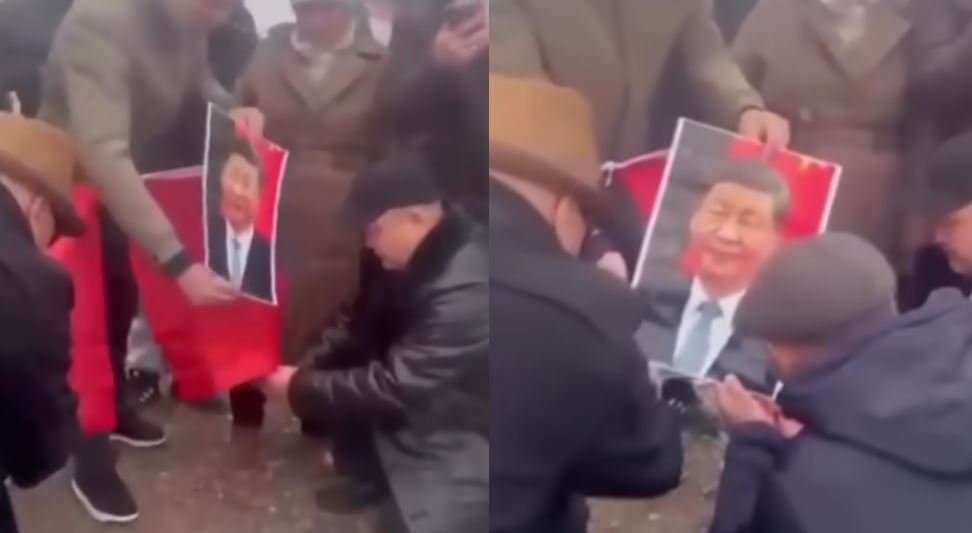
- Having burnt two Chinese flags and a picture of the Chinese president, Xi Jinping.
- Having stepped on the burning flags and pictures.
- Having uttered the following sentences:
- “Alimnur has been held captive by the Chinese for four months, and since then, these Chinese have not given us any concrete response. Therefore, I will not stop my opposition to the Chinese until Alimnur is released. Our opposition is opposition because Alimnur is a citizen of Kazakhstan.”
- “Assalamu alaikum, people of Kazakhstan. As you have just heard, our brother, Kazakh citizen Alimnur Turganbay, has been unjustly detained and held in prison by the Chinese for many days. It has been fully established that Alimnur Turganbay, his spouse, and his children are citizens of Kazakhstan. Nevertheless, China does not recognize our independence, does not acknowledge the documents issued by the Republic of Kazakhstan, and continues to detain Alimnur Turganbay without any criminal justification.”
- “Furthermore, the Chinese authorities have imprisoned many of our relatives in camps without cause; many have died, and many others continue to suffer in prison. Those who have been released from the camps have lost their health and are still enduring hardships. In addition, the Chinese are purchasing our lands and large facilities, posing economic threats to us, and also threatening us in terms of democracy. The growing presence of Chinese influence in our country risks turning us into a minority in our own state. Therefore, we oppose the visa-free regime with China, reject all unequal agreements with China, demand the regulation of relations with China, and express our opposition to China.”
- “We oppose! We oppose! We oppose!”
- “We will now express our opposition by burning the Chinese flag. Here it is…”
- “China must release Alimnur Turganbayuly! An innocent citizen!”
- “Release Alimnur Turganbay, a citizen of Kazakhstan, who was unjustly detained after leaving China. Stop the pressure and injustice being inflicted on the Kazakh and Uyghur peoples. Down with the Communist Party! Down with Xi Jinping!”
- “Down with China! They have flooded Kazakhstan with Chinese—down with China!”
- Having filmed these actions, uploaded them, and shared them on social media.

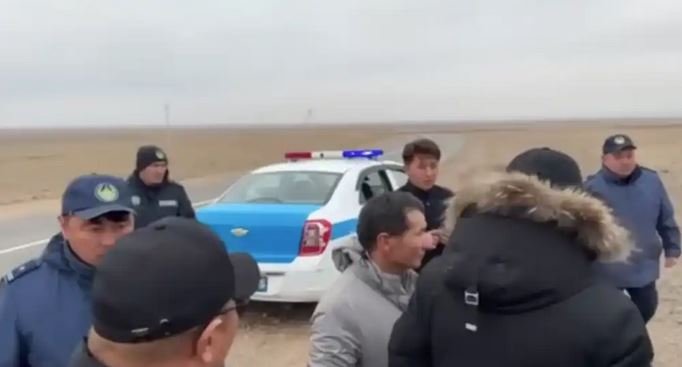
All defendants have been identified in the videos, apparently using facial recognition technology.
Almost all of the expressions at this gathering referenced in the lawsuit are about the imprisonment of Kazakh citizen Alimnur Turganbay earlier this year. This seems to be indeed what the gatherings were about. The dissent expressed is against the Chinese government for imprisoning this individual. This is very much in line with Atajurt’s previous actions, which have been focused on securing the release of other Kazakhs in Xinjiang who were, according to Atajurt and many international observers, arbitrarily detained by the Chinese state.
The defendants also mention the camp detainees during their gathering, further strengthening the impression that we are seeing a protest action aimed at the Chinese state’s imprisonment of Kazakhs, including Kazakhstani citizens, rather than an expression of hatred against any particular ethnic group. Indeed, in none of the statements above quoted in the lawsuit, the Chinese as an ethnic group are mentioned except as buyers of land in Kazakhstan and as migrants and business people entering the land. Particularly in the latter of these statements, the use of the phrase “flooded with Chinese” is not very elegant. Still, it merely constitutes an individual’s sentiment and experience. It can not legitimately be read as an attack on an ethnic group nor as an incitement to hatred or action against them.
None of the statement made in any way seem to constitute the incitement of discord against any national or ethnic group nor the insult to the national dignity and honor of the country’s citizens. Also, none of these statements can be said to be “committing a serious criminal offense against peace and human security.” To the contrary, they seem to be concerned with preventing arbitrary detentions and securing the release of, to their best knowledge, wrongfully imprisoned people. This must be said to be the opposite of inciting discord or insulting anyone’s dignity; it is calling for the respect of national and international laws.
The calls for a cancellation of what the defendants see as “unequal agreements” with China, including the visa-free travel agreement, are likewise in no way aimed at any ethnic or national group but at a specific policy of the involved states and governments. While one may disagree with their stance on these issues, their expression does not constitute a violation of Article 174, Part 2, of the Criminal Code of the Republic of Kazakhstan.
The burning of and stomping on the Chinese flags and the picture of Chinese president Xi Jinping, too, may be considered tasteless expressions of discontent and lack of respect against an individual and against the state of China, but again, they are not aimed at the Chinese people as such, nor any other national or ethnic community.
Xi is a Chinese politician and an individual considered responsible for the mass detention of Kazakhs and Uyghurs in Xinjiang. The defendants’ understandable discontent with him and his policies should not be mistaken for hostility towards the Chinese people as a people. The same goes for the Chinese flag, which to these people represents the Chinese state and the Chinese Communist Party, which they have all experienced as a violent force in Xinjiang, detaining their relatives, friends, and in several cases also them personally at earlier times.
Neither of these actions can therefore be said to be a violation of peace and human security. To my best understanding and knowledge, they do not incite national discord against the Chinese people or insult the national dignity and honor of Chinese citizens.
The connection between the defendants’ actions, as described, and the crimes they are accused of does not appear legally defensible. Contrary to the findings of the “Psychological and philological examination dated November 27, 2025, No. 1801/E/25/16/6535” cited in the lawsuit, I do not see the actions of the defendants violating Article 174, Part 2 of the Criminal Code of the Republic of Kazakhstan.
The examination seems to be confusing a Chinese politician with a known history of violent policies against the Kazakh people in Xinjiang, and particularly the relatives of the defendant, for “the Chinese people” or “the Chinese ethnic group” generally. They seem to make a similar conflation of representation with the Chinese flag, interpreting it as standing for the Chinese ethnic group when it in fact represents the Chinese state, consisting of 56 different ethnic groups, and particularly for the defendants, it stands for the Communist Party and its colonial policies in Xinjiang.
Lastly, the examination and the lawsuit have decontextualized the event from its background. The fact that the protest was aimed at the arbitrary detention of a community member and that many of the defendants have lost relatives and friends to the detention schemes of the Chinese state in Xinjiang or are themselves suffering from the consequences of such detentions does not seem to be considered in the interpretations of the events. As this background is generally known, this lack of consideration looks suspiciously disingenuous.
This leads me to my last point. The only reference to Atajurt’s past activities is by “the People’s Republic of China” in a letter addressed to “the Ministry of Foreign Affairs of the Republic of Kazakhstan” on 14 November 2025, one day after the events described. In this letter the Chinese state representatives (unnamed in the lawsuit) claim that individuals from the organization Atajurt have previously “carried out numerous incitement actions against China” and that these actions are “considered premeditated open acts aimed at tarnishing the dignity of the Chinese people, as well as the image of the Communist Party of China and its leader, and have negatively affected the friendship between the two states.”
The text from the letter is reproduced in the lawsuit without quotation marks. Also, no other sources regarding Atajurt’s previous actions are quoted or mentioned. This leaves the impression that the prosecutor filing the lawsuit is doing so on behalf of the Chinese Government and is not checking their assertions. This raises concerns about the Kazakh legal system’s sovereignty in this case. It raises suspicion about the possibility of this being a case of the Chinese state using the Kazakh legal system for its political purposes, for silencing critics, and for persecuting Kazakhs from Xinjiang outside China.
I do not see legal grounds for keeping the defendants in detention, nor for finding them guilty under Article 174, Part 2, of the Criminal Code of the Republic of Kazakhstan (incitement of national discord). I recommend that all charges be dropped and an inquiry into possible attempted misuse of the Kazakh legal system be started instead.

Rune Steenberg is an anthropologist researching the Xinjiang Uyghur Autonomous Region and the Uyghurs. He has conducted extensive fieldwork in Xinjiang, Central Asia, China, and Indonesia and has published widely on topics ranging from kinship to cross-border trade, narratives, and mass incarceration. Steenberg received his Ph.D. from Freie Universität Berlin in 2014 and has subsequently been a Post-Doctoral Fellow at the Dahlem Research School of Freie Universität Berlin and at Columbia University in New York and a Crossroads Asia Fellow at Bonn University. He is currently a researcher at Palacky University Olomouc, Czech Republic.