A legal analysis proves that the Taiwanese government violated domestic and international law in the Tai Ji Men case.
by Charlotte Lee*
*A paper presented at the session “Freedom of Religion Issues in Taiwan and the Tai Ji Men Case” of the CESNUR 2025 international conference, Cape Town, South Africa, November 19, 2025.

I am a Taiwanese lawyer and also a disciple of Tai Ji Men. Today, I would like to use the Tai Ji Men case as a lens to explore how the failure of a nation’s redress mechanisms can give rise to state violence. Through the analysis of international cases, I aim to examine the State’s obligation to provide “effective remedies” and to consider possible avenues for resolving this case within Taiwan’s legal system. More importantly, I wish to reflect on how Tai Ji Men’s Grand Master and disciples, despite enduring decades of persecution under Taiwan’s legal and tax systems, have steadfastly upheld and practiced their faith—transforming suffering into compassionate action, engaging in social concern and institutional reform, and ultimately evolving from victims into practitioners who bring concrete, positive change to Taiwan and the world.
Tai Ji Men is an ancient qigong and martial arts menpai (similar to a school) that inherits the heart teachings of Taoism, transmitted from master to disciple. The contemporary Zhang-men-ren (grandmaster), Dr. Hong Tao Tze, guides disciples to cultivate moral character, nurture the mind, and refine the body through qigong and inner practice. While strengthening individuals physically and spiritually, Tai Ji Men also preserves and shares the pure, kind, and beautiful values of Chinese culture through qigong, martial arts, spiritual cultivation, and cultural performances. Furthermore, it actively promotes conscience and peace, striving to enhance the harmony of body, mind, and spirit, and to elevate the quality of human life.
Judicial and Tax Persecution
In 1996, following Taiwan’s first direct presidential election, the authorities launched a large-scale suppression of religious groups. Tai Ji Men became an innocent victim of this political campaign, as the State employed both criminal prosecution and tax measures as instruments of persecution. Prosecutors fabricated witnesses and forged evidence, falsely accusing Tai Ji Men of being an “evil cult” while simultaneously labeling it as a “cram school” allegedly involved in fraud and tax evasion. On this basis, the prosecutor initiated criminal proceedings and referred the matter to the tax authorities for prosecution and imposition of heavy taxation and penalties. The tax authorities, failing to fulfill their duty to conduct independent investigations, relied solely on the prosecutor’s indictment. They distorted the traditional “red envelopes” from disciples to Shifu, which were used as tuition fees for a cram school, and issued tax bills for six years (1991–1996). These baseless and exorbitant tax assessments resulted in a nearly thirty-year-long persecution of cultural and religious freedom.
Over nearly three decades, the Tai Ji Men Shifu and disciples have tirelessly sought justice for this fabricated tax injustice, pursuing every available judicial and administrative remedy. In 2007, the Supreme Court of Taiwan rendered a final judgment clearing Tai Ji Men of all criminal charges, recognizing that the “red envelopes” were gifts. The wrongfully detained Shifu and disciples were granted state compensation for the miscarriage of justice. The Control Yuan, the highest constitutional supervisory and impeachment authority in Taiwan, issued investigative reports in 2002 and 2009 that confirmed serious misconduct by prosecutors and tax officials. In 2018, the Supreme Administrative Court recognized Tai Ji Men as a qigong and martial arts menpai and ruled that the final judgment in the 1992 income tax case was a wrongful decision. However, despite the tax authorities’ acknowledgment of error and subsequent correction of five years of taxes to zero, they refused to revoke the wrongful 1992 tax bill. In 2020, the National Taxation Bureau forcibly auctioned off the land designated for Tai Ji Men’s spiritual practice center; when the auction failed, the property was seized and nationalized.

The nature of Tai Ji Men’s lineage has been affirmed by various state institutions, including the tax authorities themselves, who have admitted that Tai Ji Men is not a cram school. Yet, the Ministry of Finance and the National Taxation Bureau continue to refuse corrective action, citing the finality of the 1992 tax ruling. Regarding the systemic flaws revealed in this case—such as excessively high thresholds for retrial in administrative litigation, where even new evidence is constrained by a five-year limitation period, and the reopening of administrative procedures being obstructed by tax authorities who arbitrarily impose restrictions not provided by law, resulting in practical difficulties—the legislative and executive branches have also failed to amend these institutional shortcomings.
The Taiwanese government has thus not only failed to fulfill its obligation under the International Covenant on Civil and Political Rights (ICCPR) to provide effective remedies. It has also deprived citizens of their right to redress. This constitutes a form of state violence.
International Human Rights Trends
Should the people bear the burden of the government’s institutional failures? The answer is no. International human rights practice has long affirmed that every State bears the obligation to provide its people with prompt and effective remedies.
In “Grasser v. Germany” (2006), the European Court of Human Rights (ECHR) ruled that the German government had violated the European Convention on Human Rights in a case concerning a German citizen’s claim for damages against the City of Saarbrücken regarding a construction permit dispute. The Court ordered Germany to compensate the applicant for non-pecuniary damages and legal costs. The reason was that the domestic legal proceedings lasted from 1974 to 2004, a period of nearly thirty years. The ECHR held that even if the case was complex, such an excessive duration could not be justified, thus constituting a violation of Article 6 of the Convention.
Similarly, in “Kaemena and Thöneböhn v. Germany” (2009), the ECHR found merit in the applicants’ complaint that their criminal proceedings exceeded a reasonable duration. The Court held that the State has an obligation to organize its judicial system properly and to ensure that cases are handled and concluded within a reasonable period. Domestic courts must also ensure the availability of effective remedies. Therefore, every case must be examined to determine whether domestic law provides the litigants with remedies that are genuinely “effective.” Since in this case no such remedy existed despite the excessive delay, the State was found to have violated Article 13 of the Convention.
The United Nations Human Rights Committee (HRC) has also reaffirmed, in many of its decisions, that States are obligated to provide effective judicial remedies. In the case “Jit Man Basnet and Top Bahadur Basnet v. Nepal” (2014), the complainants claimed they were unlawfully detained, tortured, and forcibly disappeared by the military, while the government failed to investigate. The Committee held that in cases involving serious human rights violations, the State must ensure access to judicial redress and establish appropriate judicial and administrative mechanisms to address such violations. According to General Comment No. 31, a State’s failure to investigate allegations of rights violations constitutes a separate breach of the Covenant. In that case, the State’s ten-year inability to conduct a thorough and effective investigation was deemed a violation of the victims’ right to an effective remedy under the ICCPR.

Obligations of the Taiwanese Government
It is evident that in the Tai Ji Men case, the state authorities have been negligent in handling the matter, thereby violating their obligations under the ICCPR and acting contrary to the global trend of protecting human rights. Pursuant to Article 2(3) of the Covenant and General Comment No. 31, ensuring effective remedies for the protection of rights is a duty shared by all branches of government. The State must adopt legislative, judicial, administrative, educational, and other measures necessary to fulfill its obligations to safeguard the rights enshrined in the Covenant.
Since Taiwan has incorporated the Human Rights Covenants into domestic law, it bears the responsibility to provide redress for the Tai Ji Men injustice. This means that administrative authorities, under Article 117 of the Administrative Procedure Act, have the power and duty to revoke unlawful tax decisions, even if they have been previously finalized. Courts, too, have the duty to apply the two Covenants in individual judgments directly, and the legislature has an obligation to amend laws for retrials, ensuring access to a remedy. This case also highlights the need for government agencies to strengthen and enhance their awareness of human rights protections.
The Path of Cultivation Continues— Practitioners of Faith in Positive Action
Tai Ji Men is a qigong, martial arts, and self-cultivation menpai that has remained unchanged in its nature. For decades, the Shifu and disciples have endured persecution through fabricated criminal and tax cases—a persecution that continues to this day. Tai Ji Men is not trapped in grief and anger. Tai Ji Men has never ceased affirming and spreading its values worldwide.
Under the guidance of their Shifu, they have steadfastly embodied the values of the Tai Ji Men faith: compassion, courage, true wisdom, and conscience. Compassion, in particular, is the essential beginning of all practice (self-cultivation). Throughout Eastern history, countless spiritual cultivators have practiced not for personal enlightenment but to bring compassion into the human world—to ferry others across the sea of suffering. The Tang Dynasty monk Xuanzang braved immense hardship to journey alone to India in search of sacred scriptures, aiming to “spread the Dharma and benefit sentient beings.” His quest opened the door to wisdom for all. Likewise, the compassion embodied by Avalokiteśvara (Guanyin) and Mazu inspired countless followers to turn compassion into action—offering medical aid, disaster relief, and the building of bridges and roads—all shining examples of compassion in action.
In the same spirit, the Shifu of Tai Ji Men has led disciples to cultivate themselves not merely for personal peace and well-being, but with boundless compassion for humanity—promoting physical, mental, and spiritual health, restoring vitality and balance, and purifying the mind through self-cultivation. Through spreading love, peace, and conscience, Tai Ji Men has visited over 120 countries, sowing seeds of love and peace across all five continents, with the hope of awakening goodness in hearts, illuminating conscience, and bringing harmony to society and the world. Thus, spiritual practice is no longer confined to meditation or introspection; it has become a global journey of enlightenment.
Compassion in practice often shines brightest in adversity. In the face of the false criminal and tax cases, Dr. Hong Tao Tze has guided disciples to transform suffering into the power of love and into concrete positive action. Tai Ji Men disciples understand deeply that this trial is not only about their own innocence, but also about exposing systemic injustice. With compassion, they have recognized the suffering of others trapped in Taiwan’s flawed legal and tax systems and have courageously stood up for countless victims of tax injustice.
Over nearly thirty years of seeking redress, the Tai Ji Men case has revealed significant deficiencies across Taiwan’s administrative, judicial, and legislative systems. Taiwanese experts and scholars jointly authored a shadow report on the two International Human Rights Covenants, using the Tai Ji Men case as an example to examine the deficiencies or violations by state authorities in areas such as freedom of religion and belief, freedom of expression, the right to a fair trial, freedom of movement, the effectiveness of state remedies, cultural rights, and the right to equality.
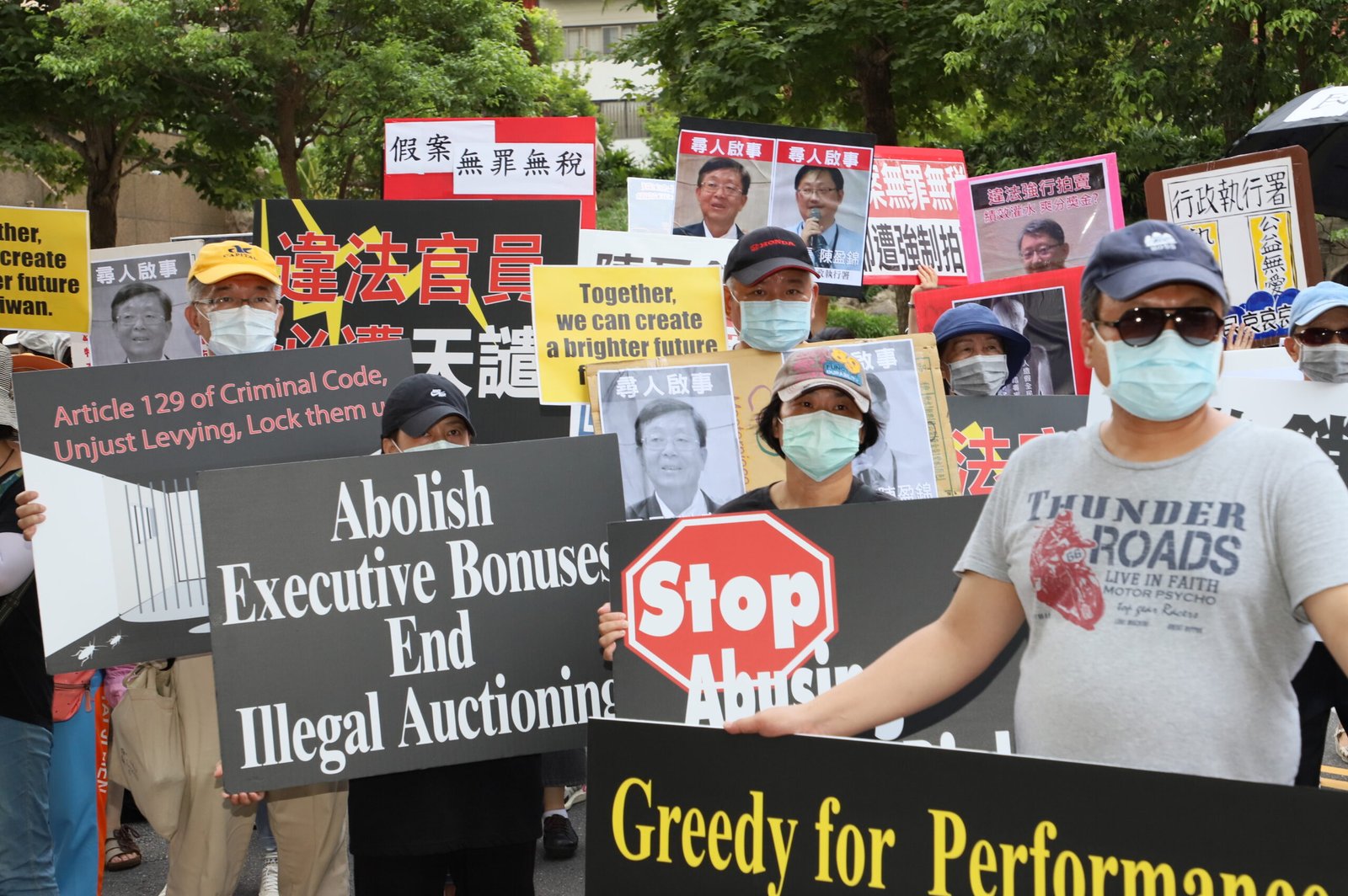
Over the years, Tai Ji Men, along with many like-minded individuals, has peacefully and rationally advocated for legal and tax reform through street campaigns, petitions, protests, and public forums. They have raised people’s awareness of systemic imbalance. By working hand in hand with domestic and international experts and scholars, they have also promoted legislative reform and achieved numerous milestones in human rights protection, such as
- the introduction of the concept of “taxpayer human rights” in Taiwan;
- led to the publication of the White Paper on Taxpayer Human Rights in the Centenary of the Republic of China in 2011;
- through the shadow report, international experts, in their Concluding Observations and Recommendations, called out Taiwan’s travel restriction for tax issues as violations of Article 12 of the ICCPR, which guarantees freedom of movement, and urged the government to review and amend its laws;
- a decrease in the taxpayer loss rate in administrative tax litigation;
- the passage of the Taxpayer Rights Protection Act in 2016;
- the Control Yuan’s 2022 investigation report on the “everlasting tax bills”;
- and in 2025, the Judicial Yuan’s draft of the Tax Administrative Litigation Act, which sparked widespread public and academic discussion.
The collective voice of the people has become the driving force for reform. The perseverance of Tai Ji Men’s Shifu and disciples reflects a higher level of spiritual cultivation, transforming compassion into tangible deeds and allowing faith to shine through their actions.
Our Shifu always reminds us: “To cultivate is to change, and to practice is to act.” Through continuous daily effort—acting, reflecting, improving, and repeating — we elevate body, mind, and spirit. I believe that this path toward justice for the Tai Ji Men case is the same. The pain we have endured, coupled with the compassion that refuses to see others suffer as we did, gives us the strength to keep moving forward—educating the government, awakening the people, and, one day, inspiring the conscience and compassion within state institutions themselves. Only then can the system be reformed and injustice resolved.
This journey of faith and practice is not yet complete — but we will continue to walk it with unwavering compassion.

Charlotte Lee is an attornay in private practice in Taiwan and a Tai Ji Men dizi (disciple).