The remarkable achievements of Tai Ji Men led to both success and government suspicion, resulting in repression.
by Rachel Chiang*
*A paper presented at the session “Freedom of Religion Issues in Taiwan and the Tai Ji Men Case” of the CESNUR 2025 international conference, Cape Town, South Africa, November 19, 2025.

The mysteries of the universe, the meaning of life, and the afterlife—questions that have haunted humanity for millennia—ensure that wherever humans exist, so do religions and spiritual groups. Each group has its own mission, goals, and unique ways (or rituals) of purification or elevation. In Chinese Taoism, for example, Qigong has been practiced as a method of cultivation for thousands of years.
Dating back to around 475 BCE–220 CE, the ancient medical classic Huangdi Neijing Suwen records: “The Yellow Emperor said, I have heard that in ancient times there were true men who connected with heaven and earth, grasped yin and yang, inhaled and exhaled essence and qi, stood alone guarding their spirit, and their muscles were as one; therefore, they could live as long as heaven and earth without end.” This illustrates the essence of Taoist cultivation to become an immortal through qi practice.
The Tai Ji Men is an ancient menpai (similar to a school) that inherited the Taoist heart lineage. The present Shifu (Grand Master), Dr. Hong Tao-Tze, teaches life philosophy and guides dizi (disciples) to cultivate both body and mind—strengthening the body, refining the spirit, and purifying the heart—to achieve the ultimate unity of mind and energy, return to one’s true nature, realize one’s inner self, and attain harmony between heaven and humanity—the ideal of enlightenment and immortality.
After passing the bar exam, I fell ill with thyroid cancer due to stress from exam preparation and the grief of my father’s sudden passing. Following surgery, I was told I would need lifelong hormone therapy, and my health deteriorated physically and mentally. Upon a friend’s recommendation, I joined the Tai Ji Men to practice qigong. Through this training, I gradually regained health, and my thyroid function normalized without medication—what my doctor called a miracle. I also learned to calm my mind through breath regulation, reducing stress and anxiety, allowing me to stay mentally balanced amid the pressures of legal work. Most importantly, through Shifu’s high-energy transmission and esoteric methods, I elevated my inner energy, maintained a positive mindset, and became more self-aware, removing negative mental impurities and purifying my spirit.
Rejuvenated in both body and mind, I also volunteered as a legal consultant at a domestic violence prevention center. Hence, Tai Ji Men Qigong is not merely breathwork—it is a spiritual discipline, a form of engaged cultivation for self-betterment and service to others.
Due to its remarkable results and strong sense of community, Tai Ji Men experienced rapid growth. However, this drew government suspicion. In 1996, following Taiwan’s first presidential election, the government launched a “religious crackdown” on large groups that had not publicly supported the winning party. Prosecutors labeled Tai Ji Men a “cult,” accusing it of “spiritual fraud” and “Qigong fraud,” indicting the Shifu, his wife, and several dizi. They also alleged that Tai Ji Men was a “cram school” evading taxes, and transferred the case to the National Tax Bureau, which imposed heavy fines.
The dizi’ offerings of teachers’ respect gifts were acts of gratitude and spiritual devotion—similar to donations or alms in other faiths. Without investigation, the Tax Bureau—following the Investigation Bureau’s stance—classified these as tuition fees for a qigong class, levying enormous taxes and penalties. Yet in Taiwan, no other religious or qigong masters had ever been taxed for such offerings. Singling out Tai Ji Men violated Article 7 (equality before the law) and Article 13 (freedom of religion) of the ROC Constitution, Article 18 of the ICCPR (freedom of belief and religion), and Article 2(2) of the ICESCR (non-discrimination).

Although the Supreme Court in 2007 ruled that Tai Ji Men had committed no crime and owed no taxes, the four-month investigation period caused irreparable harm. Prosecutors staged media coverage of raids and detentions, spreading false, sensational claims—including accusations of “raising ghosts.” The public, trusting prosecutorial authority, turned against the group. Many dizi, unable to withstand ridicule, workplace pressure, or family opposition, left the group—including my own relatives. Even today, some still associate Tai Ji Men with “cult” imagery. In the digital age, old news continues to deter potential applicants.
Financially, the fabricated “income” resulted in astronomical tax bills that far exceeded Tai Ji Men’s total assets. The Shifu was even banned from leaving Taiwan for 2,233 days. Although most tax assessments were eventually corrected, a 1992 tax bill remained, causing the confiscation of over 50 plots of land originally planned for a central training site. The organization’s assets were frozen for over 23 years, halting expansion projects and leaving many properties in ruins—severely violating property rights.
The Tai Ji Men case exemplifies the devastating consequences when the state uses judicial or tax mechanisms to intervene in religious or spiritual affairs. While many constitutions proclaim the separation of religion and state and guarantee religious freedom, in practice, the boundary between “religious” and “secular” matters is often blurred—allowing governments to favor some groups with subsidies while suppressing others through investigations and taxation.
Even though Tai Ji Men, rooted in Taoist tradition and registered with Taiwan’s Taoist Association for over 40 years, was easily smeared and remains partially unvindicated after 30 years, one can only imagine the struggles faced by other emerging spiritual groups worldwide. When the state can so easily weaponize judicial and fiscal tools to destroy a community’s existence, it not only inflicts psychological trauma and financial devastation but also endangers personal freedom and life itself.
Having endured such persecution, Dr. Hong, the Tai Ji Men Shifu, issued the ”Declaration of the International Day Against Judicial and Tax Persecution by State Power,” urging: “Heads of state and regular global citizens alike should cooperate to supervise governmental activities, ensuring that human rights are protected through respect, tolerance, and peaceful dialogue and that effective rule of law systems benefiting the public and the environment are established to create a harmonious and stable world.”
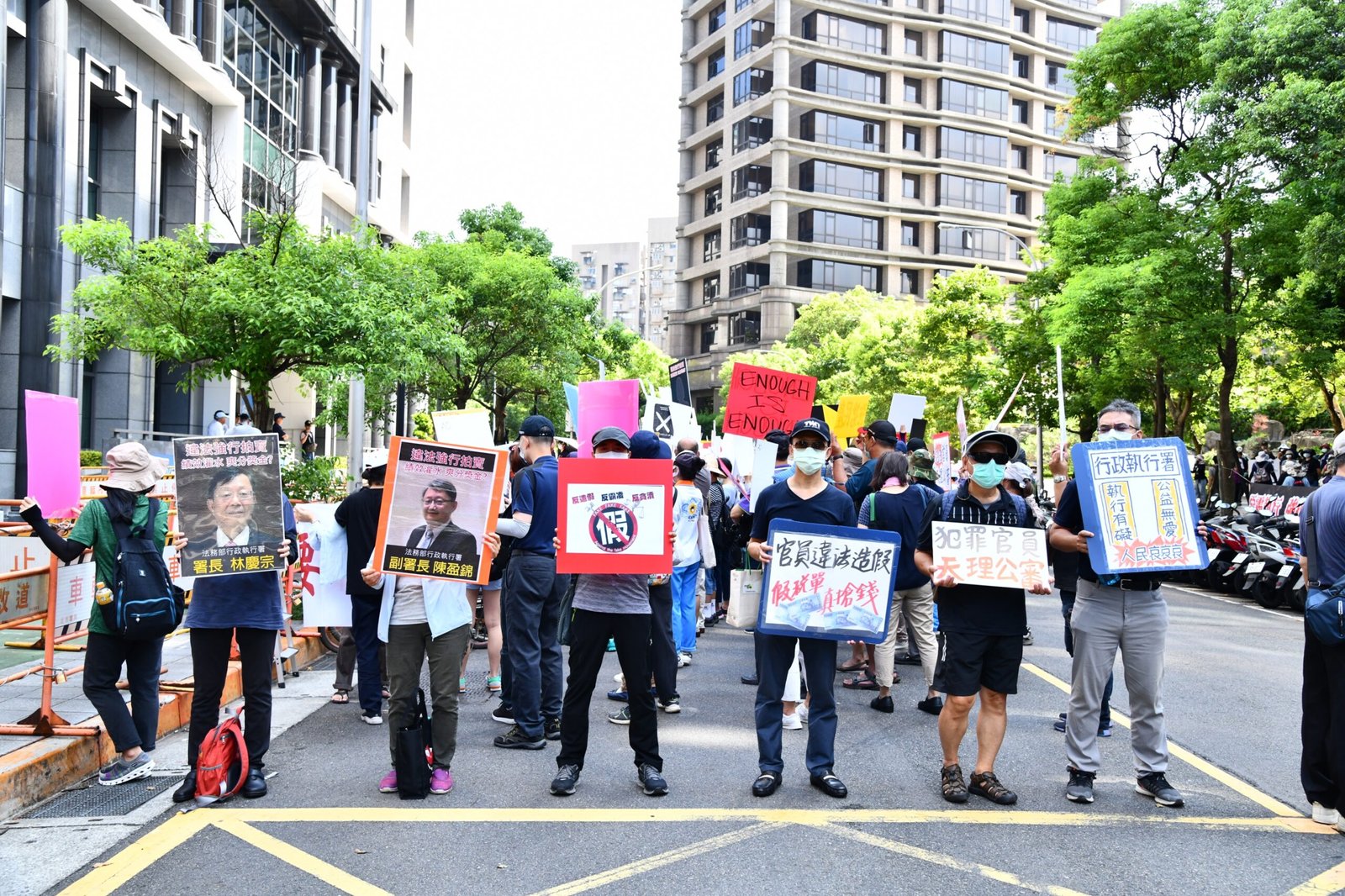
Over the years, Tai Ji Men Shifu and dizi, together with scholars, have tirelessly advocated for judicial and tax reform. Our collective efforts have led to tangible achievements: transferring search and detention authority from prosecutors to judges, codifying the presumption of innocence, strengthening cross-examination procedures, adding taxpayer rights protections to the Tax Collection Act, establishing the Taxpayer Protection Act, specialized tax courts, and prompting the Ministry of Finance and Judicial Yuan to issue reforms and legal improvements in tax-related human rights.
“To speak out is to gain strength!” We know that suffering in the world is vast and reform is slow, but thanks to the human rights advocates gathered here today, we are not alone on this journey. We will continue steadfastly, believing that our collective effort can bring hope to the world—so that all people may live freely, with dignity, and with faith in the divinity within their hearts.

Rachel Chiang works as the Chief Attorney at Libertas Law Office in Taipei. She is a Consultant Attorney at the Taipei City Center for Prevention of Domestic Violence and Sexual Assault, and a Director of the First Social Welfare Foundation.