The court decision is the culmination of almost forty years of harassment of the religious movement by politically motivated and greedy lawyers.
by Patricia Duval.
Article 2 of 5. Read article 1.
The decision by the Tokyo District Court on March 25, 2025 to order the dissolution of the Unification Church may be, if upheld in appeal, the consecration of a long term undertaking by the National Network of Lawyers Against Spiritual Sales (NNLASS), a group of anti-cult lawyers who accuse the Church faith to be a lure and religious donations a mere profit-making activity.
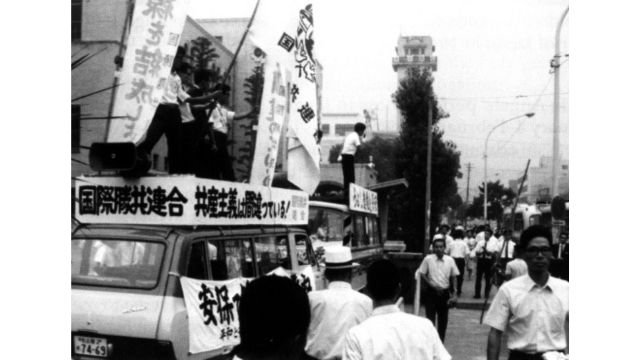
The Network was created in 1987 by far-left obedience lawyers with the stated purpose of eliminating the Unification Church from Japan, since the early times when it was fighting against communism. Reverend Moon believed that the realization of world peace required preventing the expansion of atheistic communism. To this end, he established organizations such as the International Federation for Victory over Communism (VOC) in the post–World War II era when spirituality was at risk with the expansion of communism in the area, and the National Federation for the Unification of North and South Korea, making efforts toward the unification of the Korean Peninsula.
The National Network of Lawyers Against Spiritual Sales started to actively combat the Church and, to this end, has been closely linked to the “deprogramming,” coerced de-conversion from alleged brainwashing, of the Church members since its inception.
For over forty years, around 4,300 members of the Unification Church in Japan have been subjected to forced de-conversion through abduction and confinement by families, and imposed indoctrination by professional “deprogrammers” against the Church beliefs, without the authorities lifting a finger.
The lawyers’ network has been supporting these faith-breaking practices for decades and pushing the members who finally renounced their faith to file civil suits against the Church. This was a way to prove their apostasy and their ticket out of deprogramming. It is this systematic filing of tort cases and demolition enterprise that the District Court validated on March 25, with a decision appealed to the High Court.
Pursuant to Article 81.1 of the Religious Corporations Act, the government can request a dissolution order against a religious corporation if “in violation of laws and regulations, it commits an act which is clearly found to harm public welfare substantially.”
The Tokyo District Court had to rule on whether, in the absence of criminal acts, civil decisions in private litigation could be considered a “violation of laws and regulations” in order to pronounce the dissolution of a religious corporation.
Actually this question was given a positive answer by the Supreme Court on March 3, 2025 in a case ancillary to the dissolution one (relating to the pre-dissolution procedure). The District Court adopted the same findings as this precedent, which was a reversal of, and a tailor-made, case law to obtain the dissolution of the Unification Church.
Japanese case law had in the past consistently answered this question in the negative. And succeeding Japanese governments maintained this interpretation. In 1994 and 1998, they rejected the lawyers’ Network’s pressures to file for dissolution of the Church. In 2012, the government was sued by the Network for its unwillingness to start a dissolution case and won.
However, the assassination of Prime Minister Shinzo Abe (1954–2022) in July 2022 was a game-changer. The assassin, Tetsuya Yamagami, targeted Abe due to his expressed sympathy for the Church’s peacebuilding activities and to the fact that his mother, a current member of the Church, had made substantial donations some twenty years before.
The Network of lawyers, who had been relentlessly accumulating the civil cases against the Church and could not resign themselves to the refusal of dissolution, took advantage of the murder. The influence of the anti-cult movement in triggering the murderer’s act was never investigated although the connection was made public. Ignoring the fact that the murder had been committed by an opponent of the Church, the lawyers’ Network made the assassin the victim and attacked the Church, blaming it for the crime and calling it a “criminal” and “anti-social” organization. Media pressure and accusations precipitated the downfall of Abe’s ruling majority and the Church became the useful scapegoat in the story.
After the assassination, Prime Minister Fumio Kishida, who was under pressure once more to file for dissolution of the Church, maintained first that it was impossible to do so since the Church had never been found guilty of any crime. However, due to the increasing pressure of the Network in the media, Kishida made a U-turn within twenty-four hours, and announced that he believed that civil tort decisions were enough to file for dissolution.
The dissolution claim was filed in October 2023 by the MEXT, which oversees religious corporations. This was the claim that the Tokyo District Court had to decide on.
Since Abe’s assassination, the heat has been kept up in the media by the lawyers’ Network pushing for the adoption of more and more repressive measures against the Church and its members. The ruling LDP party was put a knife to its throat to cut any ties with the Church. Any and all scholars in the country became scared of speaking up, and of being suspected of any allegiance to the Church—in particular due to their traumatic experience after the 1995 Aum Shinrikyo sarin gas attack in the Tokyo metropolitan, when anyone who had previously expressed sympathy for that group was put on the spot.
A total paranoia was then created by those lawyers to curb any support to the Church, accusing sympathizers of being criminals themselves. This toxic atmosphere has persisted to this day.
In this context, unsurprisingly, the District Court in Tokyo on March 25 simply validated the decades-long endeavors to reach the goal of Church dissolution, in the following way:
– Harvesting the fruits of deprogramming (forced de-conversions): the court relied upon thirty-two civil tort decisions, most of them launched by former members who recanted their faith under coercion, for facts dating in majority from decades before, adding settlements in and out of court to stuff up the finding that the Church had “caused damage on an unprecedented and enormous scale.”
– In the absence, or significant decrease, of claims during recent years, the court resorted to “reasonable inference” of continuity of the nuisance, using a nebulous, entirely fictional theory of potential “victims” who would not dare to speak up.
– In spite of the evidence of goodwill of the Church to comply with laws and regulations, and ignoring the faith of the believers who solicited donations, the court declared a malicious intent in soliciting donations and assumed that perpetuation of the religious doctrine and structure of the Church would make the continuation of torts inevitable.
– In the absence of any criminal conduct or violation of the law, the court decided the dissolution of the religious corporation for having infringed unknown and undefined norms of “social acceptability,” and damaged “public welfare” and “the peaceful life” of the majority, in total violation of Japan’s commitments in human rights treaties.
This court decision is iniquitous in many aspects and illegal under international human rights law.

Patricia Duval is an attorney and a member of the Paris Bar. She has a Master in Public Law from La Sorbonne University, and specializes in international human rights law. She has defended the rights of minorities of religion or belief in domestic and international fora, and before international institutions such as the European Court of Human Rights, the Council of Europe, the Organization for Security and Co-operation in Europe, the European Union, and the United Nations. She has also published numerous scholarly articles on freedom of religion or belief.