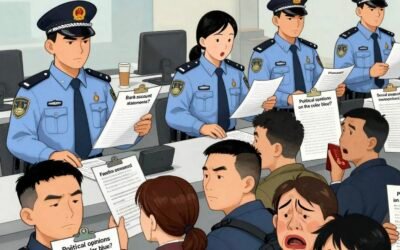
The long farce in the face of the UN Human Rights Council came to an end. It was propaganda as usual. But the world cannot stand it anymore.
by Marco Respinti

The July 2024 Universal Periodic Review (UPR) of the People’s Republic of China (PRC) at the United Nations Human Rights Council (UNHRC) was nothing short of a farce, exposing Beijing’s utter contempt for human rights and the international community. It is nothing new, of course. The examination of China by the UNHRC on January 23, 2024, at the UN Office at Geneva (UNOG), Switzerland, was in fact the grand opening of the later farce.
Far from being opportunities for genuine reflection and improvement, both events have been opportunities for the PRC to turn the UPR into an exercise in propaganda, brazenly dismissing well-documented abuses and rejecting calls for reform with a level of arrogance that should alarm every nation committed to human dignity and justice. The Chinese government’s approach to the UPR was a masterclass in diplomatic deceit. With breathtaking audacity, Beijing not only refused to acknowledge its egregious human rights violations but also had the gall to present itself as a champion of human rights. This charade would be laughable if the consequences were not so dire for millions of people suffering under the Chinese Communist Party’s (CCP) oppressive rule.
At the heart of the PRC’s human rights atrocities lies of course the ongoing cultural genocide in Xinjiang Uyghur Autonomous Region (XUAR), part of what its non-Han inhabitants call East Turkistan. Despite irrefutable evidence of mass detention, forced labor, and cultural annihilation of Uyghurs and other Turkic people, mainly Muslim, the PRC had the temerity to dismiss the UN’s 2022 Xinjiang report (deserving some criticism as it was) as “illegal and void.” By rejecting it outright, Beijing has not only thumbed its nose at the UN but also at the concept of truth itself.
The situation in Tibet, long a victim of the PRC’s brutal colonization and cultural suppression, received equally dismissive treatment. Recommendations to protect Tibetan rights and cultural identity were swatted away with the same casual disregard that has characterized China’s decade-long campaign to eradicate Tibetan culture. The international community’s failure to hold Beijing accountable for its actions in Tibet has only emboldened the Communist regime to apply the same ruthless playbook in XUAR and beyond.

Hong Kong, once a beacon of relative freedom, has been reduced to just another Communist Chinese city under the boot of ideological tyranny. The rejection of calls to repeal the draconian National Security Law reveals the PRC’s determination to crush the last vestiges of democracy and free expression in the former British colony. The world watched in horror as Hong Kong’s vibrant civil society was dismantled, yet Beijing’s response in the UPR was one of defiant justification rather than reflection or remorse. The treatment of human rights defenders, lawyers, and activists across mainland China continues to be nothing short of barbaric. Arbitrary detention, enforced disappearances, and the Orwellian practice of “residential surveillance” have become the norm. The case of Cao Shunli (1916–2014), the lawyer and human rights activist who died after being detained for attempting to engage in the PRC’s 2013 UPR, stands as a grim testament to the lengths China will go to silence dissent. Yet, in the face of such tragedy, Beijing had the gall to claim it “protects the lawful rights of all citizens as equals.”

The regime’s cynical attempt to deflect criticism by touting its economic achievements is an insult to the intelligence of the international community. The Chinese Communist government seems to believe that lifting people out of poverty gives it carte blanche to trample on fundamental human rights. This perverse logic is a direct assault on the universality of human rights and must be rejected unequivocally. The intimidation of civil society groups attempting to participate in the UPR process is a stark reminder of China’s determination to control the narrative at any cost. By silencing independent voices and flooding the process with government-affiliated NGOs, China seeks to create an echo chamber of praise for its abysmal human rights record. This manipulation of the UN system is a direct threat to the integrity of international human rights mechanisms and cannot be tolerated.
Beijing’s diplomatic maneuvering during the UPR was a display of brazen coercion and manipulation. By strong-arming allies like Russia and Venezuela to parrot its propaganda and pressuring other nations into endorsing its human rights record, the PRC attempts to create a facade of international approval. This strategy of diplomatic bullying and false consensus-building undermines the very foundations of international cooperation and must be called out for what it is: a thuggish attempt to rewrite the rules of global governance. The increasing rejection rate of UPR recommendations—from 18% in 2018 to a staggering 30% in 2024—is a clear indication of the regime’s growing contempt for international norms. The international community must recognize this trend for what it is: a deliberate and calculated assault on the international human rights framework.
As Beijing flexes its economic and political muscles on the world stage, its flagrant disregard for human rights becomes not just a moral failing but a global security threat. A regime that shows such callous disregard for the rights of its own citizens cannot be trusted to act as a responsible stakeholder in the international order. The call from over 40 UN experts for a monitoring and reporting mechanism on China must be implemented immediately. The UN High Commissioner for Human Rights, Volker Türk, must shake off any diplomatic timidity and provide forceful, unequivocal updates on the situations in Xinjiang and Tibet. Anything less would be a dereliction of duty and a betrayal of the victims of the PRC’s oppression. Moreover, countries that claim to champion human rights must move beyond toothless statements of concern and take concrete action to hold Beijing accountable.
The regime’s performance in the 2024 UPR should serve as a final wake-up call to the international community. The time for diplomatic niceties and wishful thinking about the trajectory of the PRC has long passed. Beijing has made it abundantly clear that it has no intention of respecting international norms or universal human rights. The world must respond with equal clarity and resolve.
The international community must redouble efforts to support Chinese human rights defenders, both within the country and in exile. These brave individuals, who risk everything to expose the truth about the Chinese regime, deserve not just our admiration but our active support and protection. The conclusion of the PRC’s fourth UPR should mark the beginning of a new, more confrontational approach to the country’s human rights abuses. The credibility of the international human rights system hangs in the balance. If the world fails to hold Beijing accountable now, it will send a devastating message to oppressive regimes everywhere that power and economic might can trump human rights with impunity.
The world must rise to this challenge, or history will judge us harshly for our failure to defend the most fundamental principles of human dignity in the face of such blatant and unapologetic tyranny.

Marco Respinti is an Italian professional journalist, member of the International Federation of Journalists (IFJ), author, translator, and lecturer. He has contributed and contributes to several journals and magazines both in print and online, both in Italy and abroad. Author of books and chapter in books, he has translated and/or edited works by, among others, Edmund Burke, Charles Dickens, T.S. Eliot, Russell Kirk, J.R.R. Tolkien, Régine Pernoud and Gustave Thibon. A Senior fellow at the Russell Kirk Center for Cultural Renewal (a non-partisan, non-profit U.S. educational organization based in Mecosta, Michigan), he is also a founding member as well as a member of the Advisory Council of the Center for European Renewal (a non-profit, non-partisan pan-European educational organization based in The Hague, The Netherlands). A member of the Advisory Council of the European Federation for Freedom of Belief, in December 2022, the Universal Peace Federation bestowed on him, among others, the title of Ambassador of Peace. From February 2018 to December 2022, he has been the Editor-in-Chief of International Family News. He serves as Director-in-Charge of the academic publication The Journal of CESNUR and Bitter Winter: A Magazine on Religious Liberty and Human Rights.