After a month-long journey by land and also by sea, a huge cargo of Uyghur slave labor products reached its destination.
by Marco Respinti
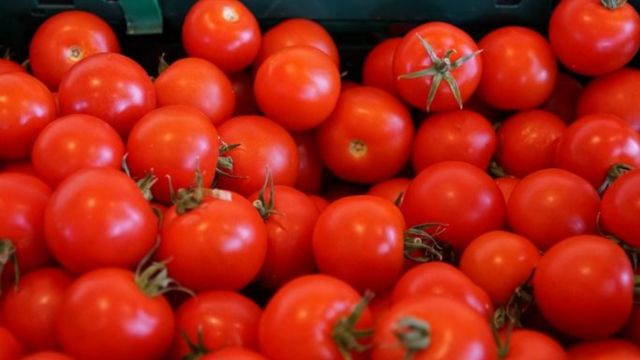
Finally, the strange cargo on its way from Urumqi, the capital of the Xinjiang Uyghur Autonomous Region (XUAR), on which “Bitter Winter” blew the whistle last month, arrived in Salerno, Italy. It left Urumqi on April 29, 2024, and it arrived in southern Italy at the end of May—or at least part of it.
As reported by official state sources, the cargo included 82 containers of “agricultural products,” that were shipped by the state-run Xinjiang Agriculture and Animal Husbandry Investment (Group) Co., Ltd.. And a train it was, even if it adopted a rail-sea combined transport mode. But only half of the cargo arrived in Salerno, and aboard a ship. As journalistic sources report, once it left Urumqi, the cargo crossed Kazakhstan by train to the port of Aktau, on the Caspian Sea, to then continue its trip by ship until Baku, Azerbaijan. There it returned on tracks, heading to the port of Poti, in Georgia, where it shifted again to cross the Black Sea on another ship. Passing through the Türkiye straits, it reached the Mediterranean Sea a few days ago. Salerno received 40 containers of those “agricultural products.” Most probably, the remaining 42 ended their journey elsewhere, on a long route specifically devised to disseminate those “agricultural products” widely and make their origin less traceable.
Now, in Salerno it turns out that those “agricultural products” are tomatoes. “Bitter Winter,” among others, had already guessed it. Now it is confirmed. It is tomatoes from Xinjiang, that its non-Han inhabitants call East Turkistan. In fact, Xinjiang produces a large quantity of tomatoes that the People’s Republic of China (PRC) exports all over the world when it is allowed by laws—and when it is not allowed as well.
It is internationally known that most of the tomatoes produced in Xinjiang and exported to the world by the PRC come from slave labor, which is of course a forbidden practice. The PRC does in fact employ forced laborers in Xinjiang as part of its persecution against the Uyghurs and other Turkic people out of hate against their culture, identity, and religion (mostly Islam). It is then likely that the Xinjiang tomatoes, which were disseminated in several countries and ended their route in southern Italy, mostly came from unlawful slave labor.
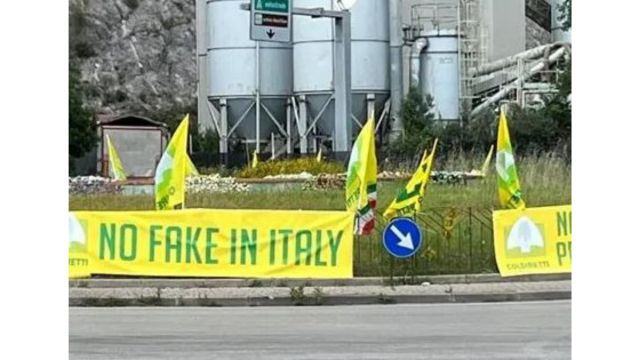
As a matter of fact, “Coldiretti” (the Confederazione Nazionale Coltivatori Diretti, the largest association representing and assisting Italian agriculture), staged a huge vocal though pacific protest against the Xinjiang cargo. Xinjiang tomatoes are invading the Italian market. Tomato sauce and other products derived from Xinjiang tomatoes, the fruits of the brutal exploitation of human beings, enrich Chinese state-owned companies thanks to those unscrupulous Italian (and non-Italian) companies that affix a “made in Italy” label to something that is manufactured in Italy but with raw material coming from China. And of course Xinjiang tomatoes cost less, “Coldiretti” adds, because they come mostly from slave labor, which violates all rules both of morality and of fair trade.
How can the Italian government, which bravely left the PRC’ tentacular “Belt and Road Initiative” in December 2023, tolerate such arrogance and abuse? How can it allow a totalitarian regime to violate all norms to impose its fake products on a country that frankly does not need them, and which of course uphold a quite different standard of human rights?

Marco Respinti is an Italian professional journalist, member of the International Federation of Journalists (IFJ), author, translator, and lecturer. He has contributed and contributes to several journals and magazines both in print and online, both in Italy and abroad. Author of books and chapter in books, he has translated and/or edited works by, among others, Edmund Burke, Charles Dickens, T.S. Eliot, Russell Kirk, J.R.R. Tolkien, Régine Pernoud and Gustave Thibon. A Senior fellow at the Russell Kirk Center for Cultural Renewal (a non-partisan, non-profit U.S. educational organization based in Mecosta, Michigan), he is also a founding member as well as a member of the Advisory Council of the Center for European Renewal (a non-profit, non-partisan pan-European educational organization based in The Hague, The Netherlands). A member of the Advisory Council of the European Federation for Freedom of Belief, in December 2022, the Universal Peace Federation bestowed on him, among others, the title of Ambassador of Peace. From February 2018 to December 2022, he has been the Editor-in-Chief of International Family News. He serves as Director-in-Charge of the academic publication The Journal of CESNUR and Bitter Winter: A Magazine on Religious Liberty and Human Rights.