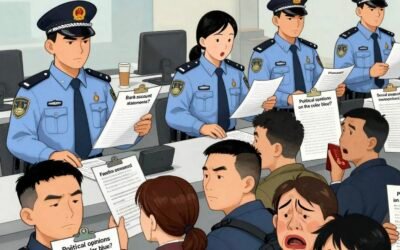
“The Express Tribune,” which is in partnership with “The New York Times,” published two op-ed pieces claiming that happiness and religious liberty reign in the Uyghur region.
by Massimo Introvigne
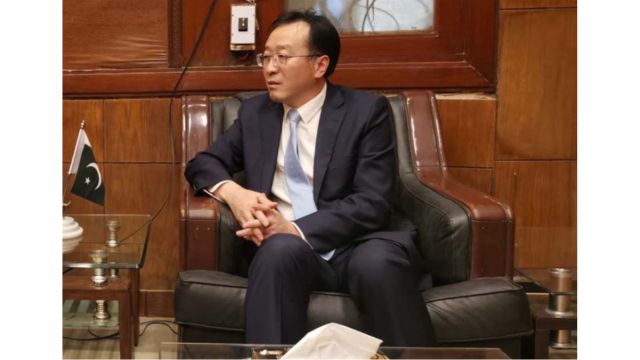
Pakistan and China are allies but there should be limits to what a respected newspaper can publish just to please Beijing. “The Express Tribune” does qualify as a respected English-language newspaper in Pakistan. It is published by the large conglomerate Lawson Group and is even in a partnership with the international edition of “The New York Times,” the only Pakistani publication to enjoy such status.
Yet, on April 13, it published an op-ed piece whose title seemed to refer to tourism but was in fact misleading: “Magnificent Xinjiang: Unique Prosperity on the Ancient and Modern Silk Road.” The author was Yang Yundong. Nowhere in the article was specified that Yang is in fact China’s Consul-General in Karachi.
The piece is involuntarily humorous. It claims that in Xinjiang, “The various ethnic groups live together in harmony, stability, and unity, tightly embracing each other like pomegranate seeds.” What particularly distinguishes Xinjiang, Yang claims, is religious liberty and the flourishing of religion. “Xinjiang continuously improves the facilities of religious activity venues,” Yang claims, perhaps implying that the demolition and “Sinicization” of mosques count as improvements. He adds that “experts, scholars, journalists, diplomats and religious people from over 100 countries as well as regional and international institutions visited Xinjiang,” and all came back home persuaded of the “happiness” reigning there: “seeing is believing.”
Considering that Parliaments of various countries have voted that what is happening to Uyghurs and other Turkic peoples in Xinjiang qualifies as “genocide,” and a United Nations report concluded that China is perpetrating there “crimes against humanity,” advertising the “happiness” allegedly prevailing in the region is both ridiculous and offensive.
Yang also falsifies history by insisting that “Xinjiang has long been an inseparable part of Chinese territory” and “Never in Chinese history has Xinjiang been referred to as ‘East Turkistan.’ In fact, there has never been a state known as ‘East Turkistan.’” These claims are demonstrably false.
It is not the first time that Consul-General Yang Yundong and Pakistan’s “The Express Tribune” play this game. On January 15, 2024, the newspaper published another article by Yang, where he already presented his favorite pomegranate metaphor. In Xinjiang, he wrote, “ethnic groups are closely united, much like pomegranate seeds, working together with shared hearts to build a beautiful homeland.” He blamed theories about genocide and forced labor on Western countries whose “objective is to undermine the prosperity of Xinjiang, curb China’s development, and attempt to achieve the strategy of ‘use Xinjiang to contain China.’”
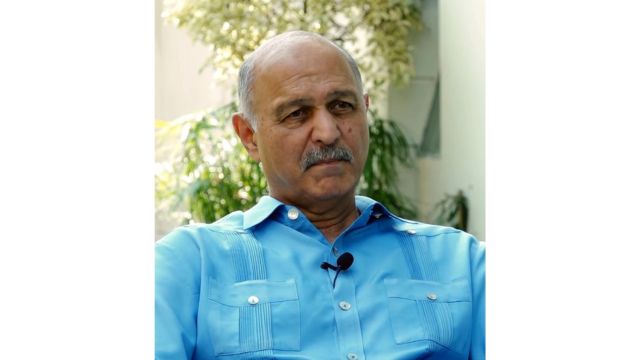
Happily, Yang reported, China has good friends in Pakistan. “The Chairman of Pakistan’s Senate Standing Committee on Defence, Mushahid Hussain Syed visited Xinjiang over 20 times, and personally experienced the development and changes in the region. He said that the economic growth of China’s Xinjiang Uyghur Autonomous Region and the population growth of the Uyghur community belie the politically-motivated fiction peddled by a few Western politicians,” Yang reported.
Yang concluded that “China expresses gratitude to Pakistan for its longstanding affirmation and support in international public opinion and multilateral forums regarding China’s policies in Xinjiang, as well as the developmental achievements and human rights progress in Xinjiang. China hopes to work together with Pakistan to uphold fairness and justice.”
Birds of a feather, indeed. But perhaps “The New York Times” should reconsider its partnership with “The Express Tribune.”

Massimo Introvigne (born June 14, 1955 in Rome) is an Italian sociologist of religions. He is the founder and managing director of the Center for Studies on New Religions (CESNUR), an international network of scholars who study new religious movements. Introvigne is the author of some 70 books and more than 100 articles in the field of sociology of religion. He was the main author of the Enciclopedia delle religioni in Italia (Encyclopedia of Religions in Italy). He is a member of the editorial board for the Interdisciplinary Journal of Research on Religion and of the executive board of University of Pennsylvania Press’ Nova Religio. From January 5 to December 31, 2011, he has served as the “Representative on combating racism, xenophobia and discrimination, with a special focus on discrimination against Christians and members of other religions” of the Organization for Security and Co-operation in Europe (OSCE). From 2012 to 2015 he served as chairperson of the Observatory of Religious Liberty, instituted by the Italian Ministry of Foreign Affairs in order to monitor problems of religious liberty on a worldwide scale.