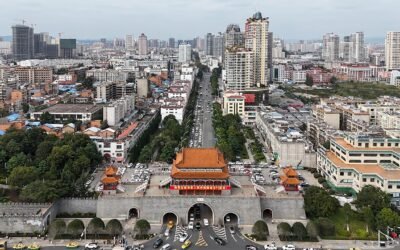
The US State Department issues visa restrictions, stating Washington remains committed to preservation of autonomy, religious identity, and human rights in Tibet.
by Marco Respinti
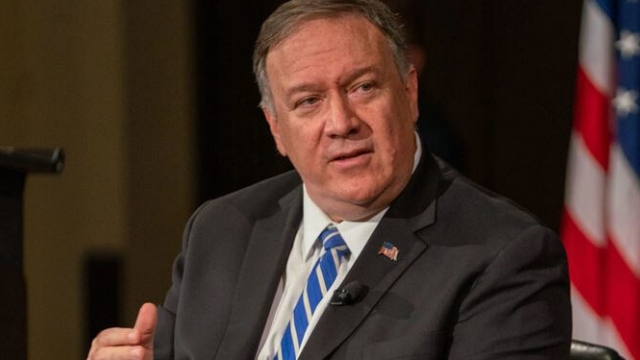
The so-called “new Cold War,” which is being fought these days between the People’s Republic of China and the United States, is a war of position and attrition. As part of this “war,” the U.S. became the most vocal and active country in the world when it comes to human rights, religious liberty, and the CCP’s misdeeds in China. The latest virtual, but nonetheless strategic, bullet has been shot at China by the US Secretary of State, Mike Pompeo, on July 7 through the Implementing Visa Restrictions Under the Reciprocal Access to Tibet Act.
The act implements “visa restrictions on PRC government and Chinese Communist Party officials determined to be ‘substantially involved in the formulation or execution of policies related to access for foreigners to Tibetan areas,’ pursuant to the Reciprocal Access to Tibet Act of 2018.”
The decision is an open retaliation against the open violation of the right to travel to Tibet by the CCP regime. “Beijing has continued systematically to obstruct travel to the Tibetan Autonomous Region (TAR) and other Tibetan areas by U.S. diplomats and other officials, journalists, and tourists,” Mr. Pompeo said, “while PRC officials and other citizens enjoy far greater access to the United States.” This, Pompeo added, undermines the “fair, transparent, and reciprocal treatment” between the U.S. and China.
Tibet, Mr. Pompeo notes, is particularly relevant, because “access to Tibetan areas is increasingly vital to regional stability, given the PRC’s human rights abuses there, as well as Beijing’s failure to prevent environmental degradation near the headwaters of Asia’s major rivers.”
The document, in fact, includes more than a technical measure. There is also a statement of principle that, while serving as the immediate rationale for the newly enacted policy, denotes the general perspective of the current administration in Washington DC. “The United States […] remain committed to supporting meaningful autonomy for Tibetans, respect for their fundamental and unalienable human rights, and the preservation of their unique religious, cultural, and linguistic identity. In the spirit of true reciprocity, we will work closely with the U.S. Congress to ensure U.S. citizens have full access to all areas of the People’s Republic of China, including the TAR and other Tibetan areas.”
This is a clear indictment of the CCP policy in Tibet. It also parallels the U.S. indictment of Chinese policies in Xinjiang and Hong Kong, thus amounting to a global denunciation of the CCP regime and its abysmal human rights record.

Marco Respinti is an Italian professional journalist, member of the International Federation of Journalists (IFJ), author, translator, and lecturer. He has contributed and contributes to several journals and magazines both in print and online, both in Italy and abroad. Author of books and chapter in books, he has translated and/or edited works by, among others, Edmund Burke, Charles Dickens, T.S. Eliot, Russell Kirk, J.R.R. Tolkien, Régine Pernoud and Gustave Thibon. A Senior fellow at the Russell Kirk Center for Cultural Renewal (a non-partisan, non-profit U.S. educational organization based in Mecosta, Michigan), he is also a founding member as well as a member of the Advisory Council of the Center for European Renewal (a non-profit, non-partisan pan-European educational organization based in The Hague, The Netherlands). A member of the Advisory Council of the European Federation for Freedom of Belief, in December 2022, the Universal Peace Federation bestowed on him, among others, the title of Ambassador of Peace. From February 2018 to December 2022, he has been the Editor-in-Chief of International Family News. He serves as Director-in-Charge of the academic publication The Journal of CESNUR and Bitter Winter: A Magazine on Religious Liberty and Human Rights.