December 10 was Human Rights Day. Bitter Winter celebrates it with four articles. Here, we address issues other than religious liberty.
Bitter Winter
- The pro-democracy movement in Hong Kong has entered its sixth month. The whole city is transformed into a battlefield. Ruthless violence by the pro-CCP police is the city-territory’s daily routine. Commenting on the images you are seeing now, Ed Chin told Bitter Winter, “This is the riot police in the heart of Central Hong Kong’s financial district. Now, this is the new normal.”
Video: Hong Kong: Live coverage by Ed Chin for Bitter Winter

- Proposed by Xi Jinping in 2015, the so-called “toilet revolution” is a campaign to improve sanitary conditions in the countryside, primarily intended to renovate all public toilets, as well as upgrade pit toilets to contemporary bathrooms with running water in private homes.
In the county-level city of Lingbao, administered by Sanmenxia city in the central province of Henan, on March 2, a village head led personnel with sledgehammers, shovels, and other tools, to demolish each and every outhouse – the predominant type of toilet in China’s countryside. Nearly 40 outhouses have already been demolished by late February. But, while the old toilets disappeared with great fanfare, no new sanitary facilities have been built. According to some calculations, by the end of April, nearly 7,000 such toilets in Lingbao city’s rural areas had been forcibly demolished. These and other similar measures of “poverty alleviation” have driven villagers to desperation and even suicide.
Video: Village government personnel are demolishing toilets.

- In March 2006, China’s National People’s Congress launched the “new socialist countryside” policy. As part of the initiative, the Beautiful Countryside Project was started. The project, which called for confiscation and demolition of private homes and enterprises, has caused widespread discontent and even resulted in several deaths.
In May, as part of the “beautiful countryside” campaign, the government of Baini town in Chongyang county in the central province of Hubei destroyed the buildings of 13 private enterprises, located along China’s National Highway 106. The affected merchants voiced their discontent but had no way to defend their rights. Over in Luanchuan township administered by Luoyang city in the central province of Henan, Gao Xiaojiao, one of the villagers whose land was seized and fruit trees destroyed, went around appealing for justice, but was repeatedly rebuffed. In despair, on May 24, she committed suicide by jumping into a reservoir.
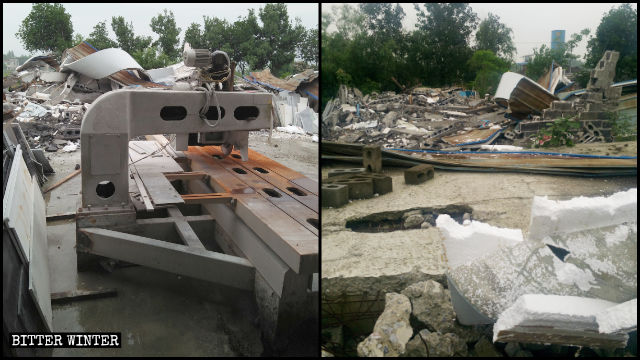
Buildings of 13 private enterprises along National Highway 106 were forcibly demolished in Hubei Province’s Chongyang county.
- In August 2018, the southeastern province of Jiangxi launched a “burial reform,” aimed at replacing burials with cremations, demanding to cremate all the deceased starting from May 1. Despite multiple cases of the elderly committing suicide in protest, the local authorities continued with the burial reform.
Hu Guiwen, an elderly man from Quanfeng town in Xiushui county, administered by Jiujiang city, passed away on June 11, and his family secretly buried him the same evening. The government learned about this the same day and decided to dig up his remains. More than 2,000 people spontaneously showed up at the cemetery to guard Mr. Hu’s grave. On June 13, after villagers found out that the government was planning to send over 400 police officers to subdue them, the number of people protecting the grave rose to nearly 10,000.

Villagers spontaneously organized a protest to stop the government from digging up graves (photo from WeChat).
- Government officials of Aojiang town in Pingyang county, under the jurisdiction of Wenzhou city in the eastern province of Zhejiang, declared that about half of the houses in Wubanqiao village, roughly 900, were “unauthorized” buildings and ordered their demolition. The demolitions began in August 2018, but the residents weren’t going down without a fight. To defend their rights, they hired a Beijing-based legal team to file a lawsuit for them. But when Wenzhou People’s Court started the proceedings, for some unknown reason, the lawyers hired by the villagers didn’t dare to say anything. On the morning of the court hearing, more than 100 villagers were on their way to Wenzhou People’s Court when they were pulled over by the police on the highway and taken to the Aojiang Town Police Station.
In response to the villagers’ appeals, on January 14, 2019, local officials, accompanied by some electricians and 50 security guards carrying shields and long iron rods, showed up at the village. The electricians were then instructed to cut off water and electricity supply and remove electricity meters in the houses. This operation lasted for a week.
Video: Villagers protest against the forced demolition of their houses:

- On the early morning of June 17, 2019, an 18-year-old high school student died under suspicious circumstances on the campus of Zhecheng High School in Shangqiu city in the central province of Henan. To find out their son’s cause of death, Zhang Ning’s parents, accompanied by some of their relatives, went to the school. To their surprise, they found the school’s gate closed, and the school administration turned them away, refusing to discuss the matter.
On the morning of June 18, more than a dozen members of the Zhang family returned to the school again, where they were met by 30 police officers. The police also blocked off the traffic at the nearby intersections. What the Zhang family never expected was that not only did the school and police not mention Zhang Ning’s cause of death, but even ordered them to stop crying outside the school since “it was against the law.” The police threatened to arrest them if they continued “to make trouble.”
Video: Family members stand in front of the school and denounce the authorities’ refusal to disclose the cause of the young man’s death.

- Yan Chunxiang, an 83-year-old former assistant engineer from China’s central province of Hubei who is unable to enjoy his retirement, has been fighting the government for the past 20 years, trying to defend his and his colleagues’ rights to receive their hard-earned pensions. On June 9, 2009, the then 73-year-old Mr. Yan went to the Ezhou city government office to personally present his position. To his surprise, as soon as he got off the bus, three young men he didn’t know intercepted and beat him. Several of his teeth were knocked out, and his ankle was fractured after the attackers kicked him. The scars on the ankle are still visible today. He was beaten twice by government-hired thugs after that. In addition, he was twice locked up in a mental hospital,

Mr. Yan’s teeth were knocked out during a beating by hired thugs.