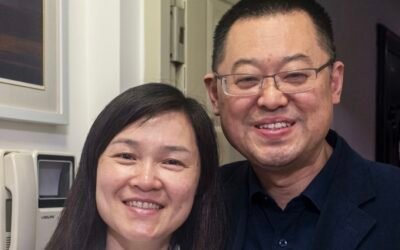
Liao Ying (50) is from the city of Zigong City Sichuan Province and currently lives in Yining city of the Xinjiang Uyghur Autonomous Region. She was arrested by the Chinese Communist Party (CCP) police on September 12, 2014, while heading to a gathering of The Church of Almighty God, a Christian new religious movement, and was later subjected to cruel torture, which resulted in paraplegia.
A little past 9 p.m. that day, as Liao Ying left to attend a gathering at fellow believers’ home, she was arrested by three plainclothes officers who were staked out in the courtyard. They took her to the Shengli street police station where they handcuffed her, put a black hood over her head, and brought her to a secret interrogation location. They left after securing her to a tiger bench – a torture device when a seated victim’s legs are tightly tied to the bench with belts, while bricks or other hard objects are gradually placed under the feet until the belts break.
The next morning, an officer with the National Security Brigade questioned Liao Ying on her personal information. When he was not happy with her answers, he viciously kicked her in the calves with his leather shoes. For several consecutive days, the police tried to force Liao Ying to reveal information on the Church, and when she refused to answer, they would repeatedly beat her and hit on her head with fists and handcuffs. They boxed her ears and slapped her in the face and head with sandals. When they got tired, they would take a short break and then continue to hit her. Liao Ying’s face was hit until it was numb and swollen, and there were several welts on her head.
On the fifth day, the police let her off the tiger bench and had her sit on the floor with her feet extended into the iron rings of the tiger bench. After her feet were tightly shackled, several officers cuffed her hands behind her back. Liao Ying suffers from a frozen shoulder; therefore, she was completely unable to lift her arms. When officers would forcibly pull at her arms, she was in so much pain that it felt as if her arms were breaking. After they were done with that, they shoved a bottle of hot water between the handcuffs and her back, causing her both painful and burning sensations; she was pouring with sweat. The police would remove Liao Ying’s handcuffs once every half hour and then continue to torture her after a short break. They have repeated this torture four times until Liao Ying lied down on the floor in agony. A police officer came over, kicked her hard and shouted at her that she was playing dead and then handcuffed her on the tiger bench. After that, they tortured her for seven days and nights. Their interrogation never yielded any results, so the police sent her to a detention center.
After ten days in custody, two officers with the National Security Brigade questioned Liao Ying. Since she wouldn’t share information about the Church, they ordered her to stand away from the tiger bench and then cuffed her hands and feet into the iron rings so that she couldn’t stand up. She had to lean over on the bench with her hands in both sides of it. The police viciously pried her hands away with their batons so that her entire body’s weight was resting on her wrists. She was sweating from pain. They didn’t release her until about an hour later. After that, they put her back on the tiger bench for two more weeks of questioning. They sent her back to the detention center after they could not get anything out of her.
On May 13, 2015, Liao Ying was given a four-year sentence and, on August 25, she was sent to Xinjiang Uyghur Autonomous Region Women’s Prison to serve her time where prison guards subjected her to 70 days of intense indoctrination and tried to force her to write renunciation statements, blaspheming God. The guards made her a particular target because she would not comply, assigning her to do dirty and tiring physical labor such as ripping steel wire balls apart and carrying boxes. In January 2016 when she had been in prison for less than two months, she started to feel unbearable back pain. Even walking became difficult, and she had to press one hand into the small of her back to be able to walk slowly. The prison guards would not allow her to see a doctor and forced her to continue working. On June 22, 2016, Liao Ying’s condition worsened to the point that she could no longer move and could not work at all. She could not take care of herself and required the help of other believers even to use the bathroom, get in and out of bed. Only then did the guards send her to the prison clinic.
In the clinic, even though Liao Ying experienced severe full-body pain unable even to sit down, her doctor would not give her any medication or injection. In the end, she was fully paralyzed and was unable to walk. The prison guards had to take her to a hospital outside prison. When she was being taken back to her cell, the guards intentionally lifted her in her wheelchair on both sides so that her feet were dragging on the ground. The injured portion of her back was resting against the wheelchair’s armrest causing a vertebral fracture. She cried out from the pain.
On August 1, Liao Ying was diagnosed with thoracic spinal tuberculosis, paraspinal abscess, and high paraplegia. She was in an immediate need of surgery. Fearing responsibility, the police reluctantly released her on medical parole after her surgery and allowed her to go home to recover. Her husband took her home on September 11, and the area where steel plates were put into her back still has not healed.

Bitter Winter reports on how religions are allowed, or not allowed, to operate in China and how some are severely persecuted after they are labeled as “xie jiao,” or heterodox teachings. We publish news difficult to find elsewhere, analyses, and debates.
Placed under the editorship of Massimo Introvigne, one of the most well-known scholars of religion internationally, “Bitter Winter” is a cooperative enterprise by scholars, human rights activists, and members of religious organizations persecuted in China (some of them have elected, for obvious reasons, to remain anonymous).