Few realize that in the Pakistani Penal Code the minimum age for criminal responsibility in 7. A Hindu boy may face death penalty.
by Massimo Introvigne
Last week, the world was shocked when it learned that an 8-year-old Hindu boy from the village of Bhong, in eastern Rahim Yar Khan district in Punjab, Pakistan, had been arrested for blasphemy, an offense that is punished with the death penalty.
International media reported that the boy had “urinated in a mosque.” Bitter Winter has learned that what happened is that the boy had entered a mosque in Bhong. He was severely reprimanded by a local cleric called Muhammed Ibrahim, because as a non-Muslim he was not supposed to enter the mosque, and taken to a room where religious books are kept. Mightily scared, the boy involuntarily urinated and wet a carpet. Ibrahim filed a complaint for blasphemy with the police, which promptly arrested the boy.
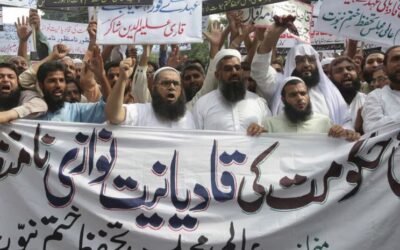
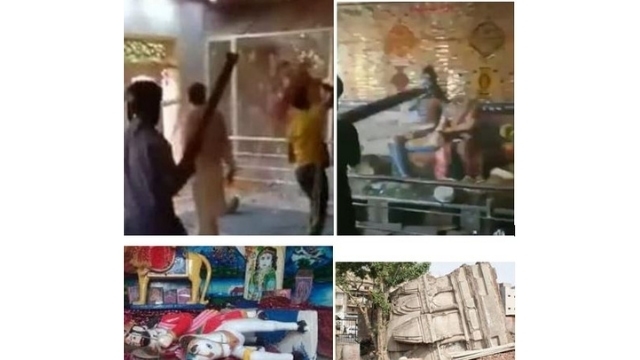
To their credit, several Pakistani politicians, including the Prime Minister, condemned the arrest and the charges of blasphemy filed against such a young boy. The boy was released on bail, but this generated the anger of local ultra-fundamentalist Muslims. A crowd of 150 attacked and damaged Bhong’s Hindu temple. Most of the local Hindu community had to flee the village.
Several attackers were arrested, and the temple has now been repaired at public expenses and handled back to the Hindu community. However, the case against the boy has not been discontinued.
Few realize that Article 82 of the Pakistani Criminal Code sets the minimum age for criminal responsibility at 7. It is true that Article 83 states that “Nothing is an offence which is done by a child above seven years of age and under twelve, who has not attained sufficient maturity of understanding to judge of the nature and consequences of his conduct on that occasion.” But this should be judged by courts of law on a case-by-case basis.
Human rights organizations have often denounced the degrading conditions in which minors and even children accused of crimes in Pakistan are kept in the local jails, particularly when they belong to religious minorities.
Read update “Pakistan: Charges Against 8-Year-Old Dropped, Problems Remain”
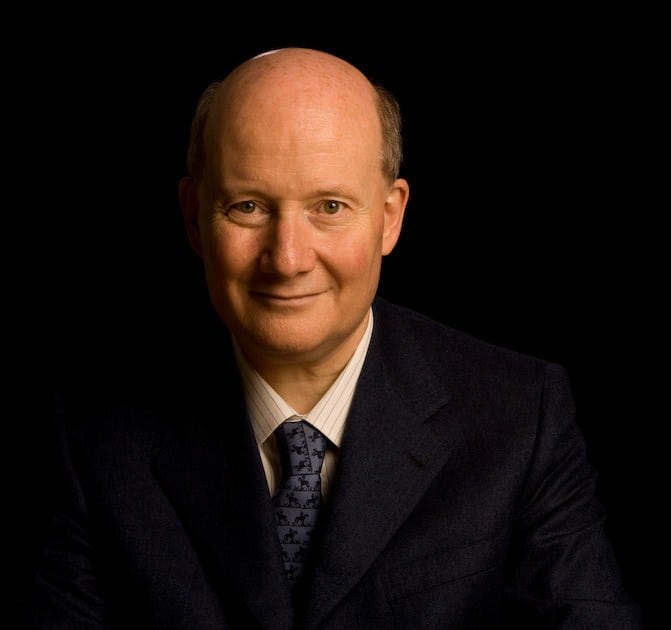
Massimo Introvigne (born June 14, 1955 in Rome) is an Italian sociologist of religions. He is the founder and managing director of the Center for Studies on New Religions (CESNUR), an international network of scholars who study new religious movements. Introvigne is the author of some 70 books and more than 100 articles in the field of sociology of religion. He was the main author of the Enciclopedia delle religioni in Italia (Encyclopedia of Religions in Italy). He is a member of the editorial board for the Interdisciplinary Journal of Research on Religion and of the executive board of University of California Press’ Nova Religio. From January 5 to December 31, 2011, he has served as the “Representative on combating racism, xenophobia and discrimination, with a special focus on discrimination against Christians and members of other religions” of the Organization for Security and Co-operation in Europe (OSCE). From 2012 to 2015 he served as chairperson of the Observatory of Religious Liberty, instituted by the Italian Ministry of Foreign Affairs in order to monitor problems of religious liberty on a worldwide scale.