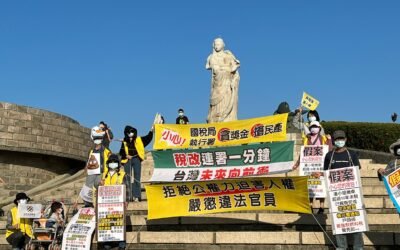
The 2007 verdict should have ended the Tai Ji Men case. Unfortunately, it did not.
by Daniela Bovolenta

On July 13, 2025, one of the regular webinars co-organized about the Tai Ji Men case by CESNUR and Human Rights Without Frontiers celebrated the 18th anniversary of the verdict of Taiwan’s Supreme Court that declared Tai Ji Men defendants innocent of all charges on July 13, 2007.
Massimo Introvigne, managing director of CESNUR and editor-in-chief of “Bitter Winter,” opened the webinar by noting that 2025 also marks the hundredth anniversary of the posthumous publication of Franz Kafka’s novel “The Trial.” The book introduced the word “Kafkaesque” into the English language. It recounts the story of a bank clerk who is arrested without knowing the charges against him and only realizes what’s happening when he is executed. Introvigne said his story strongly resonates with the predicament of the Tai Ji Men disciples in Taiwan. They also faced a capricious and irrational bureaucracy and judiciary, despite their 2007 victory. While Kafka doesn’t offer solutions, Introvigne concluded, he provides recognition—and thus the solidarity we all owe to Tai Ji Men.
Introvigne presented a video about how American philosopher Henry David Thoreau was jailed in 1846 in Concord, Massachusetts, for refusing to pay a poll tax, which he believed was unjust and would support slavery. His decision to go to jail instead of paying an unfair tax inspired his famous essay “Civil Disobedience,” which later influenced Martin Luther King Jr.

Introvigne then introduced the two speakers of the first session: Alessandro Amicarelli, a London-based human rights lawyer and the President of the European Freedom for Freedom of Belief (FOB), and Karolina Maria Kotkowska, a researcher at Jagiellonian University in Kraków, Poland.
Amicarelli reviewed the content of the 2007 Supreme Court decision. He noted that, although ultimately victorious, the Tai Ji Men paid a heavy price for the unjust persecution. So did Taiwan’s international image. Additionally, the 2007 verdict did not end the Tai Ji Men case, as the National Taxation Bureau ignored it and continued to issue fabricated tax bills. Amicarelli examined what efforts by international scholars and human rights activists have achieved in bringing the Tai Ji Men case to a global audience. However, he noted that further efforts are needed through both scholarly research and legal and political advocacy.

Kotkowska noted that 2025 also marks another hundredth anniversary. Jiddu Krishnamurti, a young Indian, was chosen by the Theosophical Society to be the messianic World Teacher. His mission was announced in Ommen, the Netherlands, in 1925. However, in 1929, at another Theosophical gathering in Ommen, Krishnamurti declared that he rejected the role of World Teacher and regarded truth as a “pathless land.” He continued his spiritual journey as an independent teacher. Kotkowska compared Krishnamurti to the Shifu (Grand Master) of Tai Ji Men, Dr. Hong Tao-Tze. Although the contexts differed, the style of both teachers led their disciples to think bravely and independently. Both faced challenges and opposition, which they confronted with courage rooted in their inner freedom.
Willy Fautré, co-founder and director of Human Rights Without Frontiers, introduced the second session and showed a video about the main issues of the Tai Ji Men case. He mentioned that July 13 is the night before July 14, which is celebrated in France as Bastille Day, marking the beginning of the French Revolution. Fautré compared the seemingly invincible Bastille fortress to the Taiwanese bureaucracy, describing it as a castle taken by Tai Ji Men in 2007 through their Supreme Court victory. However, other strongholds remain, and the fight goes on.
Fautré then shared testimonies from five Tai Ji Men dizi (disciples). Rebecca Wang, a project manager, questioned why we still discuss the case in webinars despite the Supreme Court’s 2007 ruling declaring Tai Ji Men innocent of all charges, including tax evasion. She answered that victory was not final, and Tai Ji Men continued to face unjust tax bills. Other taxpayers in Taiwan encounter similar issues. Wang compared the attitude of Taiwan’s corrupt bureaucrats to the souls in Dante’s “Divine Comedy,” who are punished according to the “law of the contrappasso,” suffering in proportion to their evil deeds. She added that Taiwanese bureaucrats are pulling the people of Taiwan into this hellish situation.

Chuck Cherng, a manager in the ICT industry, reminded the audience of statements by Taiwan law professors who argued that human rights were violated in the Tai Ji Men case. They dismissed as unfounded the National Taxation Bureau’s objection that the tax bill for 1992 was confirmed before the Supreme Court’s 2007 verdict, by a court decision that was no longer appealable, and thus could be lawfully enforced. Article 117 of the Administrative Procedure Act allows wrongful administrative measures to be revoked even after “final” court decisions. This article should have been applied to the Tai Ji Men case, but it was not.

Janis Chen, the managing director of an NGO, reflected on her parents’ experience during the “dark days” when the Tai Ji Men case began in 1996. Guided by the principles taught by their Shifu, they resisted the pressure of media slander and persecution. Other disciples did not resist and stopped practicing Qigong. Chen said that the Tai Ji Men case has been described as a “demonic mirror” of Taiwan’s issues, which include a corrupt bureaucracy and a lack of critical thinking. Chen mentioned that in 2026, independent international experts will conduct the fourth review of Taiwan’s compliance with the two United Nations Human Rights Covenants. She expressed hope that, unlike in previous reviews, the issues of tax justice and freedom of religion or belief, including the Tai Ji Men case, will be addressed.

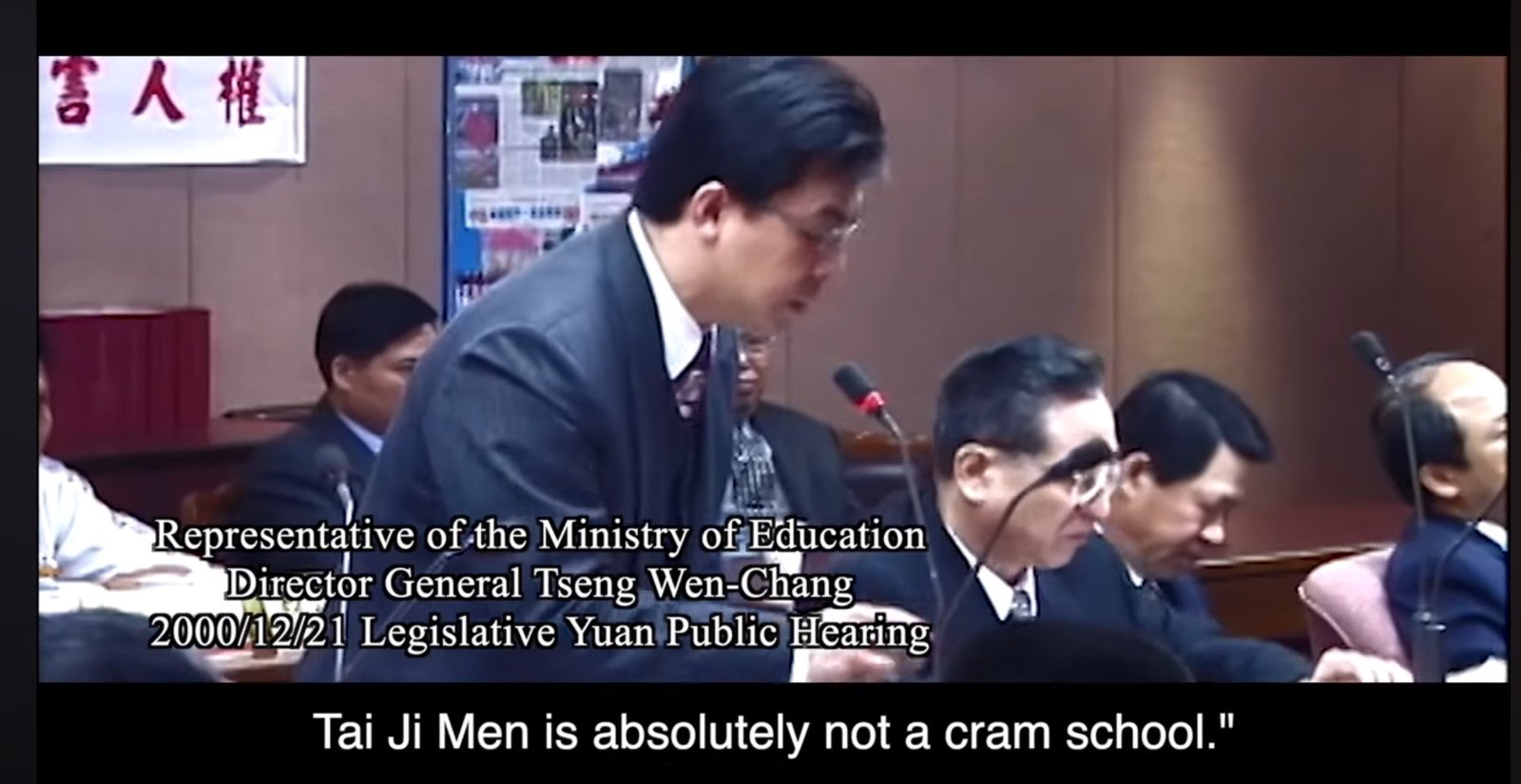
Maryann Chuang, a certified public accountant, relied on her professional experience to argue that the tax bills issued against Tai Ji Men were legally invalid. They were based on a fabricated and false assumption that the monetary offerings from Tai Ji Men dizi to their Shifu were tuition fees for a non-existent cram school, while they were non-taxable gifts. Like other speakers, Chuang insisted that, as interpreted by leading Taiwanese scholars, Article 117 of the Administrative Procedure Act allows for revocation of patently unjust judgments. Protecting citizens’ rights should precede rigidly adhering to “final” verdicts.

Wu Chih-Chung, the Vice President of a medical equipment manufacturing company, discussed the controversial bonuses awarded to tax bureaucrats when they enforce tax bills, whether justified or not. These bonuses create injustice and corruption. Wu placed these bonuses into their historical context. During Taiwan’s White Terror period, bonuses were given to those who reported Communist spies. Some spies indeed operated on the island, but many whistleblowers falsely accused innocent people to collect bonuses. This system was later extended to reward those who denounced tax evaders and the tax officers enforcing bills. Wu concluded that it is now time to end a system that played a significant role in the Tai Ji Men case and is incompatible with the anti-corruption standards of modern democracies.

Marco Respinti, an Italian scholar, journalist, and director-in-charge of “Bitter Winter,” concluded the webinar by emphasizing the importance of the Supreme Courts and their decisions. They should be the final authorities interpreting the law in all countries. In Taiwan, however, the Supreme Court was not treated as such when the National Taxation Bureau ignored its 2007 decision. That was almost unprecedented in democratic countries and violated law and logic, Respinti noted.

The webinar concluded with a video about Tai Ji Men’s fight for conscience and human rights.