They should wave a Chinese flag and show their enthusiasm—or else.
by Massimo Introvigne
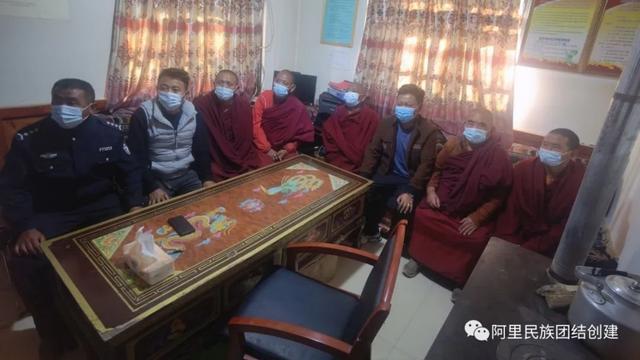
There are many images of China during the 20th Congress of the Chinese Communist Party, but those collected and posted on Twitter by American scholar Timothy Grose are the most sad and extraordinary I have seen so far.

Although Grose also found images of other ethnic-religious minorities, those about Tibetan monks form a unique ensemble. They show the monks obviously compelled to watch the 20th Congress on old-fashioned TV sets and wave Chinese flags when Xi Jinping appears on the screen. In some of the pictures, public security officers are clearly visible. In others, we may safely assume they are there, only just outside the area captured by the camera.
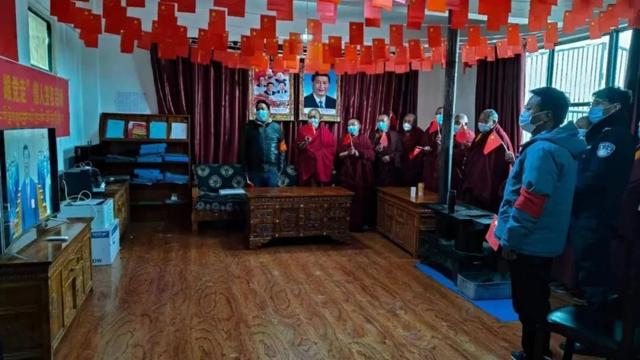
Perhaps the most unique image is the one you see below, stamped “Ganzi Buddhist Association,” i.e., the government-controlled Buddhist body of Garzê Tibetan Autonomous Prefecture, which is part of historical Tibet but is now in the Chinese province of Sichuan.

These monks cannot even pretend they are watching a national event uniting believers and non-believers. On the left side of the TV set showing Xi Jinping is the Chinese flag, on the right the flag of the Communist Party.
The same Party has decorated the hall with portraits, from left to right, of Marx, Engels, Lenin, Stalin, Mao, Zhou Enlai, Zhou De, Deng Xiaoping, Jiang Zemin, Hu Jintao, and Xi Jinping. It is a complete Marxist genealogy of the Chinese Communist Party, except that one would perhaps have expected Hua Guofeng after Zhou Enlai but the character really looks like General Zhou De. Zhou was head of the Chinese state in 1975–76 and is probably honored here as a great Red Army leader.
The monks probably don’t know who a good half of the characters are, and they may not really care. But the Party does care. It is telling its victims that yes, it is an atheistic party founded on the anti-religious ideas of Max, Engels, Lenin, Stalin (Stalin is never forgotten), and Mao, connected by an unbroken red line to Xi Jinping. Yet, it has the power to compel monks and lay Tibetan Buddhists to bow before the portraits of the Marxist luminaries, wave their flags, listen with patience to the boring and repetitious speeches, and applaud.
You will see other images of China during the 20th Congress. But, with gratitude to Timothy Grose, you will not see the oppression of religion portrayed more clearly.

Massimo Introvigne (born June 14, 1955 in Rome) is an Italian sociologist of religions. He is the founder and managing director of the Center for Studies on New Religions (CESNUR), an international network of scholars who study new religious movements. Introvigne is the author of some 70 books and more than 100 articles in the field of sociology of religion. He was the main author of the Enciclopedia delle religioni in Italia (Encyclopedia of Religions in Italy). He is a member of the editorial board for the Interdisciplinary Journal of Research on Religion and of the executive board of University of California Press’ Nova Religio. From January 5 to December 31, 2011, he has served as the “Representative on combating racism, xenophobia and discrimination, with a special focus on discrimination against Christians and members of other religions” of the Organization for Security and Co-operation in Europe (OSCE). From 2012 to 2015 he served as chairperson of the Observatory of Religious Liberty, instituted by the Italian Ministry of Foreign Affairs in order to monitor problems of religious liberty on a worldwide scale.