The CCP cracks down on temples, orders to remove symbols and bans customs related to Tibetan Buddhism.
by Zhang Feng
The popularity of Tibetan Buddhism has grown considerably over the past decade among urban residents in mainland China, resulting in mounting suppression at the hands of the CCP. A document issued by a local government in northern China’s Hebei Province in March last year requires to thoroughly investigate the spread of Tibetan Buddhism. Measures include inquiries into monks’ teachings, analysis of initiation ceremonies for novice monks and other religious activities. The document also demands to ascertain if Chinese Buddhists convert to Tibetan Buddhism, learn how their activities are organized, as well as collect and analyze information about elements of Tibetan Buddhist architecture and symbols in Chinese Buddhist venues.
Similar suppressive measures are being adopted throughout China, as local authorities clamp down on anything related to Tibet.
On November 22, 2019, a 17-meter-tall three-faced Guanyin statue in Yunkong Temple, a place of worship in Chinese Buddhism tradition, in Pianguan county of Xinzhou, a prefecture-level city in the northern province of Shanxi, was turned into ruins despite strong opposition from local believers. A government official revealed to Bitter Winter that the primary reason for dismantling the icon was because it had been consecrated according to Tibetan Buddhism traditions.

The three-faced Guanyin statue before and after demolition.
According to a local Buddhist, on October 28, officials from the county’s United Front Work Department (UFWD) and police officers blocked access to the temple with barricade tape, and officers were deployed to guard the nearby intersection. The officials ordered workers to chip the feet of the statue with an electric drill.
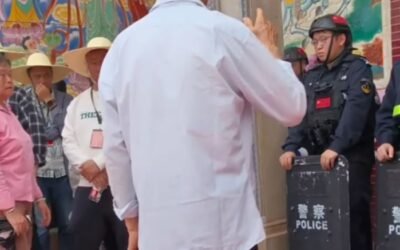
Local believers rushed to the temple to stop the demolition but were stopped by police officers. A woman in her 60s fainted after she was pushed to the ground, but was not taken to the hospital immediately. The demolition was suspended temporarily when some believers lay down in front of the statue.
Several days later, UFWD officials returned to the temple. One of them told believers that the Guanyin statue had to be demolished because the central government wants to stop the spread of Tibetan Buddhism because of fears that it would “infiltrate and split China.” Since President Xi Jinping promotes the “sinicization” of religion and wants to control all religious believers, he continued, anyone who opposes the statue demolition “is disloyal to the Party and will be investigated as a criminal.” The official added that religions challenge the supremacy of communist ideology; therefore, the CCP does not allow them to exist.
“We have nowhere to complain about this. Whoever opposes the government will be labeled counter-revolutionary and imprisoned,” the threatened believers lamented.
In May 2019, the government of Du’an Yao Autonomous County, administered by Hechi city in Guangxi Zhuang Autonomous Region, issued a notice demanding to remove Tibetan Buddhist elements from Anfu Temple.
Many such elements in other Chinese Buddhist temples, like the traditional prayer wheels, have been covered or removed on orders by authorities. In November 2019, the government of Huairen, a county-level city in the northern province of Shanxi, ordered to demolish 13 prayer wheels in Qingliang Temple within three days. The temple’s monks had no choice but to hire workers to do the job. A local Buddhist said that the wheels were purchased with donations from local believers at the cost of 40,000 RMB (about $ 5,700).

Prayer wheels in Huairen city’s Qingliang Temple were removed in November.
At the end of 2018, the UFWD and the Religious Affairs Bureau of Fuzhou, the capital of the southeastern province of Fujian, ordered to cover the prayer wheels inside a pavilion of Shuanglong Temple “because they were Tibetan.” The seven wheels were covered with painted wooden boards.

The wheels in Shuanglong Temple were covered.
“The wheels were installed four years ago for believers to pray,” a local Buddhist explained, “but officials threatened to demolish them if we didn’t hide them because of the ongoing campaign [against Tibetan Buddhism].” The government also investigated whether the temple’s abbot had contacts with Tibet.
“The prayer wheel is a Tibetan Buddhism tradition,” the Buddhist continued. “Every time people spin it, they are reminded of Tibet and its spiritual leader the Dalai Lama, whom the government labels as ‘a separatist who uses religion to split the country.’ If people follow his teachings, the Communist Party is afraid to lose control over them. For the CCP, prayer wheels represent this fear. They may also be the pretext to take away religious activity venue registration certificates and close down temples for ‘poor political awareness.’”

Uses a pseudonym for security reasons.