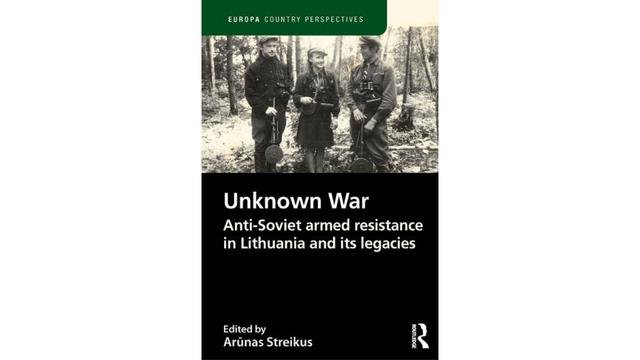
A new book in English edited by Arūnas Streikus was written before the war in Ukraine but is published in the right moment.
by Massimo Introvigne

On July 1, 2018, the remains of Lithuanian partisan commander Adolfas Ramanauskas (1918–1957), code name Vanagas, one of the main leaders of the resistance against the Soviets, were located at the Našlaičiai (Orphans) Cemetery in the Antakalnis eldership of Vilnius. After his execution, they had been left in a crouching position in a pit, together with the bodies of two common criminals executed on the same day, November 29, 1957.
A chapter by archeologist Gintautas Vėlius, a professor at Vilnius University who had a key role in the excavations at Našlaičiai Cemetery, reads like a detective story, and concludes “The Unknown War: Anti-Soviet Armed Resistance in Lithuanian and Its Legacies,” a comprehensive book edited by historian Arūnas Streikus, also from Vilnius University and just published by the academic press Routledge. Vėlius explains that the fact that Našlaičiai Cemetery was the place where the Soviets clandestinely buried the executed partisans was not known until 2016. After that date, research on the scarce records about that cemetery and the use of cutting-edge archeological techniques led to the discovery of the bodies of more than thirty partisan, including Ramanauskas.
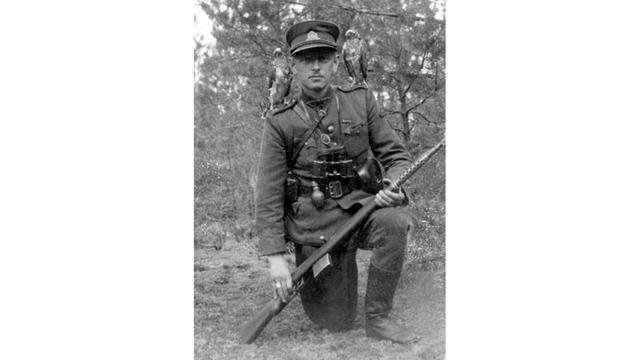
This is epic archeology, but there is more to Ramanauskas’ story, which leads us to other chapters of Streikus’ book. After his remains were found in 2018, Lithuania included him posthumously in the list of his heads of state. His remains were interred in Antakalnis Cemetery next to the graves of other state leaders. Lithuanian President Dalia Grybauskaitė presided over the ceremony, which was attended by some thirty diplomatic delegations from foreign countries.
Before and during these events, however, Russian and some American media claimed that Ramanauskas had been a Nazi collaborator in 1941 and the leader of a militia that had killed Jews in Druskininkai. The accusation was taken seriously by the World Jewish Congress and other Jewish organizations, and led to the decision by the city of New Britain, Connecticut, where he was born in 1918, to cancel plans to erect a monument to Ramanauskas. The monument was erected in Chicago instead, and unveiled at the presence of Lithuanian Foreign Minister Linas Linkevičius in 2019.
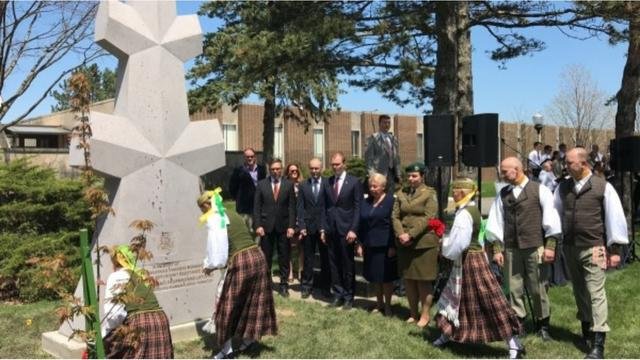
This was a textbook example of the conflict of narratives that still exists about Lithuanian partisans. The Lithuanian government traced back the campaign against Ramanauskas to “information” circulated by Russian embassies in various countries, based on KGB disinformation files prepared in Soviet times against the main partisan commanders. The Lithuanian Jewish Community in an official 2019 press release stated that it “had no reliable information implicating Lithuanian partisan leader Adolfas Ramanauskas in Holocaust crimes.” It added that the situation was different for other partisan leaders, whose monuments in Lithuania it would like to see removed.
The Ramanauskas controversy is thus a good representation of the themes discussed in the book. A chapter by historian Dainius Noreika uses a variety of sources to answer the question how many anti-Soviet partisans had “participated in the Holocaust,” i.e., in the heinous Nazi extermination of 96% of the Jewish population of Lithuania, some 190,000 women, men, and children. Noreika concludes that this number is around 5.9% of some 50,000 active Lithuanian anti-Soviet partisans. Nazi collaborators were in a much higher numbers, but there was no “strategy embraced by former killers of Jews” to join en masse the anti-Soviet resistance. Most collaborators were not interested in a path most likely leading to being killed in action, and rather tried to be forgotten or escaped abroad.
The collaboration to the Holocaust of those who became partisans, the book claims, consisted mostly in arresting and transporting Jews to German deportation centers or camps, although in some cases Lithuanian collaborators who later became partisans killed Jews too. 5.9% means 2,950 partisans. It is not a small number, and confirms both that a critical examination of partisan memories is needed and, as Noreika writes, the bravery of a partisan in the anti-Soviet fight “must not be used to indulge that person for any crimes he or she may have committed and his or her biography must not be selectively constructed through the deletion of unsavory events.”
However, the book maintains that cases should be examined carefully on an individual basis. It quotes Soviet documents proving that a special department of the KGB was put in charge of preparing accounts skillfully combining original and fabricated documents to falsely claim that most partisans, including the most visible commanders, were “Nazis.” In many cases, this was false.
For instance, Noreika criticizes in a sub-chapter called “The Anatomy of Falsification” a 2016 doctoral dissertation defended in 2016 by David Albanese at Boston Northeastern University. Albanese presented prominent partisan commander Juozas Lukša (1921–1951), code name Daumantas, as “the Kaunas dealer of death,” implicated in the anti-Jewish Lietūkis Garage Massacre of June 1941 in Kaunas. The authors of the book share the opinion that “there is no basis to claim that one of the [Kaunas] killers was Lukša-Daumantas,” and alleged eyewitness accounts came from the same Soviet “factory” that also fabricated evidence against Ramanauskas.

The book’s point is that, even if pro-Nazi and anti-Jewish atrocities were perpretrated by some who later became partisans and should not be condoned, Western authors, organizations, and media sometimes fail to distinguish between real documents and those fabricated by the KGB. Admittedly, the distinction is not always easy. Some may end up falling for the Soviet (and now, as the book insists, Russian) disinformation, and slander innocent men and women; others can unwittingly defend real Nazis.
Laudably, the book is not only, in fact nor even mostly, about controversies. It offers a valuable attempt to explain who were the anti-Soviet partisans and why they fought for what, at least in the 1950s, they should have understood was a lost cause. By then, they had abandoned any hope of Western intervention, but they continued to fight believing that their sacrifice will remain as a historical record demonstrating that the Lithuanian people had never acquiesced to the Soviet occupation. An organized resistance movement continued to fight until 1953, although the Soviet killed the last armed partisan as late as 1965.
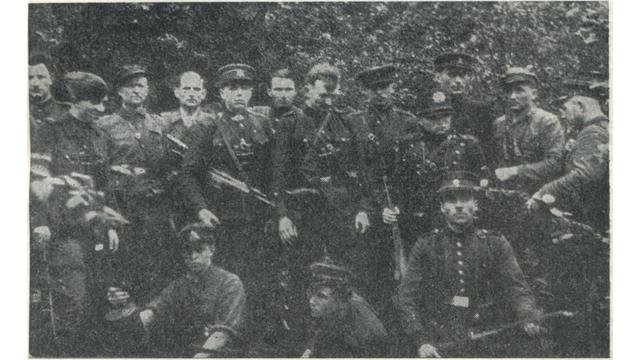
The book divides the partisan war into three periods. The first lasted from mid-1944 to mid-1946, and was fueled by many who wanted to avoid forced conscription into the Soviet Army in the last years of World War II. The resistance managed to control entire areas of the country, but the amnesty granted in 1946 to those who had avoided service in the Soviet Army significantly decreased its ranks. However, in the second period between mid-1946 to early 1949, local partisan units still managed to harass the Soviet Army, kill Soviet collaborators, and resist collectivization of the lands.
After the mass deportation of Lithuanians to Siberia and Central Asia of 1948–49, the resistance lost many non-combatant supporters on whose help it relied. The third phase started in February 1949 with the creation of a national organization, the Union of Lithuanian Freedom Fighters, whose President Jonas Žemaitis (1909–1954), executed in Moscow in 1954, was later posthumously included in the official list of Presidents of Lithuania.

Paradoxically, the unification and the moral support the Union received in the West coincided with the partisans’ acknowledgement that the Western countries would not offer to them any form of military help. This led to the end of the partisan war, and the beginning of the war for its memory.
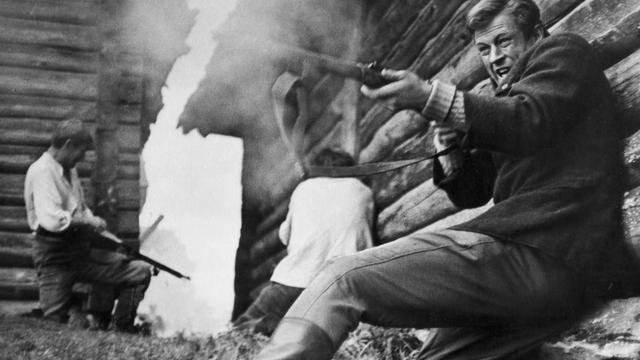
The book details the enormous effort by the Soviet propaganda to depict the partisans as bandits, thieves, and Nazis. It was not totally unsuccessful. Many Lithuanians went to movie theaters in 1965 to watch the film “Nobody Wanted to Die,” directed by Vytautas Žalakevičius (1930–1996). It was a pro-Soviet and anti-partisan movie, but it was technically well-done and depicted the partisan wars in more colors than black and white. In later years, the Soviets regarded it as not propagandistic enough, and efforts by other directors in the same veins were criticized and suppressed. The cruder propaganda depicting the partisans as almost uniformly “Nazis” continued in Russia after the fall of the Soviet Union.
The book also notes that the pro-partisan narratives proposed by the Lithuanian diaspora were never entirely convincing for lack of access to direct sources. Even the efforts by Lithuanian historians after the independence were slow in achieving academically valid results, although there is now a representative group of scholars who have produced valuable works.
The chapter by Aistė Petrauskienė examines the post-1990 efforts to recover and made available to pilgrims and visitors sites connected with the memory of the resistance. However, it criticizes what she sees as an excessive focus on graves and places where the partisans were executed, while how they lived in encampments and sometimes in hidden bunkers is not less interesting than how they died. Also, the book calls for more research on the larger circle of those who never became armed partisans but supported the resistance in many ways.
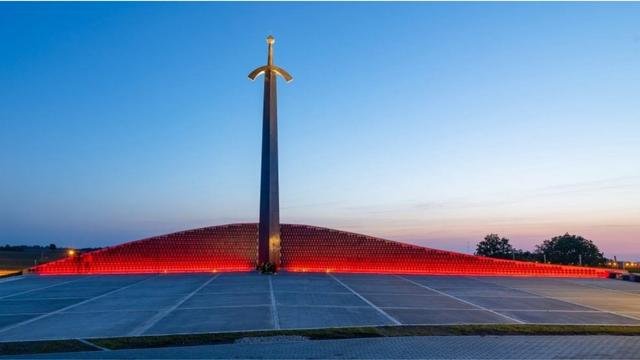
The authors note how the interest for the partisans was less widespread than expected in independent Lithuania, beyond the official celebrations, but was revamped in 2014 by the Russian invasion of Ukrainian territories. The Lithuanian resistance of 1944–1953 was compared both to the parallel resistance in the same years in Ukraine (which was however mostly concentrated in the Western regions, while Lithuanian partisans were present in almost all the national territory) and to the efforts by Ukrainians to defend their territorial integrity in 2014. Lithuanians also noticed the Russian strategy to depict all the anti-Soviet Ukrainian partisans as “Nazis,” which capitalized on the fact that some of the armed anti-Soviet fighters in Ukraine of the late 1940s and the 1950s (but by no means all) had indeed been Nazi collaborators. Extending the accusation to all anti-Soviet partisans in Ukraine was however just as false as it was for Lithuania, not to mention calling “Nazis” the Ukrainians who resisted Russia in 2014.
In fact, as we are all witnessing after the 2022 Russian invasion in Ukraine, in a certain Soviet and Russian narrative “Nazi” simply means an opponent of the Soviet Union, or today of Putin’s Russia. Streikus’ book was written before Russia invaded Ukraine, but its publication in June 2022 makes it timely and even more important. Routledge should be commended for having published such a valuable English-language anthology of works by Lithuanian scholars on the partisan war, although the outrageous price tag of $128 for a 174-page book may unfortunately limit the number of its readers.

Massimo Introvigne (born June 14, 1955 in Rome) is an Italian sociologist of religions. He is the founder and managing director of the Center for Studies on New Religions (CESNUR), an international network of scholars who study new religious movements. Introvigne is the author of some 70 books and more than 100 articles in the field of sociology of religion. He was the main author of the Enciclopedia delle religioni in Italia (Encyclopedia of Religions in Italy). He is a member of the editorial board for the Interdisciplinary Journal of Research on Religion and of the executive board of University of California Press’ Nova Religio. From January 5 to December 31, 2011, he has served as the “Representative on combating racism, xenophobia and discrimination, with a special focus on discrimination against Christians and members of other religions” of the Organization for Security and Co-operation in Europe (OSCE). From 2012 to 2015 he served as chairperson of the Observatory of Religious Liberty, instituted by the Italian Ministry of Foreign Affairs in order to monitor problems of religious liberty on a worldwide scale.