Between the end of the seventeenth century and the third decade of the eighteenth century the possibility that vampires existed was first admitted but finally ruled out by the imperial authorities.
Massimo Introvigne*
*A paper presented at the Occult Convention 2024, organized by the Società dello Zolfo, Parma, September 7, 2024
Article 2 of 5. Read article 1.

The era of the classical vampire in Europe lasted about sixty years, from the Giorgio Grando case in Istria (1672) to the episodes in Medwegya (1731–1732).
An event not without significance for the history of vampirism was the Peace of Passarowitz (1718) between the Austro-Hungarian Empire, the Ottoman Empire, and the Republic of Venice, which assigned parts of Serbia and Wallachia to Austria. Serbian practices concerning alleged vampires being dug up and burned or impaled began to attract the attention of Austrian authorities. In 1725 the first vampire destined for European fame, Peter Plogojowitz, appeared, together with the word “vampir,” in an official report.
The report on Peter Plogojowitz (in Serbian, Petar Blagojević) was written by the imperial provost of the Gradisca district, Fromann, and is in the Vienna State Archives. It was published for the first time on July 21, 1725, in “Das Wienerische Diarium,” reproduced in the same year by Ranft (a theologian whose interest in vampires we discussed in the previous article of this series), and translated, not without embellishments, into the major European languages.
Kisilova is located in present-day Serbia, not in Hungary, as due to the confused political situation of the time many European gazettes reported. We learn from Fromann that “after a subject named Peter Plogojowitz died ten weeks ago in the village of Kisilova and was buried, in this same village within a week, nine people, old and young, also died after suffering an illness that lasted twenty-four hours. And they said publicly, while they were still alive, on their deathbeds, that the aforementioned Plogojowitz, who had died ten weeks earlier, had visited them while they were sleeping, lay on top of them and attacked them.”
The prosecutor’s report continues, “When it comes to these creatures (whom they call vampires) one must find various marks, i.e., the uncorrupted body, skin, hair, beard, and growing nails; and the subjects unanimously decided to open the tomb of Peter Plogojowitz to see if these marks were indeed found on him.”
The prosecutor, “after an examination conducted with the most scrupulous circumspection,” attested that “first of all, I did not smell the faintest odor normally characteristic of the dead.” The body, “with the exception of the nose, which is about to fall off, is completely fresh… Not without wonder I saw fresh blood in his mouth, which according to common observation he had sucked from the people he had killed.”
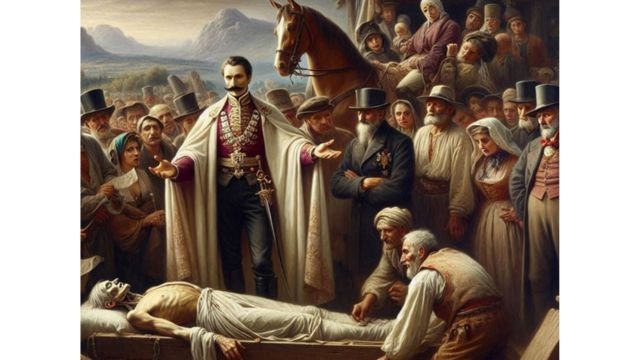
At the sight of the spectacle, the villagers obtain a stake, point it and pierce Plogojowitz’s heart. “Not only does a large amount of blood, completely fresh, come out of the ears and mouth, but other extraordinary signs (which I omit to mention for due respect [the erect penis]) occur,” the prosecutor wrote. “Finally,” Fromann concluded, ”according to their usual practice they burn the body to ashes. Of this I inform the honorable administration, and at the same time I would like to ask, in obedience and humility, that if a mistake has been made in this matter I should not be held responsible for it but the crowd, which was beside itself with fear.”
However, it was the events of Medwegya in 1732 that were the detonator for the great European explosion of interest in vampirism, especially in Germany and France. According to Ranft, “they threw everyone into the greatest wonder. In all gatherings of people of the upper and lower classes there was talk of it. Even the ladies began to discuss this subject (…). At the last Easter fair in Leipzig [1733] one could not enter a bookstore without seeing something there about blood suckers.” The same was happening in Paris, and there was no shortage of echoes in London as well.
Medwegya’s cycle actually consists of two different phases. The first dates back to 1726 (or 1727) when a soldier from the village, Arnold Paole, died. He had recounted that, in the course of his military travels, he had been the victim of a vampire, but that he thought he had freed himself from any consequences of the encounter by eating earth taken from the grave of another undead and rubbing himself with its blood. Despite these precautions, residents of Medwegya began to complain of nightly visits from Arnold Paole twenty to thirty days after his death, and claimed that he had caused four people to die.
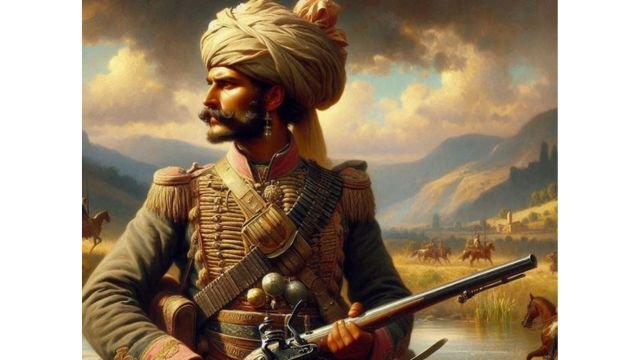
Local authority authorized Paole’s exhumation forty days after death. The characteristic marks were found and blessed stakes were driven into his heart. The deceased Paole let out a cry and a large amount of blood came out of his body, which was burned. For good measure, his four victims were burned as well.
Medwegya 1 held a local character. It was certainly not mentioned in the gazettes of the European capitals. We only know about it because it was reconstructed on the occasion of the second, far more serious cycle of the years 1731–1732.
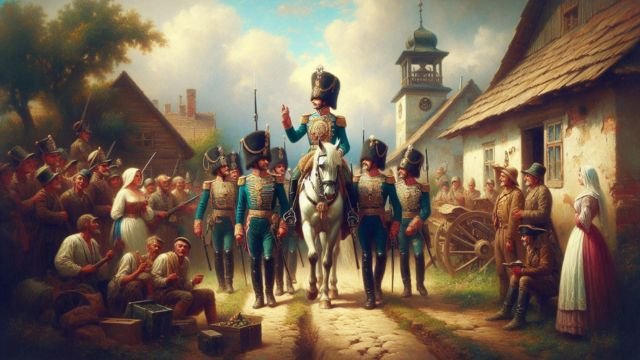
In Medwegya 2 the local gendarmes reported the existence of as many as thirteen vampires. The Austrian administration in Belgrade quickly appointed a medical commission, which arrived in Medwegya on January 7, 1732, led by military surgeon Johann Flückinger. One is amazed at the speed of the Austrian imperial bureaucracy: the commission concluded its on-site investigation in a few days and delivered its report on January 26, 1732. The Flückinger report, entitled “Visum et Repertum,” was published in Nuremberg in the same year 1732. It was reviewed in more than a hundred gazette articles throughout Europe, and the astonished Europeans became familiar with the word “vampire” for the first time.
Flückinger left it to the authorities to draw conclusions, but he claimed to have collected dozens of testimonies from people who said they were attacked by the thirteen vampires who sucked their blood. For all intents and purposes, he had their graves opened, found their uncorrupted bodies and mouths with fresh blood, and had them beheaded by Romanis, believed to be expert vampire hunters.
Even before Medwegya, Austrian legal scholars had questioned whether exhuming corpses and decapitating, impaling, or burning them without a court order was an abuse. In an area where several cases of vampirism had occurred, Olomouc (now in the Czech Republic), the jurist Karl Ferdinand de Schertz published in 1704 his famous “Magia Posthuma,” overall a modest work that has gone down in history mainly because of its title and because it affirms with certainty the existence of vampires.
Reports that vampires roamed the enlightened Austro-Hungarian Empire alarmed Empress Maria Theresa, who entrusted an investigation to her personal physician, Dutchman Gerhard van Swieten. His report was written in French for the Empress in 1755, immediately translated into German, and published in 1768.
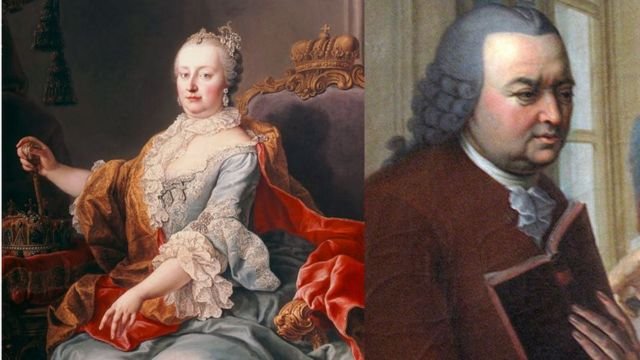
Van Swieten’s paper affirms the Enlightenment’s and skeptical viewpoint: vampires do not exist, the condition of the bodies can be explained by natural causes, and the alleged evidence by hallucinations where ancestral superstitions emerge. The thesis was not new and recalled the one presented under the heading “Vampires” in the forty-sixth volume of the great “Universal-Lexicon,” published between 1732 and 1754 in Leipzig by Johann Heinrich Zedler.
Maria Theresa suspected that the spread of news about vampires was related to the activities in Moravia and neighboring lands of a secret society, the mysterious “Devotees of Christopher and the Crown.” They practiced private forms of exorcism and deliverance from spirits, searched for hidden treasures, and perhaps cultivated esoteric-millenarian beliefs hostile to the government.
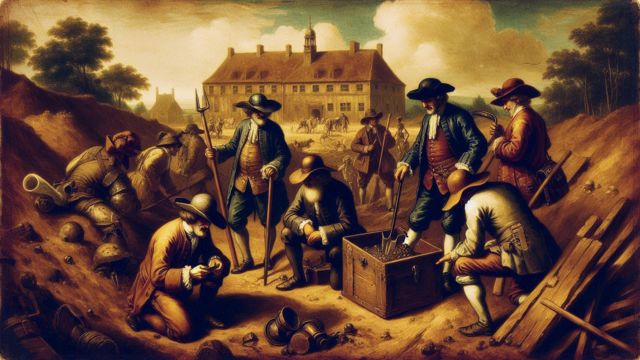
These elusive Devotees had already been banned in an anti-witchcraft letter patent issued in July 1753 by the Empress herself.

Massimo Introvigne (born June 14, 1955 in Rome) is an Italian sociologist of religions. He is the founder and managing director of the Center for Studies on New Religions (CESNUR), an international network of scholars who study new religious movements. Introvigne is the author of some 70 books and more than 100 articles in the field of sociology of religion. He was the main author of the Enciclopedia delle religioni in Italia (Encyclopedia of Religions in Italy). He is a member of the editorial board for the Interdisciplinary Journal of Research on Religion and of the executive board of University of California Press’ Nova Religio. From January 5 to December 31, 2011, he has served as the “Representative on combating racism, xenophobia and discrimination, with a special focus on discrimination against Christians and members of other religions” of the Organization for Security and Co-operation in Europe (OSCE). From 2012 to 2015 he served as chairperson of the Observatory of Religious Liberty, instituted by the Italian Ministry of Foreign Affairs in order to monitor problems of religious liberty on a worldwide scale.