Table of Contents
Xi Jinping’s policy to eradicate poverty looks more like yet another propaganda tool, forcing local officials to play along in delivering the undeliverable.
Jiang Tao
Ever since it was put forward in 2015, President Xi Jinping’s poverty alleviation policy goal of lifting 70 million impoverished households out of poverty by 2020 has been a target for contention. As the deadline is drawing close, authorities on all levels are taking any measures possible to accomplish the “mission impossible” of meeting the standards of impoverished families having sufficient food and clothing – the two “no-worries” – and provided with “three guarantees”: compulsory education, basic medical care, and safe housing. In reality, however, the conditions of impoverished households are not getting any better. Fearing to lose their jobs, some local officials across China are taking matters into their hands in making sure that the policy goals are met by demolishing the homes of the impoverished or making them live with their children. Others are “training” the poor to lie to their superiors to pass inspections.
Bitter Winter interviewed some of those who have been “lifted out of poverty” or help to create the illusion of achievements to learn about the realities of poverty alleviation measures.
Lie or be punished
Around midnight on March 6, the impoverished households in Zhangji village of Xiayi county, located in central China’s Henan Province, were awakened one by one by local officials. The startled villagers were told that upper-level bureaucrats were coming for an inspection the next day, so they must memorize the rules of the “Two No Worries and Three Guarantees” to say the “right things.”
To avoid any problems, the most verbal and “disobedient” villagers were hauled away in a car to a construction site and had people assigned to watch over them, while others were sent away to their relatives’ homes.
A villager in her 80s pleaded with the officials: “I’m old and senile. I don’t know anything; don’t take me away.” But, regardless, poverty assistance personnel forcefully dragged her into a vehicle.
Making sure that that the households know the “right” answers, the officials organized a pre-inspection drill. When asked if she was satisfied with the poverty alleviation policies, one villager answered truthfully, “Welfare is only given to people who have connections in the government; we regular people don’t get anything.” The answer was considered to be wrong, and the woman had to be punished: officials shut down the supermarket run by her son. The family was forced to apologize for her forthrightness, and paid several thousand RMB in bribes to get the matter settled.
Many villagers from impoverished households could not remember the “correct answers,” and were afraid that they might slip during the inspection and cause trouble for their families. To avoid the officials, some left home and wandered around, waiting for the inspection to end. Others were reprimanded: A villager, deemed “uncooperative” during the inspection, later received a warning from his son’s work unit stating if he didn’t cooperate with the government, his son’s teaching credentials would be revoked.
Villagers complained: “How is this poverty alleviation? It’s practically harassment!”
Cheat sheets to pass inspections
A poverty assistance worker from Henan gave Bitter Winter a copy of a form distributed to government personnel that “train” the impoverished to answer poverty alleviation-related questions. The paper lists the questions that might be asked during the inspections and advises on how to answer them correctly. Poverty assistance personnel are asked to write down some answers that would correspond to the real conditions of each household that has been “lifted out of poverty” and make sure that they memorize them.


The form includes the following questions and answers:
No. 11 Q: Is every member of your family covered by the county/town health insurance and the medical insurance for serious health problems?
A: Yes. (If a member of the household is in hospital, he/she should specify how much money the reimbursement covers and make it clear if they have chronic disease card.)
Q: Are you living in your own house?
A: (If the house is their own and is safe, they can answer according to facts. If the house doesn’t belong to them or is not safe, they should explain that their children, nephews, or other relatives provide them with long-term accommodation in their houses for free and take care of them in everyday life.)
Q: How do the village officials do their work?
A: Very well.
Q: Have they offered you any help?
A: Yes.
Q: Are they fair in handing out things?
A: 1. Very fair. 2. Yes, they’re fair.
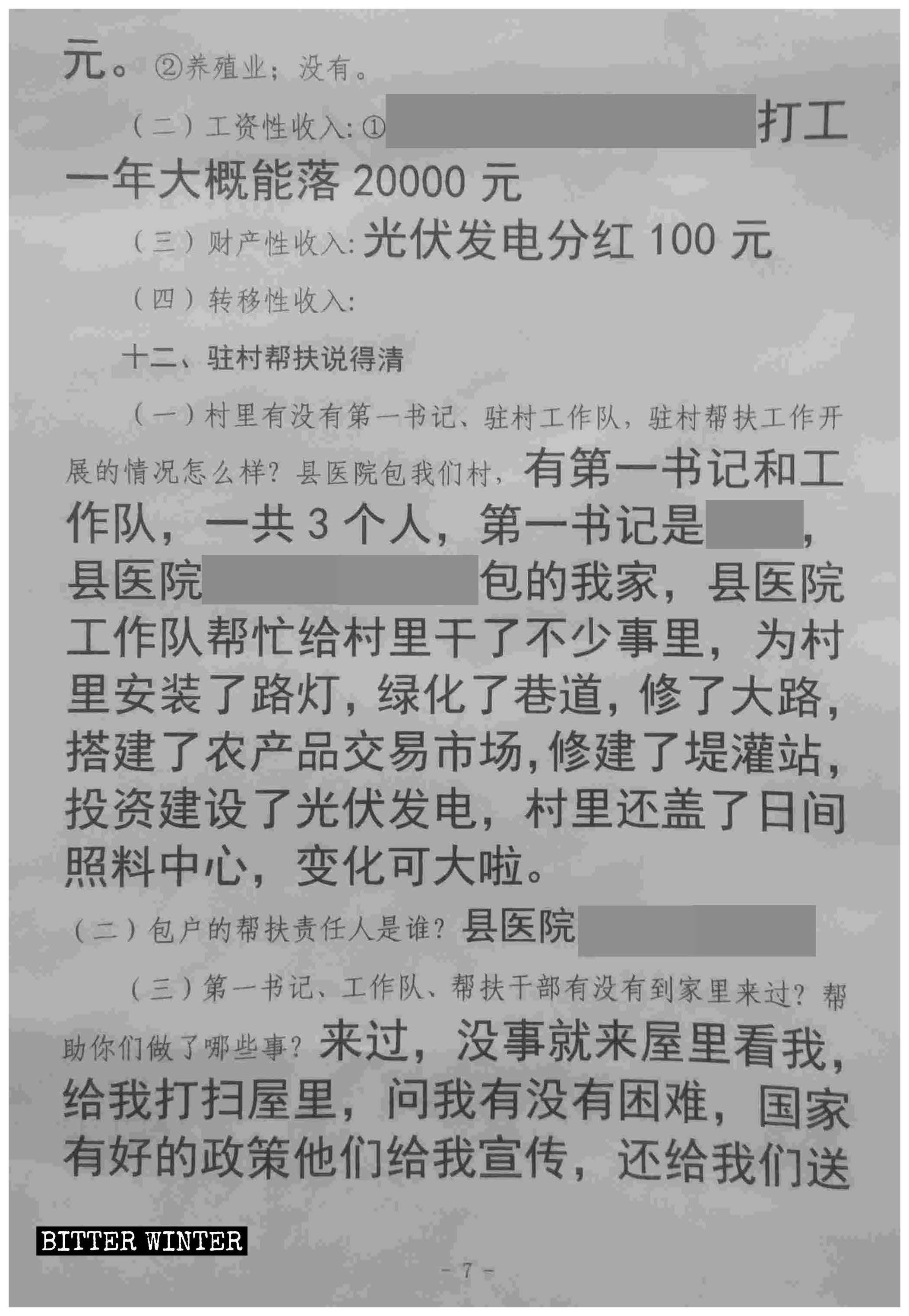
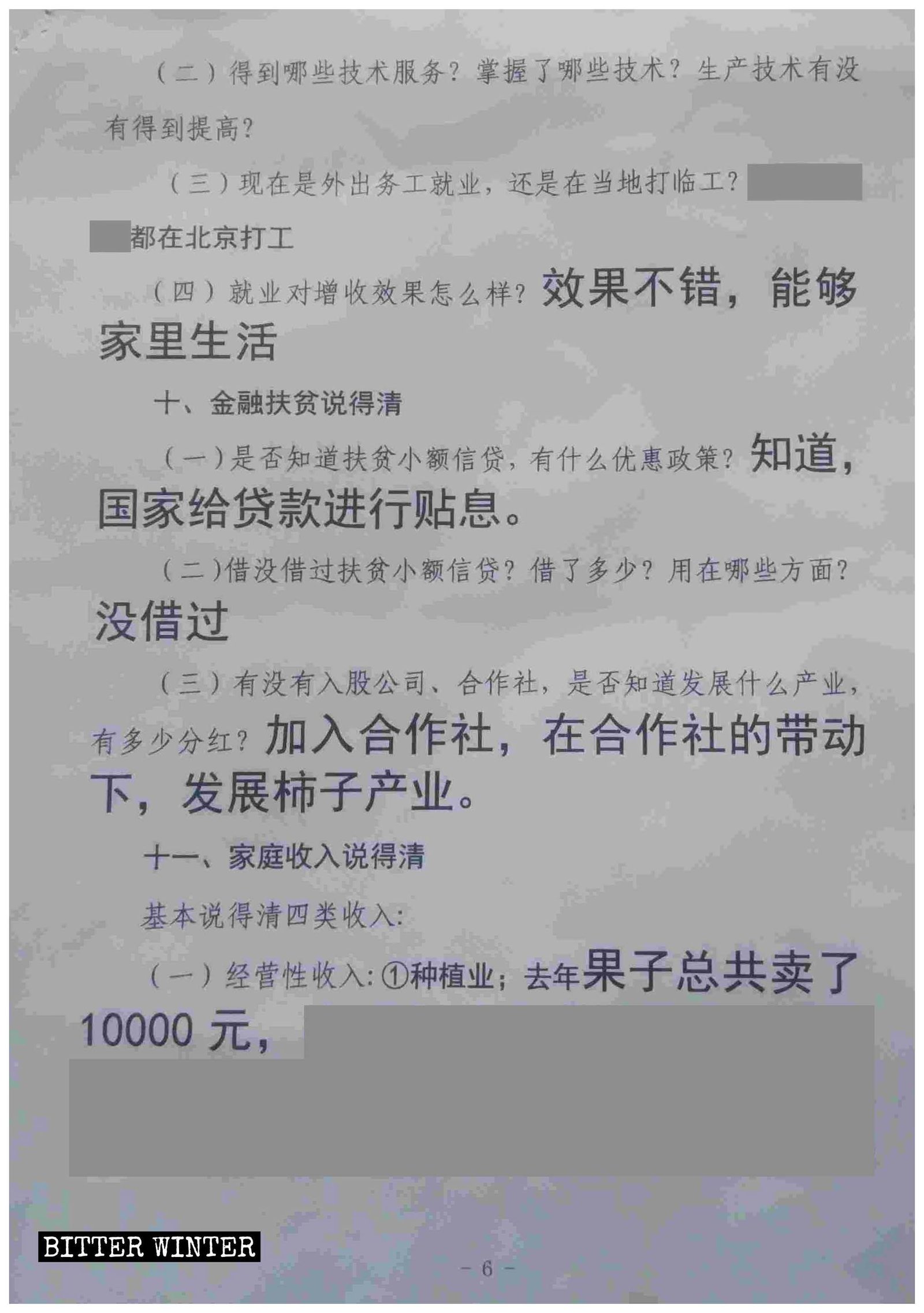
In a cheat sheet, prepared by a poverty alleviation worker and given to an impoverished household in the northern province of Shanxi, the “correct” answers corresponding to their real-life situation were given. The family was also required to memorize them. To make sure that the elderly in the household could read the answers, they were written in enlarged characters.
-

- A copy of a cheat sheet for “correct answers” during inspections, received by a household “lifted out of poverty” in Shanxi Province.
-

- A copy of a cheat sheet for “correct answers” during inspections, received by a household “lifted out of poverty” in Shanxi Province.

-

- A copy of a cheat sheet for “correct answers” during inspections, received by a household “lifted out of poverty” in Shanxi Province.

-

- A copy of a cheat sheet for “correct answers” during inspections, received by a household “lifted out of poverty” in Shanxi Province.
-

- A copy of a cheat sheet for “correct answers” during inspections, received by a household “lifted out of poverty” in Shanxi Province.

-

- A copy of a cheat sheet for “correct answers” during inspections, received by a household “lifted out of poverty” in Shanxi Province.

-

- A copy of a cheat sheet for “correct answers” during inspections, received by a household “lifted out of poverty” in Shanxi Province.

-

- A copy of a cheat sheet for “correct answers” during inspections, received by a household “lifted out of poverty” in Shanxi Province.

Here are some examples from the cheat sheet:
Q: Do you have enough food? Does your family have grains in storage?
A: Yes, I have enough food. Now it’s very convenient. I can buy the food I want at any time.
Q: How often do you have meat or eggs?
A: Almost every day. I can have meat and eggs whenever I want.
Q: After the implementation of medical care and health insurance policies, has the economic burden for treating health problems been lightened? Has it become more convenient or is it just as before?
A: The burden is much lighter. For minor health problems, we can get treated in the village, and for some illness, once we call the doctor, they’ll come and treat us at our home.
Q: Have the Party secretary, members of poverty alleviation work group, and poverty assistance officials come to your home? What did they do for you?
A: Yes, they visit me whenever they have time. They cleaned my room, asked if I have some difficulties in life. When the state promotes some good policies, they’ll explain the policies to me, and they have brought us some consolation gifts, such as a trash can, a heating pad, and a thick cotton curtain for winter.
Poverty alleviation “alleviates” the impoverished of their residences
Sometimes, it is not enough to coach the impoverished to pass the dreaded inspections. More drastic measures are needed to show that poverty alleviation goals have been achieved. To please the leadership, Zhaizhuang village officials in Huicun town, under the jurisdiction of Henan’s Yongcheng city, ordered several impoverished households in March to tear down mud houses within 20 days or face forceful demolition.
Government officials announced via loudspeakers: “We’re achieving an overall goal of becoming ‘moderately prosperous’ [xiao kang小康] in 2020, how can we allow these old houses to remain? This is an order from the Central Committee to the local level. Refusing to tear down the houses amounts to opposing the government! All mud housing in Yongcheng city has been torn down.”
A distressed villager in his 60s said, “Even if I sell off all of my family’s sheep and lambs, I won’t have enough money to build a new house, not even half of it. The government is having houses torn down without offering any subsidies. Poverty alleviation! Poverty alleviation! The more they alleviate us, the poorer we get!”
In the end, the man chose to tear down his mud house himself. “I can at least preserve my roof tiles and reduce some of my losses,” he lamented.
Two elderly individuals in Yucheng county were made to move out of the portable dwelling they lived in. With nowhere to go, the couple had no choice but to sleep in makeshift beds on the streets behind the village.
Classes disrupted, doctors taken away from work
In true Communist spirit, everyone in the community is involved in the poverty alleviation battle. Waiting for an inspection, the teachers of a school in Zhumadian city were wracking their brains while trying to come up with ways to demonstrate that the 9-year compulsory education – one of the three guarantees for the impoverished households – has been implemented successfully. Finally, they were ordered to make all 16-year-old or younger drop-outs to return to school. The impoverished students were also trained on how to answer the questions by the visiting officials correctly. All this to pass the inspection; according to one of the school’s teachers, those students were sent home after the officials went away.
“Right now, it’s fine for teachers not to do their real jobs properly, but they have to be available on call to complete their ‘poverty alleviation’ assignments – otherwise they will face pay cut or dismissal,” another teacher at the school explained. “A phone rings in the middle of class to inform about an inspection, and teachers have to rush off to give people from impoverished households ideological lessons, teaching them how to praise the Party and Xi Jinping, and say how they have benefited from the poverty alleviation policies. If anyone answers wrong, they [the teachers] will be dismissed.”
Other employees that are paid by the government, like doctors, are also distracted from their daily work to take part in the poverty alleviation charade. The Party committee of a village in Yucheng county appointed a local doctor to coach for inspections 100 impoverished households. Every day, he had to go to their homes and teach them how to reply to the higher-ups. The doctor was threatened to have his license revoked if he refused to oblige.
Another doctor complained that he has to drop anything he does and leave his patients whenever the phone rings ordering him to visit an impoverished household and get them ready for inspections. “I’m totally swamped,” he said.
Xi Jinping’s politically-charged campaign to eradicate extreme poverty by 2020 is raising concerns in China and abroad. “Local leaders are taking it extremely seriously, almost in a panicky way. Part of the problem is that they don’t know really what to do, so they’re kind of grasping at different solutions,” said John Donaldson, a poverty expert and associate professor at Singapore Management University. “They’re throwing everything at it.”
Experts fear that the officials will just announce that poverty has been eradicated, regardless of the reality, to avoid embarrassing the president.

Uses a pseudonym for security reasons.