Taiwan still experiences significant problems with the quality and freedom of the media, as confirmed by the case of Tai Ji Men.
by Willy Fautré*
*Introduction to the second part of the webinar “The Media Impact on FoRB and the Tai Ji Men Case,” co-organized by CESNUR and Human Rights Without Frontiers on May 8, 2025, after World Press Freedom Day (May 3).

In early May, the International Federation of Journalists launched its 23rd annual South Asia Press Freedom Report, entitled “Frontline Democracy: Media Amid Political Churn.”
The report was produced with support from UNESCO, Norsk Journalistlag, the European Commission, and the U.S. National Endowment for Democracy. It covered the situation of press freedom in Afghanistan, Bangladesh, Bhutan, India, the Maldives, Nepal, Pakistan, and Sri Lanka.
The Report recorded a total of 250 media rights violations in the last 12 months, including the targeted killings of 20 journalists and media workers. This is a dramatic increase from the eight deaths reported in the 2023-24 period. Journalists across the region faced attacks, arrests, and detention, with at least 70 media professionals jailed or detained, and over 190 assaulted, threatened, or harassed, often by law enforcement. At the time of publication, at least 19 journalists remain behind bars.
Concerning Taiwan, the International Federation of Journalists noted that last year, reporters from the Taiwanese Central News Agency (CNA) were denied interview permits to the World Health Assembly (WHA), with officials reportedly asking them to provide a “Chinese passport.” The International Federation of Journalists (IFJ) then joined its affiliate, the Association of Taiwan Journalists (ATJ), calling on the United Nations and the World Health Organization to uphold press freedom and allow access to journalists and media workers regardless of nationality.
The Committee to Protect Journalists (CPJ) also supported the Taiwanese media, which was barred from access to the World Health Assembly.
On 1 March of this year, Article 19 in London published a press release about the threat in the Indo-Pacific Region represented by China’s digital authoritarian cybersecurity model. Their answer was, “To resist China’s cyber norms, we must support Taiwan.”
In its recent annual report 2025, Reporters Without Borders ranked Taiwan 27 out of 180 states and territories, the last three of the list being the People’s Republic of China, North Korea, and Eritrea.

In their report, Taiwan was described as a liberal democracy and the world’s 21st largest economy that “generally respects the principles of media freedom. However, its journalists still suffer from a very polarised media environment dominated by sensationalism and the pursuit of profit.”
Sensationalism is a key word. On the one hand, it is a fact that journalists and media outlets are victims of all sorts of political repression, as the statistics show, and they can rightly complain about their increasingly shrinking space of action due to the intrusion of commercial actors and private interests. On the other hand, media outlets and journalists can also be servants of sensationalism because sensationalism sells. When the impact of their work is based on a thorough investigation and unbiased analysis, it is a scoop and it is laudable. But when the facts are distorted, manipulated, or even fabricated, just to sell, it is a shame because they disfigure the nobility of their profession. And not only that. They cause a lot of damage in many people’s lives, protecting their impunity under the umbrella of their freedom of expression.
Unfortunately, Tai Ji Men and its disciples (dizi) have much experience in this regard. In their personal and professional lives, dizi have been victims of derogatory labels and misrepresentations, misused just to sell. Several journalists and media outlets have their share of responsibility in the stigmatization, hostility, intolerance, and damage they have suffered. Biased and false accusations, fake news, and sometimes even gross lies have been thrown to the public, without investigation or fact-checking, if not on purpose, just to sell.
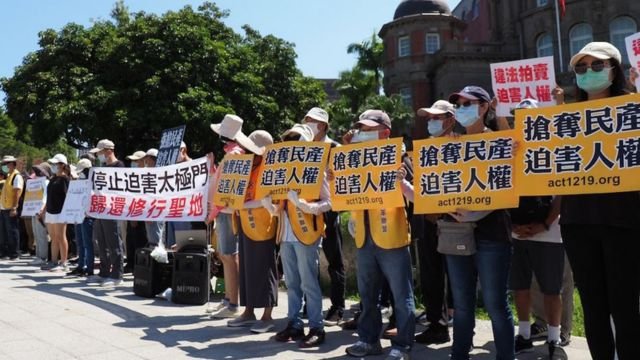
With their experience, Tai Ji Men dizi could and should sanitize the media with the help of other victims—not censor but sanitize, with the help of Taiwanese media regulators and watchdogs, using the profession’s ethical rules. If they do so, their suffering will not have been in vain.

Willy Fautré, former chargé de mission at the Cabinet of the Belgian Ministry of Education and at the Belgian Parliament. He is the director of Human Rights Without Frontiers, an NGO based in Brussels that he founded in 1988. His organization defends human rights in general but also the rights of persons belonging to historical religions, non-traditional and new religious movements. It is apolitical and independent from any religion.
He has carried out fact-finding missions on human rights and religious freedom in more than 25 countries He is a lecturer in universities in the field of religious freedom and human rights. He has published many articles in university journals about relations between state and religions. He organizes conferences at the European Parliament, including on freedom of religion or belief in China. For years, he has developed religious freedom advocacy in European institutions, at the OSCE and at the UN.