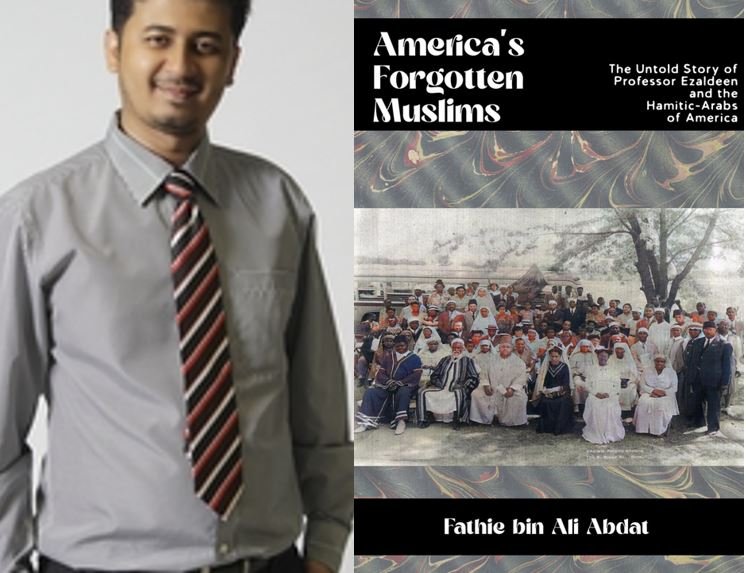
A book by Fathie bin Ali Abdat tells the fascinating story of Professor Muhammed Ezaldeen and his unique American Islamic religious movement.
by Massimo Introvigne
We live in a time when we no longer need to browse catalogs, as Amazon suggests books we might be interested in. If Amazon misses a valuable recommendation, someone will promote books of interest on Facebook.
However, I would still miss relevant books without brave colleagues reviewing them. Thanks to a review by Australian scholar Carole Cusack in the “Journal of the Study of New Religions,” I discovered a book about the Hamitic-Arabs of America, a group I knew almost nothing about.
Throughout American Islamic history, some voices are marginalized—brilliant, radical, and frequently overlooked. Fathie bin Ali Abdat’s book, “America’s Forgotten Muslims: The Untold Story of Professor Ezaldeen and the Hamitic-Arabs of America” (Chicago: Magribine Press, 2024) effectively restores one of these voices to prominence.
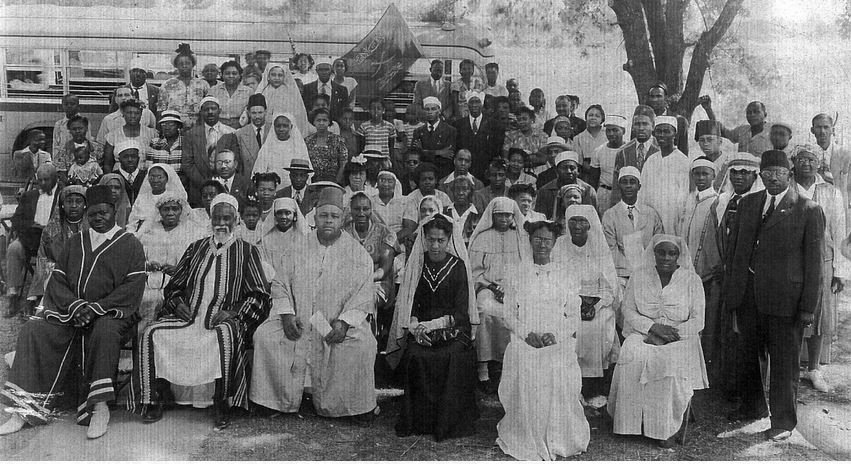
Professor Muhammed Ezaldeen, originally James Lomax-Bey, was a unique religious leader. In the late 1920s, frustrated with the Moorish Science Temple of America, he left to pursue his own path. After studying extensively in Egypt and Turkey, he returned to the U.S. with a new understanding of Islam that combined African heritage, anti-colonial ideas, and spiritual independence.
In Egypt, besides working as a tour guide for foreign tourists, Ezaldeen attended the prestigious Al-Azhar University, which provided him with a knowledge of mainstream Islam that was unmatched among American Black Muslim leaders.
His teachings highlighted the African-American identity as “Hamitic-Arabs,” seeking to restore historical dignity from racialized readings of scripture and history. In this process, Ezaldeen established a foundation for a movement that was both spiritual and political—one that questioned mainstream Islam and American racial hierarchies.
“Islam is not the property of any one people—it is the key to self-determination,” Ezaldeen stated in a sermon (217). In 1938, he established the Addeynu Allahe-Universal Arabic Association, Inc. (AA-UAA); offshoots still exist today.
Ezaldeen’s followers established two rural communes—in Ashford, New York, and Elm, New Jersey—that were practical experiments for his ideas. These self-governing communities concentrated on farming, Islamic education, and independence. Children studied Arabic, and adults engaged in Quranic exegesis and “Hamitic” history.
Ezaldeen believed that faith should manifest in daily life, not just in prayer but also through food, governance, and language. Abdat characterized these communes as “not escape hatches but blueprints for new civilizational possibilities” (p. 308).
The FBI monitored Ezaldeen closely, labeling his teachings as “subversive” and his communes as “potential radical cells.” Japanese agents in pre-war America targeted Ezaldeen’s followers with propaganda, trying to influence them in international conflicts. They temporarily succeeded in convincing the Hamitic-Arabs that the Japanese shared a similar racial background and would win the war, which would lead to liberation for African Americans.
Ezaldeen engaged with more than just the Japanese. Indian Ahmadi missionaries sought to correct theological views, while white supremacist groups issued threats of violence.
Yet, his followers genuinely believed the professor might lead them to a better spiritual and material life. One FBI memo noted: “Ezaldeen’s ideology is potent because it links theology with racial grievance. His followers are loyal, disciplined, and reject materialist values” (391).
“America’s Forgotten Muslims” is more than a biography—it offers a new perspective on American religious history. Abdat compares Ezaldeen with well-known figures like Noble Drew Ali and Elijah Muhammad, but emphasizes that Ezaldeen’s subtle rural revolution provided a distinct spiritual answer to oppression.
Scholars interested in Black Islam and diaspora studies will find this work valuable. It contributes to expanding research on Black Islam, transnational religious identity, and grassroots theological resistance.
From X.
Abdat’s writing combines investigative journalism with storytelling history. He shares rare documents, sermons, and interviews with remaining followers. His style is vivid and engaging, featuring humor, tension, and powerful moments of emotion. “Reading Ezaldeen’s teachings is like watching a tightrope walker navigate politics, faith, and race with nothing but scripture and charisma,” writes Abdat (432).
In an era when spiritual movements are frequently condensed into headlines or hashtags, “America’s Forgotten Muslims” provides depth, nuance, and respect. Ezaldeen’s story—and that of the Hamitic-Arabs—is more than just history; it urges us to reconsider what it truly means to create faith-based communities amid marginalization.
This book doesn’t simply remember—it restores.

Massimo Introvigne (born June 14, 1955 in Rome) is an Italian sociologist of religions. He is the founder and managing director of the Center for Studies on New Religions (CESNUR), an international network of scholars who study new religious movements. Introvigne is the author of some 70 books and more than 100 articles in the field of sociology of religion. He was the main author of the Enciclopedia delle religioni in Italia (Encyclopedia of Religions in Italy). He is a member of the editorial board for the Interdisciplinary Journal of Research on Religion and of the executive board of University of California Press’ Nova Religio. From January 5 to December 31, 2011, he has served as the “Representative on combating racism, xenophobia and discrimination, with a special focus on discrimination against Christians and members of other religions” of the Organization for Security and Co-operation in Europe (OSCE). From 2012 to 2015 he served as chairperson of the Observatory of Religious Liberty, instituted by the Italian Ministry of Foreign Affairs in order to monitor problems of religious liberty on a worldwide scale.