A new book edited by Michele Olzi explores the Internet’s invented religions and asks whether they are here to stay.
by Tancredi Marrone
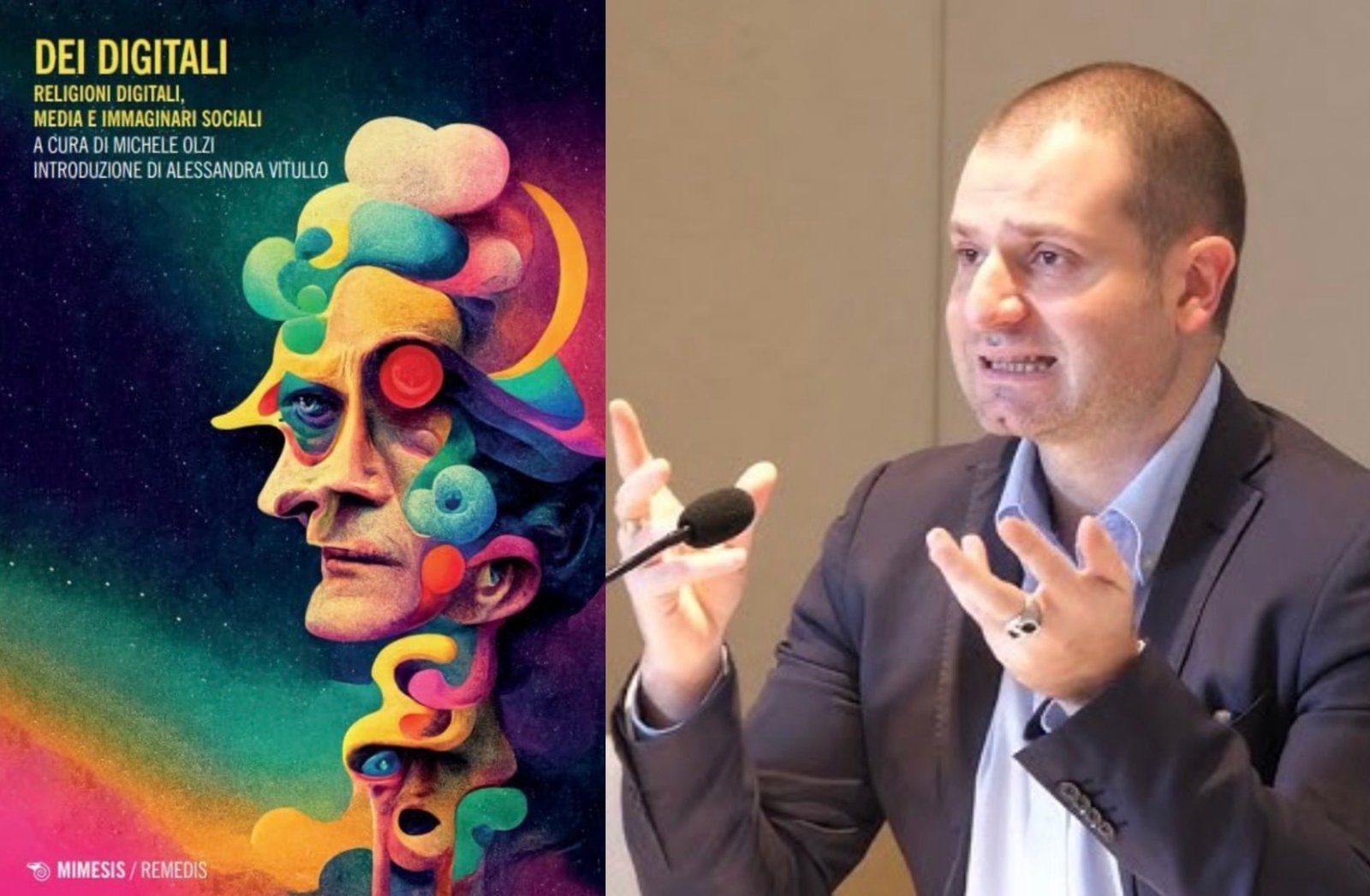
The study of religion within the context of digitalization and networked spaces has become both unavoidable and essential. Information technology permeates our lives so thoroughly that it cannot be separated from daily experience; it is often integral to it. “Dei Digitali, Religioni Digitali, Media e Immaginari Sociali”—“Digital Gods, Digital Religions, Media and the Social Imaginarium” (Milan and Udine: Mimesis, 2025)—edited by Michele Olzi, guides the reader toward a comprehensive understanding of this expanding field of research. Each chapter builds on the previous one, offering the attentive reader the tools to recognize the methodological approaches introduced in the opening contribution. As this is an Italian volume, I have translated the titles of the papers when necessary; the first contribution, however, was originally written in English and later translated into Italian, so I retain its original title.
After an introduction by Alessandra Vitullo, the opening essay, “Contextualizing Current Digital Religion Research on Emerging Technologies,” by Heidi A. Campbell and Giulia Evolvi, maps the various intersections between religion and technology. It introduces concepts such as networked religion and the third space, highlighting the diversity and fluidity of research models used to analyze religion in the digital age. The chapter also examines how platforms shape new religious phenomena, how digital technologies become active components of ritualization, and how elements of transhumanism and virtual reality contribute to forms of implicit religion. It further explores how digital spaces and online groups challenge traditional notions of authority, identity, and community.
In the chapter titled “Digital Religions for Digital Societies: From Ecunet to Shrimp Jesus,” Alberto Ghio and Stefania Palmisano build on these foundations by tracing five waves in the development of digital religions. They show how the relationship between religion and information technology has shifted from something peripheral and confined to IT environments to something deeply intertwined with offline life. As online communication became widespread among religious groups, evolving technologies generated new digital spaces that reshaped identity, authority, and community within religious movements. Their analysis underscores how religious expression adapts—sometimes in counterintuitive ways—to technological change, offering researchers a wealth of new contexts to explore.
Michele Olzi, in his chapter “Videophanies: On the Symbolic, Technological, and Gaming Connection Between Religion and Videogames,” approaches digital environments through the analytical lens of hierophany, treating them as potential sites for manifestations of the sacred that cannot be conveyed through conventional means. Drawing on Rachel Wagner’s theories, he examines video games as worlds in which players suspend the ordinary secular order and enter alternative realities—much like the creation of sacred space. Through avatars and immersive environments such as Second Life or World of Warcraft, users explore alternate identities and realities, stepping outside the everydayness of offline life. In this pursuit of other worlds, the sacred dimension of hierophany emerges through digital technologies.

Alberta Giorgi, in her chapter on online religious feminisms, shows how marginalized groups—particularly those navigating the intersection of feminism and religion—use social media and digital communication platforms to articulate their voices. Digital technologies reshape authority, community, and identity, enabling conservative evangelical or Muslim women, for example, to express feminist concerns or challenge patriarchal structures within their traditions. Debates spread across groups as sympathizers engage with differing ideologies. Influencers gain prominence beyond their offline circles, especially on YouTube, while podcasts create intimacy and emotional resonance through sound. Giorgi highlights how sensory engagement becomes central to digital activism.
Nicola Pannofino, in “This Video Will Find You: The Techno-Mysticism of the Internet and the New Forms of Channelling on YouTube,” analyzes how the phenomenon of channeling—receiving messages from the spirit world—has adapted to digital platforms. Video titles are crafted to address viewers directly, creating the impression of personalized revelation. The messages promise insight precisely when the viewer is “ready” to receive them, and YouTube’s algorithm becomes a mechanism for delivering meaning associated with higher powers.
Marco Castagnetto’s chapter, “The Artificial Guide for Autohermeticists: Artificial Esotericism Between Hyperstition and the Artificial Turn,” explores new movements that blend digital and magical practices. He reconstructs philosophies rooted in artistic experimentation and reality-control techniques based on belief and visualization. Practices such as reality-shifting aim to move toward an idealized reality, echoing the sacred spaces of virtual worlds. These techniques, deeply connected to esoteric traditions and digital technologies, have influenced movements ranging from transhumanism to neo-technomagic and techno-paganism, sacralizing virtual reality. Technology thus becomes an extension of the occultist’s capacity to effect change.
In “Literary Imaginarium and Religious Imaginarium: (Re)inventing the Religious Landscape Through Weird and New Weird Paraliterature,” Marco Mutti shifts the focus away from the strictly digital while remaining within the realm of alternative worlds. He examines how religion emerges from literary imagination, tracing its roots to countercultural movements and showing how such imaginaries evolve into religious movements or cults depending on participants’ inclinations. Examples include Dudeism, inspired by the film “The Big Lebowski,” and the Typhonian Order of the Ordo Templi Orientis, which draws heavily on Lovecraftian literature. These imaginary worlds fill emotional or existential gaps for followers, even when they do not constitute “religion” in conventional terms. Mutti also discusses conspiracy movements inspired by “The X-Files” and engagements with alternate histories, all of which create parallel worlds for exploration and integration.

The final chapter, Marco Maculotti’s “The Devil in the Walls: Conspiracies and Satanism in Cinema from Polanski to the Nineties,” presents a series of imaginaries shaped by cinematic symbolism. Satanism, occultism, and conspiracy dominate the films he analyzes, featuring directors such as Polanski, Yuzna, and Kubrick. Characters in these narratives experience profound unease, slipping into madness and isolation, often culminating in bleak revelations.
Maculotti also draws parallels with Italian horror cinema of the same period, referencing cult directors such as Dario Argento, Mario Bava, Aldo Lado, and Francesco Barilli.
I consider this volume both enjoyable and informative. Although its focus is not limited to digital technologies, it offers valuable insights for specialists in folklore, anthropology, and history alike. I do feel that the transition from strongly digital topics to the broader social imaginarium could have been smoother, though this does not diminish the value of the collection. Readers who appreciate the significance of non-material spaces—as illustrated in the early chapters—and who are open to dreamscapes and popular narratives will readily perceive the connections between these mental spaces and virtual reality.

Tancredi Marrone is a researcher in Religious Studies who works with anthropological methods. His expertise includes esotericism, psychedelics, altered states of consciousness, and their expression in cinema, literature, painting, and music. He also organizes workshops and conferences on esotericism, creating immersive environments that bring together rigorous scholarship and experiential depth.