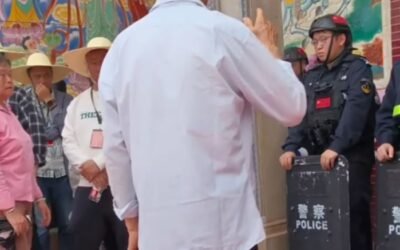
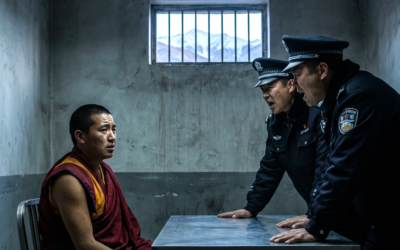
Legendary for his sense of justice, the divinized Medieval magistrate is worshiped by Chinese who cry for the regime’s injustice. The CCP is not amused.
by Wang Yichi
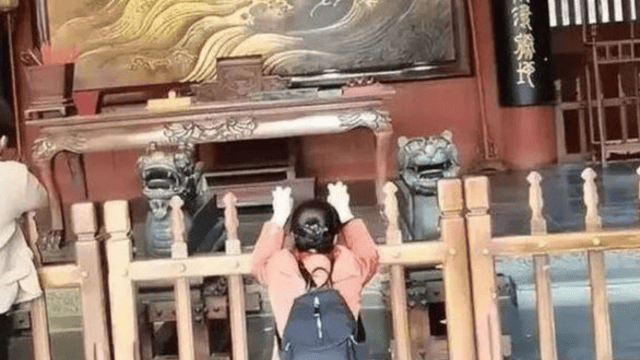
These days, Chinese pray and cry in front of statues and memories of Bao Zheng. This is, after all, not surprising. Bao was famous for his legendary sense of justice, and Xi Jinping and his regime will be remembered in history for their equally legendary practice of injustice. This is why the Chinese Communist Party (CCP) is afraid of Bao Zheng.
What happened this month is that a video of a woman praying and crying desperately in front of the Kaifeng Mansion in Kaifeng, Henan, where Bao once administered justice, was filmed by a tourist. It came out that she was one of many “petitioners” asking in vain for redress of injustices perpetrated against them. The woman had won a court case in the Changtu County Court of Liaoning Province but the decision in her favor was never enforced under various pretexts. The video went viral and other victims of administrative and legal injustices started visiting temples and other sites commemorating the divinized Bao Zheng, where they suddenly erupted in tears. The “petitioners” are part of a large movement in China, where thousands present their petitions for redress and are often repressed and beaten by the police.
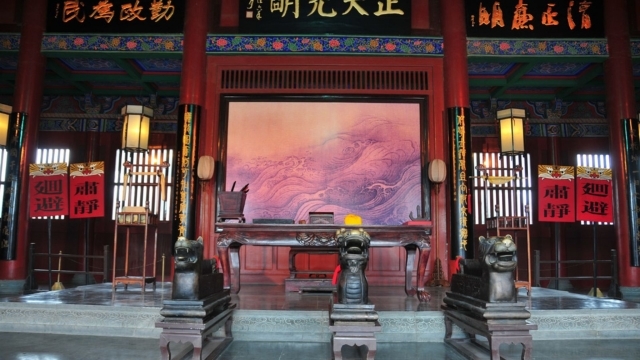
Bao Zheng is an appropriate patron saint for them. He was born in 999 and died in 1062. A magistrate during the Song Dynasty, he was so incorruptible that he prosecuted the uncle of the Emperor’s favorite concubine and several powerful aristocrats. He often ruled in favor of peasants against their landlords.
After his death, Bao was venerated as an incarnation of Wenquxing (文曲星), the god presiding over examinations and literary pursuits. He is a favorite character in Chinese operas.

There are two main centers for the worship of Bao Zheng. One is in Kaifeng, where he hold court and where the Kaifeng Mansion and a Bao Gong (“Lord Bao”) Temple are located. The other is the Hefei Bao Gong Park in Hefei, Anhui, where Bao was born and is buried. Rumors circulated on social media and several media outlets that after the crying woman video the authorities had closed the access to the Bao Gong Temple in Kaifeng under the pretext of renovation works and a statue of Bao had been removed. Netizen lampooned the CCP and even published poems on social media comparing Bao Zheng’s justice with present days’ injustice.
However, it turned out that the information was not correct. Authorities in Kaifeng insist that the Bao Gong Temple and the Kaifeng Mansion have not been closed. Local citizens confirmed to “Bitter Winter” that they are accessible, although both plainclothes and uniformed police officers keep the area under surveillance and identify those who pray loudly or cry. Folk devotions are generally tolerated in China, but not when they become connected with popular protest.

What in fact happened is that the Hefei Bao Gong Park in Hefei, another popular Bao Gong pilgrimage site, was closed “for renovation.” The two stories got confused on social media, but the whole sequence of events confirms that the CCP is afraid of Bao Gong. CCP scholars note that it is unclear whether Bao ever existed. This is perhaps less important than his folk career as a powerful symbol of justice, something that is sadly missing in Xi Jinping’s China.

Uses a pseudonym for security reasons.