Decades ago, Kuomintang lost a great occasion to promote real democracy and true justice, casting its dark shadow on the future. The Tai Ji men case shows it all too well.
by Marco Respinti*
*Text of a video prepared for the 77th anniversary of the 228 Incident in Taiwan.

Everyone knows Superman, including those who are not familiar with comics or even dislike them. Superman is not a super-man. It appears as such to human beings, since some peculiar conditions grant him wondrous abilities. He comes from planet Krypton and his name is Kal-El. His rather tacky costume is not an eccentric outfit, but the armor of the knights of his world, consecrated to good and wisdom. The emblem on his chest is not the initial “S” of his earthly name, but the crest of the House of El and means “hope.”
His father, Jor-El, a member of the governing body of Krypton, was the first to realize that the planet was doomed. Ridiculed by others, to pass down Krypton’s civilization, he sent his new-born son, Kal-El, to Earth. Later, Kal-El confronted his most deadly enemy, General Zod. Zod chased Superman, dreaming of a new future for the remnant of Krypton. He seems to be on a mission similar to Superman’s, but indeed he is not. While Kal-El wishes to uplift terrestrials through the wisdom of Krypton into a pacific coexistence of the two races, Zod aims at re-populating the Earth after a genocide of human beings.
When in 1945 it extended its rule to Taiwan, ending 50 years of Japanese occupation of the island, General Chiang Kai-shek (1887–1975) rapidly gave the impression to move along the line of General Zod: imposing his “good” on others through death.
Visiting the “National 228 Memorial Museum” in Taipei, Taiwan, the first of many impressions I had, and the most persisting, was the sense of deception that swamped the Taiwanese. They suffered horror and terror—but most striking was the rape of their innocence. They believed that, after a long harsh foreign rule, others could come and bring peace. They trusted them. They welcomed them. And they were massacred. In the Museum, this feeling is palpable.
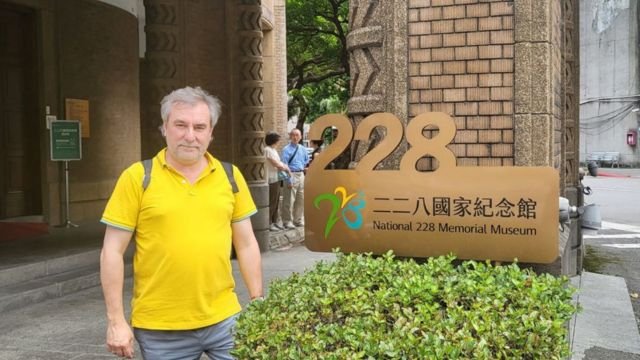
My reference to Superman is not whimsical. Often popular culture serves as a cautionary tale for real life. The 228 massacre revealed the worse aspect of a regime that soon engaged in the White Terror and kept the martial law in force until 1987. The deriving evils were immeasurable. All the good things that could have come from proposing a serious democratic alternative to yet another Communist nightmare, this time in Mainland China, were canceled. The Kuomintang’s rule in Taiwan lost a great occasion that irreparably stained its reputation and even projected its black shadow on the future.
The stigma of corruption and fraud, that were characteristic of the Kuomintang rule, and indeed ignited the dissatisfaction that led to the 228 incident, continued after the end of the martial law and the nationalist government. A number of bureaucrats and some branches of the democratic government of Taiwan did not learn their lessons. This invalidated a transitional justice that was still too much transitional and not enough justice, especially for some groups of law-abiding, pacific citizens of the Republic of China (Taiwan).
A serious case in point is that of Tai Ji Men. This group of Taiwanese citizens are only guilty of one thing, and have one request only. Tai Ji Men was regarded as guilty of not having supported the Kuomintang, when in 1996 that party won the presidential elections, while the movement, as many other spiritual or religious groups in Taiwan and elsewhere, was in fact not involved in politics. Their request is to see their sorrow ending, the wrongdoings they suffered finishing, truth triumphing, and justice winning.

A unique man from another world, with an all-loving father in the skies and another in Kansas, living in disguise until he was 33, then serving and saving mankind with a red cape on his shoulders, destined to die and be born again, Superman has a lot to tell us here. He has been correctly described as a Jesus-like figure. All what is fundamental, both in reality and imagination, is in fact religious or has religious roots, which can be recognized and affirmed only if freedom of religion prevails.
The good name of Tai Ji Men will be cleared of all lies the day when the true nature of its case will be fully recognized as a blatant violation of the most basic right of all, religious liberty, curtailed by the rudest of all wrongs, ideology.
When Tai Ji Men finally wins in Taiwan, it will benefit all groups and individuals in the Republic of China and potentially elsewhere. That day, the long shadow of the 228 incident, which contributed to fueling the machine of corruption that devastated Tai Ji Men and many other Taiwanese, will be finally dissolved.

Marco Respinti is an Italian professional journalist, member of the International Federation of Journalists (IFJ), author, translator, and lecturer. He has contributed and contributes to several journals and magazines both in print and online, both in Italy and abroad. Author of books and chapter in books, he has translated and/or edited works by, among others, Edmund Burke, Charles Dickens, T.S. Eliot, Russell Kirk, J.R.R. Tolkien, Régine Pernoud and Gustave Thibon. A Senior fellow at the Russell Kirk Center for Cultural Renewal (a non-partisan, non-profit U.S. educational organization based in Mecosta, Michigan), he is also a founding member as well as a member of the Advisory Council of the Center for European Renewal (a non-profit, non-partisan pan-European educational organization based in The Hague, The Netherlands). A member of the Advisory Council of the European Federation for Freedom of Belief, in December 2022, the Universal Peace Federation bestowed on him, among others, the title of Ambassador of Peace. From February 2018 to December 2022, he has been the Editor-in-Chief of International Family News. He serves as Director-in-Charge of the academic publication The Journal of CESNUR and Bitter Winter: A Magazine on Religious Liberty and Human Rights.