The Simonovsky District Court of Moscow prosecutes nine practitioners as “agents of the U.S. Department of State.”
by Massimo Introvigne
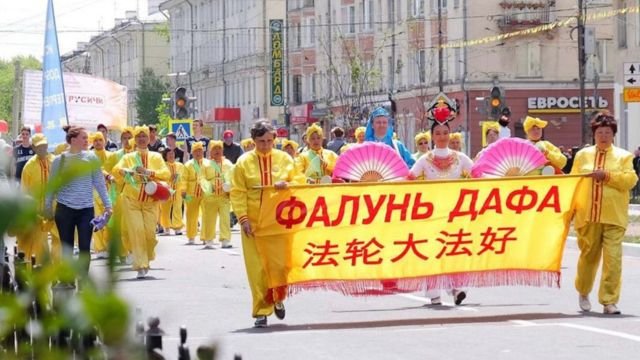
Falun Gong in Russia is part of the long list of “undesirable” organizations. After the war of aggression against Ukraine was started in 2022, Russian laws were amended and organizing, participating in, and even promoting or simply displaying symbols of undesirable organizations on social media are now crimes punished with jail or labor camp penalties. In practice, “undesirable” and “extremist” organizations are now dealt with in a similar way.
Until March 2023, the Russian anti-cult group RATsIRS was part of the notorious European umbrella organization FECRIS. Both RATsIRS and FECRIS support the Chinese repression of Falun Gong. They also systematically deny the criminal practice of organ harvesting of which Falun Gong practitioners and others are victims in China, despite the fact that this crime against humanity has been acknowledged and condemned twice by the European Parliament.
Russian prosecutors and courts after the aggression against Ukraine have embraced the FECRIS theory that organ harvesting is a myth. Although FECRIS leaders would occasionally say its has been invented by “Bitter Winter,” Russia prefers to blame a conspiracy by the U.S. Department of State.

On February 2, the Simonovsky District Court of Moscow announced the prosecution of nine Falun Gong practitioners.
Besides being active in an “undesirable” organization, they are prosecuted for spreading information about organ harvesting in China “following instructions of their U.S. Department of State handlers.”
It is thus confirmed that discussing organ harvesting in China is forbidden in Russia. These are times in which nothing should disturb the alliance of two genocidal regimes, Putin’s and Xi Jinping’s.

Massimo Introvigne (born June 14, 1955 in Rome) is an Italian sociologist of religions. He is the founder and managing director of the Center for Studies on New Religions (CESNUR), an international network of scholars who study new religious movements. Introvigne is the author of some 70 books and more than 100 articles in the field of sociology of religion. He was the main author of the Enciclopedia delle religioni in Italia (Encyclopedia of Religions in Italy). He is a member of the editorial board for the Interdisciplinary Journal of Research on Religion and of the executive board of University of California Press’ Nova Religio. From January 5 to December 31, 2011, he has served as the “Representative on combating racism, xenophobia and discrimination, with a special focus on discrimination against Christians and members of other religions” of the Organization for Security and Co-operation in Europe (OSCE). From 2012 to 2015 he served as chairperson of the Observatory of Religious Liberty, instituted by the Italian Ministry of Foreign Affairs in order to monitor problems of religious liberty on a worldwide scale.