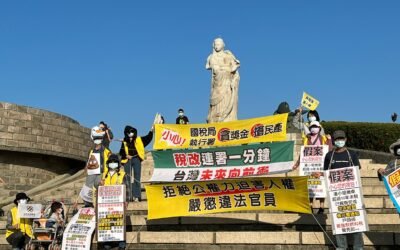
An international webinar reflects how freedom of the media cannot be separated from responsibility towards the truth.
by Daniela Bovolenta

After the World Press Freedom Day of May 3, CESNUR and Human Rights Without Frontiers organized on May 8, 2025, one of their regular webinars on the Tai Ji Men case, under the title “The Media Impact on FoRB [Freedom of Religion or Belief] and the Tai Ji Men Case.”
Massimo Introvigne, Managing Director of CESNUR and Editor-in-Chief of “Bitter Winter,” introduced the webinar by proposing a comparison between Dr. Hong Tao-Tze, the Grand Master (Shifu) of Tai Ji Men, and the Catholic Jesuit priest and professor at Saint Louis University Walter J. Ong, one of the leading communication and media scholars of the 20th century. Ong, Introvigne said, is well-known for his studies of the transition from orality to literacy in human history. His analysis of how these passages influence the conscience is less remembered today. Ong noted that the contemporary prevalence of electronic and digital communication can lead to a fragmentation of the conscience. Media can promote a return to conscience but also work against it by spreading false news. Dr. Hong, Introvigne stated, offers systematic teaching on the primacy of the conscience and how we can affirm it. At the same time, he and Tai Ji Men suffered from the lack of conscience in irresponsible media that echoed the lies of Prosecutor Hou Kuan-jen, the man who started the Tai Ji Men case.
Introvigne then presented a video on World Press Freedom Day by the United Nations Secretary General António Guterres. He noted the number of journalists persecuted and killed in recent years. He also commented that artificial intelligence may help ensure information integrity, but may also be used to discriminate and manipulate.

The first speaker of the first session was Michele Olzi, from the University of Insubria, in Italy. Olzi reflected on the connection between press freedom and democracy as outlined by the late Italian political scientist Norberto Bobbio. There is no democracy, Bobbio said, without the right to dissent from the authorities and publicly express this dissent. Such an expression is impossible without free media. However, Bobbio also noted that press freedom has an ethical dimension and may be used irresponsibly. This is what happened, Olzi said, in the Tai Ji Men case in Taiwan, when media repeated fabricated accusations and did not carefully examine whether they were true or (as Taiwan’s highest courts later confirmed) false.
Peter Zoehrer, an Austrian journalist and the Executive Director of Forum for Religious Freedom Europe (FOREF), was the second speaker of the first session. He stated that the media tend to under-represent cases where religious and spiritual minorities are persecuted or discriminated against, offering several examples from Nigeria, Pakistan, China, and Japan. He called the Tai Ji Men case a “textbook example” of persecution, where most Taiwanese media not only failed to reestablish the truth but willingly cooperated with those who spread falsehoods and slander.

Willy Fautré, co-founder and Director of Human Rights Without Frontiers, chaired the second session of the webinar. He surveyed the situation of press freedom and press accountability in Taiwan. While Taiwan is a democratic country, he said, international watchdogs have noted that local media tend to “sensationalism” and insufficient fact-checking. Nowhere was this more apparent, Fautré noted, than in the Tai Ji Men case, where media, “just to sell,” irresponsibly repeated fake news. He concluded that Tai Ji Men dizi may now use their experience to work with other victims of media slander and promote a reform of media accountability.
Fautré then presented a video addressing the challenging but essential issue of whether one should comply with unjust orders. This topic was exemplified by a German court’s ruling that, after the fall of East Germany, convicted a guard for shooting a man attempting to flee from East to West Berlin, rejecting the defense that he was simply following orders.

Fautré presented the testimonies of five dizi. Lillian Chen, an obstetric sonographer, noted that as a health professional, she knows how important it is that patients receive correct information. Dr. Hong taught her to watch the news daily, but not to passively accept all that is said. The Tai Ji Men case proved that the media can also spread false information. Chen also reminisced about her participation in Tai Ji Men cultural activities, from the sword dance at the opening ceremony of Taipei 2017 Universiade to a trip to Saudi Arabia in 2025. These activities also taught her to develop independent judgment, affirming the key role of the media but not always taking them at face value.

Valerie Tsai, a university student, stated that fact-checking and looking dispassionately for the truth are duties of the media, strictly connected with press freedom. When dealing with court cases, the media sometimes rely only on information they receive from prosecutors. Once they have embraced and advertised a particular theory, it is difficult for them to go back. This happened in Taiwan in the Tai Ji Men case, and more broadly in the Taiwanese media’s reporting on cases of alleged tax evasion, Tsai said.

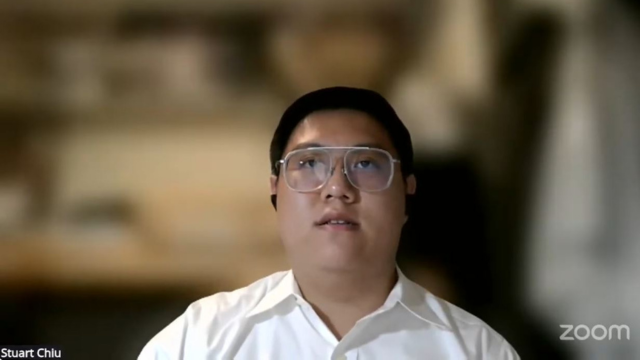
University student Stuart Chiu reflected on the United Nations theme for the 2025 World Press Freedom Day, “The Safety and Sustainability of Journalism in the Digital Age.” The theme, he said, does not refer only to threats against journalists but also to how misinformation threatens the public trust in the news. Chiu then offered an outline of the Tai Ji Men case. He noted the media’s uncritical acceptance of the false accusations presenting Tai Ji Men as “a cult” or “a fraud.” Tai Ji Men, Chiu said, had to create its own media coverage through press conferences, publications, and national and international events. While this improved the dizi’s communication skills, it evidenced a lack of responsibility in the Taiwanese mainstream media’s Tai Ji Men case coverage.
Jason Ni, a third university student, insisted that press freedom does not concern journalists only. It concerns everybody. He quoted UN General Secretary Guterres, who said that “Press freedom represents the very lifeblood of human rights,” and Jodie Ginsberg, CEO of the Committee to Protect Journalists, according to whom “All our freedoms rely on press freedom.” Ni acknowledged that expressing ourselves freely and bravely is not easy, as he learned as a Tai Ji Men dizi, and by playing both basketball and violin. However, as Dr. Hong teaches, we may all learn to communicate with truth by reconnecting with our inner conscience.

Sally Wang, a citizen journalist, mentioned the astonishing figure of some 400 media reports that slandered Tai Ji Men at the beginning of the case, repeating the charges fabricated by Prosecutor Hou that later collapsed before the courts. She noted that this also happened in other Taiwanese tax cases. In Taiwan, Wang stated, the medias typically side with governmental agencies such as the National Taxation Bureau without checking the facts accurately. For this reason, besides participating in public protests, and traveling with Dr. Hong to different countries to spread Tai Ji Men’s culture of conscience, peace, and love, Wang decided to become a citizen journalist and offer an alternative coverage of controversial matters.

Marco Respinti, Director-in-Charge of “Bitter Winter,” offered the conclusions of the webinar. He quoted the famous fable “The Boy Who Cried Wolf,” by ancient Greek author Aesop. A careless young shepherd took pleasure in alarming his fellow villagers by telling them falsely that a wolf was coming. When the wolf came one day, he tried to alert the villagers, but they were no longer ready to believe him. The wolf ate all the sheep of the village’s shepherds, including the boy’s. Respinti commented that this tale should become mandatory reading for modern journalists. They often “cry wolf” and spread false alarms and news about religious and spiritual minorities, and remain blind to real dangers and problems. Respinti concluded that media slander targeting Tai Ji Men in Taiwan exemplifies this process.

As usual, the webinar concluded with a video that conveyed the truth about the Tai Ji Men case through a song and music.