Prayer is not only a ritual but also a form of deep reflection and a call to action. It has sustained Tai Ji Men disciples for the 29 years since the case against them started.
by Aurora Li*
*A paper presented at the Third World Conference for Religious Dialogue and Cooperation, Kruševo, North Macedonia, June 23, 2025.

Globalization has eased information and cultural exchanges, but also fueled competition for land and resources. As a result, wars, abnormal climates, disasters, and cyber threats have surged, deepening global anxiety. In this troubled context, “peace” has become a shared aspiration. Yet, true peace must begin within each individual—by awakening conscience and rebuilding inner harmony. Conscience is the starting point and the driving force for sustainable peace.
In this paper, I will share my over twenty years of practice and reflection in Tai Ji Men—through prayer, martial arts, and qigong—and how they have helped me restore peace in body, mind, and spirit, and guided me to face the challenges of globalization.
At Tai Ji Men, I realized that prayer is not merely a ritual but a form of deep reflection and meaningful action. In recent years, in response to global chaos, our Shifu (Grand Master) has taught us to spend five minutes daily meditating for the world—offering blessings with sincerity and conscience, reflecting on our actions, and taking responsibility for our mistakes. This daily practice teaches us that the essence of prayer lies in reflection. When we calm our hearts, our conscience naturally guides us toward goodness.
Yet, Shifu always reminds us, “It is better to act than merely to speak.” A true cultivator should embrace the world with compassion and courage, going wherever we are needed. Having grown up practicing in Tai Ji Men, I have been fortunate to follow Shifu to many countries and witness countless touching moments during bell-ringing ceremonies for peace.
The Bell of World Peace and Love, cast in 2000, bears the Declaration of World Peace and Love engraved at its top. This declaration was issued in 1999, following three devastating earthquakes in Colombia, Türkiye, and Taiwan. It urges people to respect life, protect nature, and cultivate love—not only for themselves and their countries, but for all people and the Earth. The Bell Ringing Ceremony is held in the style of ancient rituals, aiming to bring together influential global leaders in a shared commitment to create a world free from sorrow, fear, war, and suffering.

For over two decades, Dr. Hong Tao-Tze, the Shifu or Zhang Men Ren (leader) of Tai Ji Men, together with his dizi (disciples), has traveled across five continents with the Bell of World Peace and Love to promote global peace. To date, 637 political and economic leaders from 158 countries, including 80 heads of state and 15 Nobel Peace Prize laureates, have rung the bell.
In 2022, in the face of the COVID-19 pandemic and the Russia-Ukraine war, the United Nations repeatedly warned of a “triple planetary crisis” involving climate change, biodiversity loss, and pollution. While many lived in fear of infection at this critical juncture, our Shifu led us to attend two major international conferences in Europe: Stockholm+50, organized by the UN in Sweden, and the 25th Eurasian Economic Summit in Türkiye. During these events, presidents and high-ranking officials from various nations were invited to ring the Bell of World Peace and Love, to gather positive energy from heaven and earth through the sound of peace.
What moved me the most was Dr. Kwaku Afriyie, Ghana’s Minister for Environment, Science, Technology, and Innovation, who became the 400th Bell Ringer in the world. As he rang the Bell and prayed for “absolute peace for all people,” he choked up with emotion and said, “Three words have always run throughout my life, although I am not perfect—conscience, morality, and ethics. I am grateful and honored to be part of such a spiritually uplifting event.”
His sincerity made me realize how powerful it is when good intentions resonate across borders. Every choice made with conscience, and every person willing to do good, is a shining light of hope for the future.

On October 16 of the same year, Tai Ji Men, along with over 500 global organizations, held the “Conscience Leads, Lights Up Hope” Global Prayer for Love and Peace Ceremony at National Taiwan University Sports Center. We invite people around the world to participate in a global “60 Seconds of Silence” to pray for peace and join kind thoughts through conscience. During the event, October 16 was designated as “World Prayer Day,” encouraging everyone to pray for themselves, others, and the world—to return to a pure heart, pray with conscience, and act with sincerity and kindness. These prayers expressed hope to end wars, eliminate diseases, bring peace to all people, achieve global harmony and mutual prosperity among all living beings, and allow the universe’s positive energy to guide Earth toward sustainable development. The ceremony incorporated music, bell ringing, drumming, martial arts, and other performances. Tens of thousands of participants attended onsite and online, sending ripples of positive energy for sustainability and harmony.
That day, I also joined the “Kung Fu Fan” formation. In Chinese, the word for “fan” (扇) sounds like “goodness”(善), and the fan dance symbolizes using one’s kind thoughts to awaken the inner conscience of others.
In the past, I insisted on doing things in my own way, which led to conflicts with others, and I did not know how to resolve them. However, through practice, I learned to learn from others, cooperate with teammates, mindfully perceive each other’s movements, and support and cover positions of one another. The powerful “swish!” sound created by each wave of the fan inspired us to move forward with courage. This energy was shared with the audience as well. In that moment, I profoundly felt the immense strength of teamwork and how kind thoughts, when shared, can change the world.
I also understood that both martial arts practice and prayer are ways to reconnect with conscience—a clarity between yin and yang, right and wrong—leading us to “see ourselves, see the universe, and see all beings.” True goodness is not merely about personal well-being but also about uplifting others. With this awareness, I now dedicate myself to sharing these values with fellow brothers and sisters, passing down this culture of peace and conscience to future generations, to bring the power of goodness to the world.
Similarly, in the face of social injustice, since a prosecutor’s fabricated indictment of Tai Ji Men in 1996, our Shifu taught us to apply mastery, focus on the heart, endure with patience, and cultivate harmony. For nearly three decades, we have upheld truth and conscience through peaceful, rational means to transform our painful experience into greater public awareness, awaken the government’s conscience, and protect freedom of belief worldwide. We also hope that no Taiwanese citizen will ever suffer such injustice again, and that the dark side of politics will not destroy this precious cultural heritage.

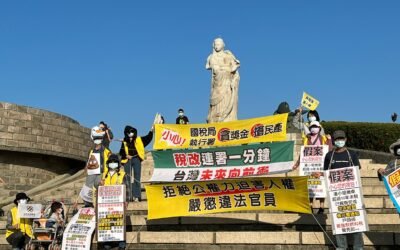
We have taken to the streets, sought justice through the courts, organized public hearings in the Legislative Yuan, and participated in international forums to promote legal and tax reform and human rights education. By speaking out for cultural rights, freedom of belief, and justice in legal and tax, we embody the martial spirit of “courage” and “righteousness,” turning conflict into peace through constructive action.
A major controversy in the Tai Ji Men case is the taxation of gifts from dizi to Shifu—traditional tokens of gratitude, common in many cultures and previously untaxed in Taiwan. The National Taxation Bureau falsely claimed that these gifts were tuition fees for a non-existent cram school. Although the Supreme Court ruled that Tai Ji Men was not guilty of fraud or tax evasion and owed no taxes, and the National Taxation Bureau acknowledged that Tai Ji Men is not a cram school, it still issued ill-founded tax bills. On August 21, 2020, despite widespread public condemnation, the National Taxation Bureau, together with the Administrative Enforcement Agency, forcibly auctioned off the sacred land of Tai Ji Men, blatantly violating legal procedures. The land was ultimately nationalized and taken over by the state.
Over the past twenty years, I have constantly shed tears in the quiet of the night, heartbroken that the sincere offerings to Shifu were misinterpreted, leading to false accusations. Shifu personally and thoughtfully selected the site in the Miaoli mountains and acquired it piece by piece to create a place for dizi’s self-cultivation. Yet, that vision was shattered by injustice. It remains a painful memory—I felt helpless yet profoundly wished I could change the outcome.
Now in its 29th year, the Tai Ji Men case has become a litmus test for human rights and freedom of belief in Taiwan. It has drawn international attention and has been discussed at global conferences. In light of Taiwan’s upcoming fourth review of the implementation of the United Nations Two Covenants, which it has incorporated into its domestic law despite not being part of the UN, civil society groups are calling on the Taiwanese government to resolve the structural issues revealed by the case. They include the lack of effective remedies under Article 2 of the International Covenant on Civil and Political Rights (ICCPR), and violations of freedom of religion and belief protected under Article 18 of the ICCPR and Article 15 of the International Covenant on Economic, Social and Cultural Rights (ICESCR). Misrepresenting religious practices and the unlawful land seizure have infringed upon cultural and property rights.
Tai Ji Men offers a peace-rooted solution to the global crises through conscience awakening and qigong practice. This journey begins with personal calmness, leading to social cohesion and cultural sustainability. It is a nonviolent, resilient force that plants seeds of peace in people’s hearts.
Looking ahead, we urge the Taiwanese government to face the structural issues revealed by the Tai Ji Men case and provide genuine remedies in line with international covenants, to restore truth and justice, and to write a responsible and meaningful chapter in the history of human rights and cultural freedom in Taiwan. We also call on the international community to jointly uphold freedom of belief and cultural diversity, so that every act of conscience will no longer be isolated and can flourish under institutional protection. The first step toward peace in Taiwan is to redress the Tai Ji Men case.

Aurora Li is a graduate student in the Master’s Program of Nutritional Science at National Taiwan Normal University and a licensed nutritionist with a specialization in health-promoting nutrition. She has practiced qigong in the Tai Ji Men tradition for over 25 years since childhood and has long served as a cultural volunteer.