On United Nations International Day of Parliamentarism, scholars and human rights activists discussed the connection between Parliaments, taxes, and human rights.
by Daniela Bovolenta

On June 30, 2024, United Nations International Day of Parliamentarism, CESNUR and Human Rights Without Frontiers organized one of their webinars on the Tai Ji Men case, with the title “Parliaments, Democracy, and Tai Ji Men.”
Massimo Introvigne, an Italian sociologist of religions who serves as the editor-in-chief of “Bitter Winter,” chaired the first session. It opened with a video about the participation of Tai Ji Men dizi (disciples) on June 19–22 in the Second World Conference for Religious Dialogue and Cooperation, organized in Strumica, North Macedonia, by the UNESCO Chair in Intercultural Studies and Research and the Center for Intercultural Studies of the University of Saints Cyril and Methodius, Skopje.

Introvigne introduced the webinar by discussing what UNESCO officially regards as the first Parliament in history that had effective legislative powers and included commoners in addition to aristocrats and clergy, the Spanish Cortes of León of 1188. Introvigne noted that the main reason that led to the Cortes of León was taxes. The Cortes established the principle, which later became a main slogan of the American Revolution, “no taxation without representation,” preventing the King from imposing taxes not approved by assemblies including representatives of the people. Parliaments and taxes, Introvigne concluded, were thus connected since the very origins of parliamentarism. This should be taken as a lesson for Taiwan, he said, where the Legislative Yuan seems to have been expropriated by tax bureaucrats of its function to act as the ultimate arbiter of tax questions and solve cases such as the one of Tai Ji Men.

Davide Suleyman Amore, an Italian historian of religions, a member of the Italian Association of History of Religions (SISR), and the secretary of “As-Salàm” Islamic Cultural Association, which manages a mosque where he sometimes serves as imam, compared Western parliaments and the Islamic Shūrā, an ancient Muslim system of consultation among members of local communities. While today Western parliamentarism is based on the principle of separation between religion and the state, the Islamic Shūrā explicitly refers to moral and religious ideals. Amore suggested that Taiwan, faced with the injustice of the Tai Ji Men case, may learn from both systems, parliamentarism and Shūrā. A discussion in the Legislative Yuan can be supplemented by a consultation of experts and representatives of religious communities active in Taiwan, so that the long-lasting case may finally be solved.
Peter Zoehrer, an Austrian journalist and the Executive Director of Forum for Religious Freedom Europe (FOREF), noted that parliamentarism has limits and does not automatically guarantee justice and democracy, as the Tai Ji Men case in Taiwan demonstrates. Two ways of addressing these problems and try to solve cases such as Tai Ji Men, Zoehrer said, are building coalitions of different religions and spiritual movements concerned with issues of freedom of religion and belief, and cooperate with independent media, which in some cases may be willing to help.

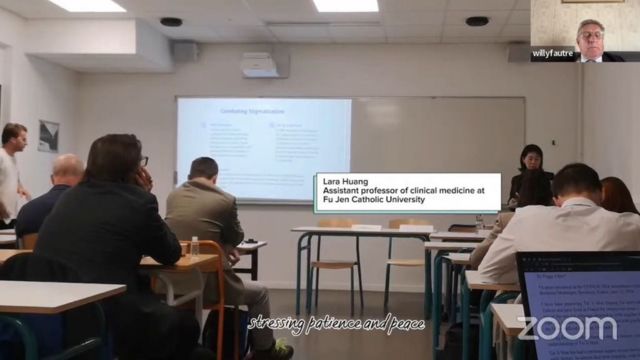
The second session was chaired by Willy Fautré, co-founder and Director of Human Rights Without Frontiers. He first introduced a video that summarized papers on the Tai Ji Men case presented at the yearly conference of CESNUR held at the University of Bordeaux, France, on June 12–15. There, Tai Ji Men and the case were discussed both in a plenary session paper by Massimo Introvigne and in a session chaired by well-known British sociologist Eileen Barker, in which both scholars and dizi presented their testimonies.
Fautré emphasized that the date of June 30 was selected by the United Nations in 2018 as the International Day of Parliamentarism to commemorate the foundation on June 30, 1889, of the Inter-Parliamentary Union, which is still active in Geneva, Switzerland. The Union’s aim was to foster cooperation between parliamentarians of different countries. This remains a way of internationalizing national problems, Fautré said, which may help solve human rights cases. He expressed the hope that more international politicians, in addition to scholars, will become aware of the Tai Ji Men case and support the dizi’s struggle for justice. Fautré concluded with an appeal to the new Taiwan Minister of Finance Chuang Tsui-Yun asking her to finally solve the Tai Ji Men case.
Fautré then presented the testimonies of five dizi. Bobby Chen, a story artist, presented some best practices of parliaments asserting their powers and protecting their citizens’ human rights, as it happens in New Zealand and Singapore. As opposite to this, the Legislative Yuan in Taiwan did not succeed in promoting justice and reining in corrupt bureaucrats. Chen mentioned the example of Prosecutor Hou Kuan-Jen, the man who created the Tai Ji Men case and was guilty of several violations of law. Rather than disciplined, he was ironically promoted to Director General of the Agency Against Corruption and later Director-General of the Institute of Forensic Medicine.

Sienna Lin, a graduate student, mentioned the history of Taiwan’s parliamentarism, which started in Japanese colonial times with a petition asking Japan to allow the establishment of a Taiwanese Parliament. Taiwanese citizens, Lin said, expected that a free Parliament would ensure democracy and human rights. Although some good results were achieved, other hopes were dashed, Lin commented, as demonstrated by the Legislative Yuan’s inability to solve the Tai Ji Men case. She also mentioned the “Injustice Site Monuments” erected at the Swiss Mountain Villa near Taipei and the Lainan Street Academy in Kaohsiung, which became dilapidated because of the tax case. They are a living memory of the need to rectify the injustices of the Tai Ji Men case.

Gene Wang, a process manager in a medical device technology industry, explained that in his delicate field medical companies have to comply with very strict regulations and deal with regulatory agencies. Notwithstanding this, scandals do happen, and he mentioned one where a company decided to use cheaper raw materials rather than the medically approved and tested ones for its breast implants, causing thousands of women to develop breast cancer. What this incident shows, Wang said, is that ultimately it is the willingness to act conscientiously and recognize conscience as the compass allowing us to distinguish between right and wrong that avoids wrongdoings and crimes. Parliaments and public officers, including tax bureaucrats, should respect the same principle, Wang concluded—which unfortunately did not happen in the Tai Ji Men case.

Cindy Wang, a graduate student, commented that parliaments should gain the respect of citizens through their dignified proceedings. Taiwan, by contrast, has
been described as a “rambunctious democracy” as confirmed by the severe conflicts that erupted in the Legislative Yuan on May 18, 2024. Wang reported the opinion of Lien Fu-Long, Taiwan Contact Professor at the University of Osnabrück, in Germany, who believes that the problems of Taiwan’s parliamentarism come from the excessive power of the government administrative units, including the National Taxation Bureau, as evidenced by the Tai Ji Men case. These units largely draft the laws that the Legislative Yuan then votes. Wang concluded by expressing the hope that the Legislative Yuan may assert the principle of parliamentary oversight of government agencies, rather than being dictated by them.

Fletcher Wu, a project manager, also mentioned the May 18, 2024, conflicts in the Legislative Yuan. They were connected with a proposed parliamentary reform bill, which according to Wu has become necessary to guarantee effective supervision and accountability mechanisms. The failure to solve the Tai Ji Men case, Wu said, proves that reform is needed. Wu also mentioned that, despite tax harassment, Tai Ji Men has continued its world mission on behalf of peace, love, and conscience and reported on his own participation to the Cultural Goodwill Group’s visit to Fiji in 2019, the 100th country to be visited by Tai Ji Men.

Marco Respinti, an Italian journalist and scholar who serves as director-in-charge of “Bitter Winter,” offered the conclusions of the webinar. He discussed his participation in both a hybrid seminar organized on July 1, 2022, at the Renaissance Hotel in Washington DC and online by CESNUR and Human Rights Without Frontiers on “Effective Parliamentarism and the Tai Ji Men Case,” and a meeting in Taipei of international scholars and human rights activists with the then President of Taiwan’s Legislative Yuan Yu Shy-Kun, on April 6, 2023. The delegation also met the President of the Control Yuan, Chen Chu, on April 11, 2023. Both promised efforts to solve the Tai Ji Men case. Results have not been achieved, Respinti said, and he called both on Chen Chu and on the new President of the Legislative Yuan, Han Kuo-Yu, to follow up after the 2023 meetings and take decisive action towards the solution of the case.

The webinar concluded with a video using music and a song to present the Tai Ji Men case and remind the audience of the need to solve it.