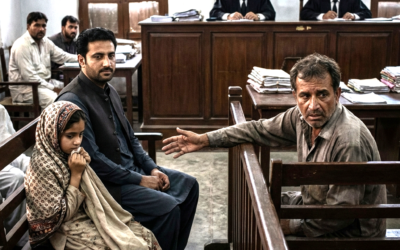
The ubiquitous anti-blasphemy laws are used to threaten women activists with the death penalty, using fabricated evidence.
by Massimo Introvigne

Pakistan is consistently listed among the countries where women’s rights are less respected, despite the fact that in the 20th century it had a female Prime Minister, Benazir Bhutto. Rapes, kidnapping, forced marriages target particularly the female devotees of minority religions, but Muslim women are not safe either. Despite laudable efforts to improve the situation, women are still left behind in the field of education. And, while laws have been passed to protect the women’s rights, courts, particularly in rural areas, may be reluctant to enforce them.
An increasingly active movement for women’s rights exists in Pakistan, and becomes visible every year on March 8, International Women’s Day, with the Aurat March (i.e., “Women’s March”) organized since 2018 in several Pakistani cities.
Islamic fundamentalists are incensed at the Aurat Marches and the women organizing them. They tried to have them banned as representing foreign interests, and used the fact that the flag of one of the participating organizations, the Women Democratic Front, uses the colors purple, white, and blue to claim that the march is financed by France, and that French blue, white, and red flags were displayed there.

Worse came this year, when videos were released through social media showing women in the Aurat March chanting that “Allah should also hear us,” and “the Messenger (i.e., Prophet Muhammad) should hear our call for freedom.” Mentioning the names of God and his Prophet in an inappropriate context amounts to blasphemy, a crime punished with the death penalty in Pakistan.
However, after the videos went viral and social media users reacted by asking that the women be hanged, mainline Pakistani media investigated the issue, and concluded unanimously that the videos had been doctored. Islamic fundamentalists may criticize other aspects of the modern world, but know how to use cutting-edge technology. In fact, the women chanted “The mullahs [conservative religious clerics] should also hear us” and “Imran [Khan, Pakistan’s Prime Minister] should hear our call for freedom,” but the videos were manipulated, and the words “mullahs” and “Imran” were substituted with “Allah.” Similarly, they chanted “Fazlur should also hear us,” referring to Fazlur Rehman, the president of the conservative Islamic political party Jamiat Ulema-e Islam Pakistan, but in the video “Fazlur” was changed to “Rasul” (the Messenger).

The Human Rights Commission of Pakistan (HRCP) commented about the manipulation of the videos: “This is not just repugnant; it is an incitement to violence. We demand that action be taken against all such persons [responsible for the fake videos].”
However, not only the videos continue to circulate but a court in Peshawar has started a case against the organizers of the Aurat March for blasphemy, and another court in Islamabad has registered a parallel case following a complaint by a local lawyer.
On May 7, Pakistan Today commented that, “this trend of using blasphemy to silence women’s rights activists is a decade-old ploy of Islamists. […] Islamist policies have long silenced marginalized segments in the country, including women.”
Meanwhile, at a Zoom event organized on May 8 by Minority Concern Pakistan, Christian leaders expressed the opinion that in the current Pakistani political climate repealing blasphemy law is impossible, and international pressure on Pakistan about this issue is doomed to fail.

Massimo Introvigne (born June 14, 1955 in Rome) is an Italian sociologist of religions. He is the founder and managing director of the Center for Studies on New Religions (CESNUR), an international network of scholars who study new religious movements. Introvigne is the author of some 70 books and more than 100 articles in the field of sociology of religion. He was the main author of the Enciclopedia delle religioni in Italia (Encyclopedia of Religions in Italy). He is a member of the editorial board for the Interdisciplinary Journal of Research on Religion and of the executive board of University of California Press’ Nova Religio. From January 5 to December 31, 2011, he has served as the “Representative on combating racism, xenophobia and discrimination, with a special focus on discrimination against Christians and members of other religions” of the Organization for Security and Co-operation in Europe (OSCE). From 2012 to 2015 he served as chairperson of the Observatory of Religious Liberty, instituted by the Italian Ministry of Foreign Affairs in order to monitor problems of religious liberty on a worldwide scale.