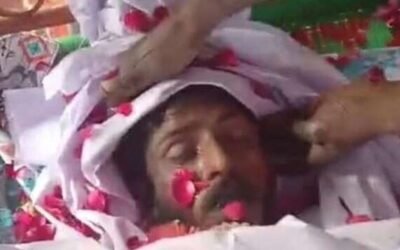
Graves have been desecrated in the village of Perochak, in the Sialkot District of Punjab. It is not the first time.
by Massimo Introvigne

In September 2021, Bitter Winter published a series on the persecution of the Ahmadis in Pakistan, one of the oldest and bloodiest persecutions of a religious minority in the world today.
The Ahmadiyya is a movement founded within Islam by Mirza Ghulam Ahmad (1835–1908). Conservative Muslims accuse Ahmad of having considered himself a “prophet,” whereas Islam teaches that no prophet could arise after Muhammad. The Ahmadi formula for Ahmad, “at the same time a prophet and a follower of the Holy Prophet [ Muhammad],” is not enough to establish Ahmadiyya’s orthodoxy in the eyes of Muslim clerics.
In Pakistan, laws prevent the Ahmadis from calling themselves “Muslims,” and they are heavily persecuted. If they are not Muslims, some argue, they should not even be buried in Muslim cemeteries. Dozens of Ahmadi graves and cemeteries have been desecrated. Muhammad Abdus Salam (1926–1996), one of the world’s leading physicists and a Nobel Prize laureate, had the word “Muslim” erased from his grave in Rabwah, Punjab, because he was an Ahmadi.
Yet, in several Pakistani villages cemetery arrangements between Ahmadis and mainline Sunni Muslims went on for decades without causing any special problem, until the recent rise of an even more militant anti-Ahmadi movement, fueled by ultra-fundamentalist organizations and parties.
In the village of Perochak, in the Sialkot District of Punjab, since 1948 Ahmadis and non-Ahmadis have shared the same cemetery. An agreement allows the Ahmadis to be buried on one side of the cemetery and the non-Ahmadis on the other side.
Yet, on April 6, the Assistant Commissioner (AC) of Daska along with the Station House Officer (SHO) of Motra Station with their officers arrived at the cemetery and started destroying 43 graves of Ahmadis.

During the incident, the AC was told on the spot that this has been a joint cemetery for 71 years, and the residents have always respected the arrangements with no quarrels. It seem that a local radical Sunni cleric, Maulawi Irfan Asad, incited the action of the AC.
Protests were to no avail, and the destruction continued. It seems that Pakistan’s ultra-fundamentalist Sunni Muslims are not happy with persecuting just the living Ahmadis. Now they persecute the dead too.

Massimo Introvigne (born June 14, 1955 in Rome) is an Italian sociologist of religions. He is the founder and managing director of the Center for Studies on New Religions (CESNUR), an international network of scholars who study new religious movements. Introvigne is the author of some 70 books and more than 100 articles in the field of sociology of religion. He was the main author of the Enciclopedia delle religioni in Italia (Encyclopedia of Religions in Italy). He is a member of the editorial board for the Interdisciplinary Journal of Research on Religion and of the executive board of University of California Press’ Nova Religio. From January 5 to December 31, 2011, he has served as the “Representative on combating racism, xenophobia and discrimination, with a special focus on discrimination against Christians and members of other religions” of the Organization for Security and Co-operation in Europe (OSCE). From 2012 to 2015 he served as chairperson of the Observatory of Religious Liberty, instituted by the Italian Ministry of Foreign Affairs in order to monitor problems of religious liberty on a worldwide scale.