In 1990s, the suicides and homicides of the Solar Templars energized the European anti-cult movement. But where did this group come from?
by Massimo Introvigne
Article 1 of 9

The three incidents of suicides and homicides involving the Order of the Solar Temple (in French, Ordre du Temple Solaire, OTS), an esoteric new religious movement based in Switzerland and Quebec, had a crucial role in energizing the anti-cult movements in Europe, and persuaded governments and Parliaments in several countries that “cults” should be investigated through special commissions.
In this way, the OTS crimes, which were very much real, had however a negative effect on the general situation of religious liberty in Europe, creating witch hunts where hundreds of peaceful new religious movements were accused of being “potentially violent” or even “preparing mass suicides.” Reconstructing what the OTS and the tradition it was part of were really all about has thus an interest that goes beyond the tragedy of the Solar Temple. It will also show that the OTS had peculiar features of its own, eluding easy comparisons with other groups labeled as “cults.”
This series is based on my early studies of the OTS and in the landmark study of the movement by Swiss historian Jean-François Mayer, who not only is the best specialist of the subject but also assisted the Swiss judges in the investigation of the first suicides and homicides.
The OTS was not born in a vacuum. It is a deviant part of a much larger tradition, neo-Templarism, or the belief that the order of the Knights Templar, disbanded by the Catholic Church in 1307, secretly continued its existence to our very days. Unnecessary to say, other neo-Templar organizations are not responsible for the wrongdoings of the Solar Temple. Yet, while keeping this statement firmly in mind, they should be necessarily mentioned to understand where the Solar Temple came from.
The Order of the Temple, a Catholic monastic-chivalric order whose history is intertwined with that of the Crusades, was dissolved in 1307 by Pope Clement V (1260–1314) under pressure by the King of France, Philip the Fair (1268–1314), who resented the power and the independence of the Knights Templar and was also interested in confiscating their substantial assets.
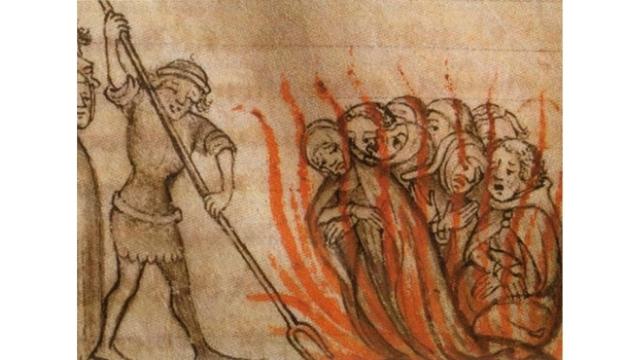
After the suppression, the Order survived for a few decades outside France, but by the early 15th century at the latest, the Templars had completely disappeared. The thesis of their secret continuation has been denounced by specialists of medieval history as a mere legend.
The idea that the Templars, officially suppressed, had continued their activities clandestinely until the 18th century, spread first of all within the French and German Freemasonry. Freemasonry was born in the United Kingdom, and presented itself as the heir of the trade guilds of the stonemasons. For some, this was too “humble” an origin, which the nobility of continental Europe accepted with difficulty. Thus, the legend was spread of persecuted knights who had “hidden” in the English and Scottish guilds of stonemasons in order to continue their activities.
Especially in Germany, these mysterious knights were identified with the Templars. This is the origin of the Templar degrees of Freemasonry, which were born in continental Europe but quickly spread to the United Kingdom thanks to the work of Thomas Dunckerley (1724–1795), the founder in 1791 of a Grand Conclave (later Grand Priory) of the Knights Templar within English Freemasonry. Today, Masonic Knights Templar are found in several Masonic orders.

In the 18th century, however, not all the holders of Knights Templar degrees accepted the idea that their lodges must remain subordinate to Freemasonry. One Parisian lodge, the Knights of the Cross, argued that this should not be the case. If the Templar legend was true, then the guilds of stonemasons had an esoteric interest only as far as within them since the 14th century were hidden the heirs of the Order of the Temple. They concluded that the Knights Templar should have precedence over Freemasonry, and that Masonic organizations should subordinate themselves to the (neo-)Templar ones rather than vice versa.
The origin of this controversy goes back to an adventurer active in the years of the French Revolution, the former Catholic seminarian turned podiatrist Bernard-Raymond Fabré-Palaprat (1773–1838). In 1804, he claimed to have discovered a list of Templar “Grand Masters” from the suppression of 1307 until 1792. In that year, he argued, the last “hidden” Grand Master, Duke Louis-Hercule-Timoléon de Cossé-Brissac (1734–1792), had died, massacred in Versailles by the Jacobins.
The Knights of the Cross declared that a document, allegedly found in the drawer of a furniture of the Duke, authorized whomever found it to proceed to the election of a new Grand Master. Thus, in 1805, the lodge appointed Fabré-Palaprat Grand Master (initially “provisional”) of a revamped Order of the Temple. The idea interested Napoleon (1769–1821) himself, who authorized a solemn ceremony in 1808.

Fabré-Palaprat, however, did not have in mind only a chivalric order destined to re-enter more or less quickly into the orbit of the Catholic Church. His far more ambitious idea, which he began to manifest in 1812, was to use the neo-Templars to establish a new religion. In 1814, Fabré-Palaprat claimed to have fortuitously purchased from a bouquiniste a Greek manuscript entitled Evangelikon, a (largely unorthodox) version of the Gospel of John, preceded by a commentary called Lévitikon. According to modern scholars, these texts, although containing possibly older material, would rather appear to be late 17th– or 18th-century forgeries.
The John the Apostle of the Evangelikon presents himself as an anti-clerical rationalist, who strips Christianity of any supernatural character and reduces Jesus Christ to an initiate educated in Alexandria. Before dying, Jesus Christ would appoint as his successor John the Apostle, whose “Order of the East” would then continue in the Order of the Temple.
The importance of this succession is evident: as Grand Master of the reconstituted Order of the Temple, Fabré-Palaprat proclaimed himself the authentic successor of John the Apostle, and indeed of Jesus Christ himself, vested with all the powers of the priesthood. He could thus proceed to the foundation of a Templar Church, which he called the “Johannite Church” and declared the only true legitimate Christian church. He then approached a defrocked Catholic priest, Ferdinand-François Châtel (1795–1857), who had founded an independent “French Catholic Church.”

In 1831, Châtel joined the Order of the Temple, and shortly thereafter Fabré-Palaprat consecrated him as bishop and primate of the Johannite Church, which gathered a few ex-priests.
The Johannite Church, however, lasted only a few years. Not all members of the Order of the Temple took it seriously. Some did not intend to break with the Catholic Church, and rather broke with Fabré-Palaprat. When the latter died in 1838, the link between the Order of the Temple and the Johannite Church was broken, and the opportunity arose for a reconciliation between his followers and those who had left the Order because of the Johannite Church controversy.
Massimo Introvigne (born June 14, 1955 in Rome) is an Italian sociologist of religions. He is the founder and managing director of the Center for Studies on New Religions (CESNUR), an international network of scholars who study new religious movements. Introvigne is the author of some 70 books and more than 100 articles in the field of sociology of religion. He was the main author of the Enciclopedia delle religioni in Italia (Encyclopedia of Religions in Italy). He is a member of the editorial board for the Interdisciplinary Journal of Research on Religion and of the executive board of University of California Press’ Nova Religio. From January 5 to December 31, 2011, he has served as the “Representative on combating racism, xenophobia and discrimination, with a special focus on discrimination against Christians and members of other religions” of the Organization for Security and Co-operation in Europe (OSCE). From 2012 to 2015 he served as chairperson of the Observatory of Religious Liberty, instituted by the Italian Ministry of Foreign Affairs in order to monitor problems of religious liberty on a worldwide scale.