Social justice cannot be separated from ecology and from freedom of religion or belief. It was the lesson of Dian Fossey. It is the lesson of Tai Ji Men.
by Massimo Introvigne*
*Introduction to the webinar “No Social Justice Without Freedom of Belief: The Tai Ji Men Case,” co-organized by CESNUR and Human Rights Without Frontiers on February 20, 2026, United Nations World Day of Social Justice.
It is a joy to introduce again one of these periodic webinars, where we reflect on the Tai Ji Men case and the meaning of justice, conscience, and peace in our world. Today, we gather in the spirit of the United Nations’ World Day of Social Justice. In 2025, it generated significant documents and papers around that year’s theme, “Strengthening a Just Transition for a Sustainable Future.” It reminded us that social justice and ecological sustainability are inseparable. Scholars increasingly agree that ecology is not a separate issue from justice; it is one of its foundations. When the environment collapses, it is always the most vulnerable communities—human and non-human—who suffer first and suffer most.
I have just returned from a long journey in Africa devoted to two of my lifelong passions: freedom of religion or belief and endangered animal species. These two concerns may seem distant from each other, yet the more I travel, the more I see how deeply they are connected. Justice is never one-dimensional. It is a tapestry woven from respect for nature, cultures, and the dignity of every being.
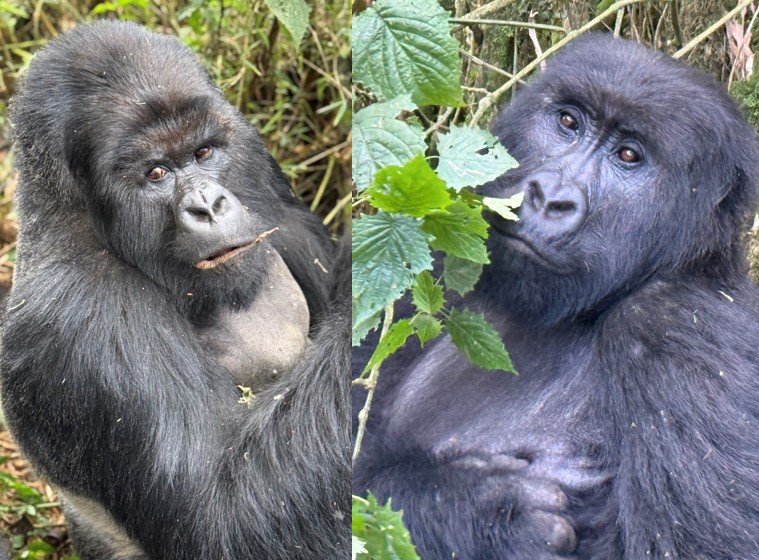
One of the most moving moments of my trip was in Rwanda, where my wife Rosita and I visited Volcanoes National Park. This extraordinary place is home to roughly 40% of the world’s remaining 1,000 mountain gorillas. These magnificent beings share 98% of their DNA with us. Without entering into debates about evolution, it is impossible not to feel a profound kinship when you look into their eyes. They mourn their dead. They gather around a deceased relative in what observers have described as a kind of ritual. They show tenderness, loyalty, and grief.
Much of what we know about them comes from the work of Dian Fossey, the American primatologist who lived among the Rwandan gorillas for many years. Her life was portrayed in the 1988 Hollywood film “Gorillas in the Mist,” with Sigourney Weaver playing Fossey. Fossey’s research revolutionized our understanding of gorillas, but her greatest legacy was her fight against poachers and the corrupted politicians and bureaucrats who profited from the destruction of wildlife. Thanks to her, the gorilla population in Rwanda has not disappeared but is slowly increasing.
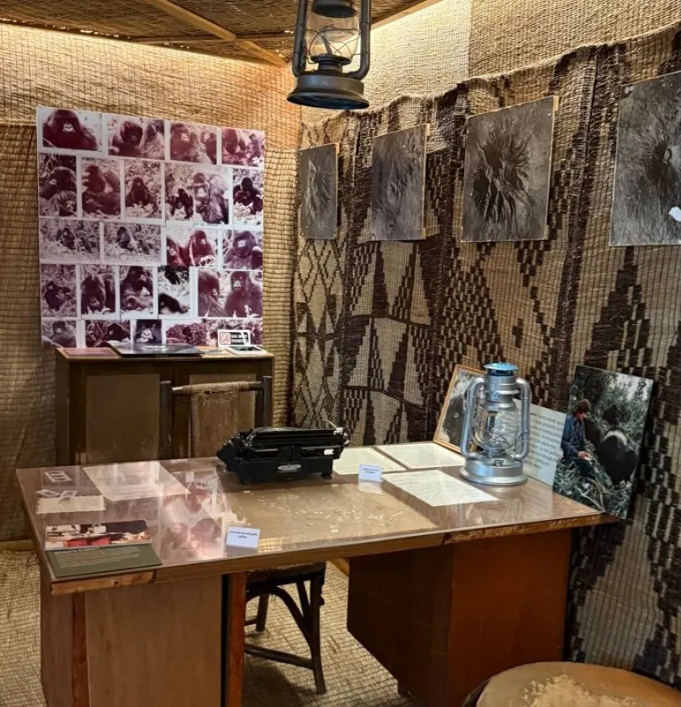
Fossey was murdered in 1985. Although Rwandan authorities accused her research assistant, few in the West believed this explanation. Her struggle had angered influential political and economic actors. What is less well known is that Fossey also defended the rights and cultures of local communities. She understood that protecting the gorillas required protecting the people who lived near them. Some of the politicians who opposed her were later implicated in the 1994 genocide. Her life is a testament to the profound link between ecological justice and social justice.
Rosita and I visited the Fossey Museum in Kinigi after a long, muddy trek to meet a gorilla family—actually two families greeting each other. It was an emotional experience. Standing there, we felt how deeply intertwined the protection of nature, culture, and conscience is.
As a Roman Catholic, I am reminded of the Church’s teaching on “human ecology,” which insists that care for nature and care for human rights are inseparable. Freedom of religion or belief is part of this human ecology. Communities have the right to protect their environment—its forests, its animals, its sacred spaces—and to protect their culture, including their spirituality.
This brings me back to Taiwan, the 228 Incident, and the Tai Ji Men case.
The February 28 Incident of 1947 was, in many ways, a tragedy born from the Kuomintang’s disregard for the rights, identity, and culture of local Taiwanese communities. It was a violation of human ecology. And in post-authoritarian Taiwan, the Tai Ji Men case has been another such violation. For nearly three decades, a peaceful spiritual community has been subjected to fabricated accusations, unjust tax bills, and the nationalization of sacred land.
In 2020, land that is essential to Tai Ji Men’s identity—and includes a sacred bamboo forest—was nationalized based on a tax theory that courts had already declared unfounded. This was not only a legal injustice. It was an ecological and cultural injustice. It was a wound to the community’s spiritual environment, its heritage, its human ecology.

The struggles of Tai Ji Men and the struggles of Dian Fossey are, of course, different in their circumstances. But they share a common passion for justice. They both show that social justice is not a simple or narrow concept. It includes ecological sustainability, cultural rights, fairness, freedom of religion or belief, and the right of communities to live in harmony with their environment.
The World Day of Social Justice invites us to imagine a world where development does not destroy culture, where progress does not trample conscience, and where economic interests do not silence spiritual communities. A just transition requires more than new technologies. It requires a transformation of the heart. It requires conscience.
Tai Ji Men has always taught that conscience is humanity’s compass. And indeed, conscience is what unites all these struggles: the conscience of Dian Fossey defending the gorillas; the conscience of local Rwandan communities protecting their land; the conscience of Tai Ji Men resisting injustice with peace and dignity; the conscience of all those who believe that a sustainable future must be a just future.
As we honor the World Day of Social Justice, we are reminded that justice is not abstract. It is lived in the forests of Rwanda, in the sacred bamboo groves of
Taiwan, in the hearts of all who refuse to accept injustice as normal. The resilience of Tai Ji Men is part of a global movement of conscience, a movement that insists that human dignity, cultural identity, and ecological harmony must be protected together.
May we continue this journey with courage, compassion, and unwavering commitment to justice.

Massimo Introvigne (born June 14, 1955 in Rome) is an Italian sociologist of religions. He is the founder and managing director of the Center for Studies on New Religions (CESNUR), an international network of scholars who study new religious movements. Introvigne is the author of some 70 books and more than 100 articles in the field of sociology of religion. He was the main author of the Enciclopedia delle religioni in Italia (Encyclopedia of Religions in Italy). He is a member of the editorial board for the Interdisciplinary Journal of Research on Religion and of the executive board of University of California Press’ Nova Religio. From January 5 to December 31, 2011, he has served as the “Representative on combating racism, xenophobia and discrimination, with a special focus on discrimination against Christians and members of other religions” of the Organization for Security and Co-operation in Europe (OSCE). From 2012 to 2015 he served as chairperson of the Observatory of Religious Liberty, instituted by the Italian Ministry of Foreign Affairs in order to monitor problems of religious liberty on a worldwide scale.