What is known about the American President Garfield is enough to conclude that “The Elected of the Dragon” is just a work of fiction.
by Massimo Introvigne
Article 5 of 6. Read article 1, article 2, article 3, and article 4.

Did a “manuscript” with the adventures of Clotilde Bersone and the Ninth Circle really exist? The journal of the French Jesuits, “Études,” which had already debunked the anti-Masonic hoaxes of Léo Taxil, when confronted with Clotilde Bersone in 1929 labeled her revelations as “sick fairy tales.”
In the second edition of 1932, signing with his pen name Duguet, Boulin explained to the skeptical Jesuits of “Études” that the existence of the manuscript had been confirmed precisely by a Jesuit, Richard, although his name had not been disclosed in the first edition.
In this same text, Duguet/Boulin mentioned “a text on which we worked,” written by Richard himself. Two years later, in 1933, Duguet/Boulin explained that there were in fact two manuscripts: one copied by Richard, the other not handwritten by “Clotilde Bersone” but “dictated” by her. The latter had been at the Hiéron of Paray-le-Monial, before being passed to Mgr. Jouin and to the archives of his anti-Masonic magazine. The personal archive of Jouin is not at present accessible to scholars, and thus it is not possible to ascertain whether the famous manuscript is still there.
But would the existence or non-existence of the manuscript really solve the riddle of Clotilde Bersone? After all, what could the manuscript add or take away from the discussion? Its main interest would be to allow a comparison with the published version, which would show how much Duguet/Boulin added when he “novelized” the text he received from Richard.
However, even if it were found, the manuscript would tell us nothing about the real-life existence of Clotilde Bersone. Independently from any manuscript, there are two crucial elements, which allow us to conclude that the adventures of the “Élue du Dragon” were entirely fictional.
A “Countess of Coutanceau,” if we take the book at face value, should have been with this name, rather than with her real one of Clotilde Bersone, at the center of the social and diplomatic life of Paris from 1877 to 1881. We read that she animated social events, presided a scientific-cultural society as a cover for the Satanic lodge, and participated in public ceremonies with the most prominent personalities of the Republic.
I carefully researched for my book “Satanism: A Social History” the main Parisian newspapers of these years, which devoted several daily pages to gossip and parties, without finding a single mention of a Countess of Coutanceau. Almost fifty years later, Duguet/Boulin stated that the existence of a Countess of Coutanceau was confirmed to him by the writer Juliette Adam (1836–1936), a famous gossip. Even is true, this vague reminiscence by a lady who was almost one hundred years old at that time cannot substitute the total absence of the supposedly well-known countess from the press of the era.

The second circumstance that excludes the historicity of the text published in 1929 concerns the American President James A. Garfield. Surprisingly, no one, neither at the time of the most heated controversy on “L’Élue du Dragon” nor afterwards, bothered to consult American scholars of Garfield. Based on their works, it is comparatively easy to reconstruct the movements of Garfield between 1877 and his murder in 1881. He remained constantly in the United States, and we can confidently exclude that he went to France, Italy, or Europe in general, where he could not have directed Satanic lodges or the Ninth Circle, nor become the lover of Clotilde Bersone.
Unfortunately for those who still believe in the factual truth of Bersone’s adventures, the leading historian of the 20th President of the United States, Theodore Clarke Smith (1870–1960), wrote that “no American public man left more ample biographical material than Garfield (…); for every step of his career, from the beginning of his diary at the age of sixteen, there is the abundant testimony of his letters, journals and official papers, such as military reports and Congressional speeches. In addition, he left numerous addresses, articles, or memoranda of an autobiographical character, which, taken together, supply a commentary on nearly every aspect of his life.”
Thus, we know with certainty where Garfield was on June 29, 1875, that fatal evening of his alleged meeting with Clotilde Bersone in Paris. He was in his cottage in Little Mountain, Ohio, where he remained from June 15 to August 15, not with Clotilde Bersone but with his wife. He was not even able to move, as he was recovering from a surgery, which had become necessary for digestive problems that had occurred during a previous trip to California.
He spoke in public for the first time after the surgery in Warren, Ohio, on August 31, 1875, to support the re-election as governor of Ohio of his political mentor, Rutherford B. Hayes (1822–1893), who will be elected President of the United States in 1877. From August 1875 to his assassination in 1881, we can follow both the political career, closely connected to that of Hayes, and the movements of Garfield literally day by day. In the absence of flights, it is impossible that he ever went to Paris in these years. Garfield had been to Europe with his wife in the summer of 1867 and had stopped in Paris for “almost two weeks,” before visiting Rome. However, that was before Bersone allegedly became a Satanic initiate.

Are there any “Satanic” clues in Garfield’s career? He was a Freemason, personally initiated into all the degrees from the fourth to the fourteenth of the Scottish Rite during the same day by Albert Pike (1809–1891) in Washington, on January 2, 1872. Receiving several degrees in the same day was not an infrequent practice in the Scottish Rite. Pike had been accused to be the leader of Palladism, the Satanic highest level of Freemasonry, by Taxil: but this was part of the Taxil hoax, although in contemporary conspiracy theories he is made a leader of the Ninth Circle too.
In 1876, Garfield was suspended from Freemasonry, for the trivial reason that he had consistently failed to pay his yearly dues. This was evidence that he was not a particularly active or enthusiastic Freemason. Unlike many of his colleagues in the Republican Party, he was not anti-Mormon, and when visiting Utah had a friendly meeting with the Mormon president Brigham Young (1801–1877). He was anti-Catholic, although to a lesser degree than his mentor and predecessor Hayes, who involved him in an unsuccessful campaign to drive the Little Sisters of the Poor out of Washington D.C.
While visiting the West, Garfield recommended keeping the Native Americans at a safe distance from Catholic missions. When he was in Rome, he deplored “the infinite impertinence with which every symbol of its greatness [of the Roman Empire] (…) has been converted into papal symbols [sic],” expressing his “contempt for Catholicism.” In 1873, which he called his Annus Diaboli, he ran the risk of abandoning his political career due to the rumors, then disproved, concerning bribes paid to him by the Crédit Mobilier of America for a railway business.
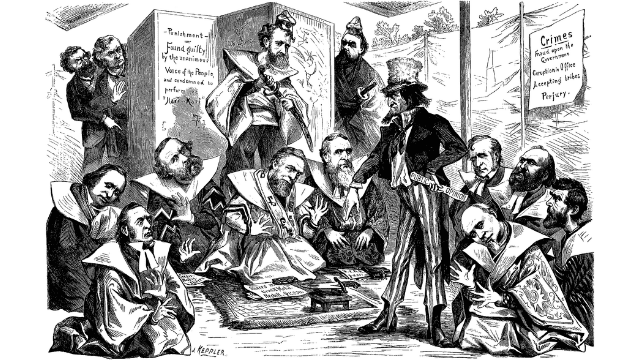
His murderer, Charles Julius Guiteau (1841–1882), although not a Satanist, had been a member of the Oneida Community of John Humphrey Noyes (1811–1886), where a form of sexual perfectionism was practiced. Guiteau wrote lengthy texts of a prophetic-religious nature, among which a book of prophecies with the title Truth. He also got syphilis from a prostitute, and killed Garfield because he refused to receive him and to give him an official position. Guiteau believed he was entitled to the gratitude of the President, as he had “helped” Garfield to be elected with his prophecies.
Nothing in all this suggests, however, a connection with Satanism. In fact, having killed Garfield, Guiteau, declared that “the President was a Christian and that he will be happier in Paradise than here.”

What is certain is that Garfield was never in Paris between 1875 and 1881, where he could not have lived with Clotilde Bersone nor directed the Seventh Circle.
Massimo Introvigne (born June 14, 1955 in Rome) is an Italian sociologist of religions. He is the founder and managing director of the Center for Studies on New Religions (CESNUR), an international network of scholars who study new religious movements. Introvigne is the author of some 70 books and more than 100 articles in the field of sociology of religion. He was the main author of the Enciclopedia delle religioni in Italia (Encyclopedia of Religions in Italy). He is a member of the editorial board for the Interdisciplinary Journal of Research on Religion and of the executive board of University of California Press’ Nova Religio. From January 5 to December 31, 2011, he has served as the “Representative on combating racism, xenophobia and discrimination, with a special focus on discrimination against Christians and members of other religions” of the Organization for Security and Co-operation in Europe (OSCE). From 2012 to 2015 he served as chairperson of the Observatory of Religious Liberty, instituted by the Italian Ministry of Foreign Affairs in order to monitor problems of religious liberty on a worldwide scale.