The Chinese government is expanding the scope of crackdowns on religions by stifling businesses that produce religious items.
by Yang Xiangwen
Quyang county, administered by the prefecture-level city of Baoding in the northern province of Hebei, is renowned across China for stone carving crafts. During the reign of the Western Han dynasty (206 BC-24 AD), Emperor Wu (157 BC-87 BC) named the area the “carving town.” Religious statues made in the county are sold all over China and also in Taiwan, but amid the CCP’s campaigns against people of faith, even those who make religion-related items are not spared.
Since the end of 2019, the county’s government has been collecting information on the production of religious statues in local workshops. The data is aggregated based on the location of businesses, their sales, and the religious affiliation of the sculptures they make.

Religious statues outside carving workshops were removed or covered.

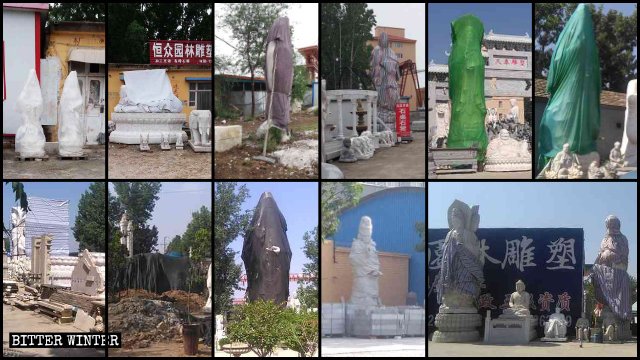
In April, the local government dispatched over 30 police officers to check on statue-making businesses and ensure that no religious icons could be seen outside them. Among them, Cihai Company, Jiutai Sculpture, and Shigong Park were ordered to cover or remove Buddhist statues kept outdoors, officers threatening to “destroy them if they disobey.”
To survive, some businesses started making “patriotic” effigies. “I was banned from making and selling Buddhist statues and was told to place one of Mao Zedong in front of others,” a business owner lamented. “This is the suppression of religion!”
Large exquisite Buddhist statues used to greet visitors at the entrance to Linqu Huayi Sculptural Arts Co., Ltd. in Weifang, a prefecture-level city in the eastern province of Shandong. Because of crackdowns on businesses making religious statues, the company’s productivity has declined sharply. All religious icons were cleared out of the factory, and a statue of Mao Zedong replaced the Buddhist deities at the entrance in December 2018.

“In 2018, the company suffered a loss of five million RMB [about $ 710,000] because of the government’s policies, and workers were not paid regular salaries for months,” a company employee explained.
“Whoever goes against government’s policies in China will suffer,” a manager of another company added. “One remark can land you in big trouble with authorities.”
Mr. Li from Baoji city in the northwestern province of Shaanxi used to build temples. Because the CCP’s religious suppression campaigns started affecting his business, he now does odd jobs to earn a living. He had to stop building two temples last year because his clients were afraid that the places of worship could be demolished based on the newly issued government regulations. “They decided to wait and see before making any decision,” the man said, showing the photos of his work on his cellphone proudly.

Uses a pseudonym for security reasons.