Italian political scientist Norberto Bobbio reminded us that press freedom includes the “right to dissent.” The Tai Ji Men case proves that this right may be misused.
by Michele Olzi*
*A paper presented at the international webinar “The Media Impact on FoRB and the Tai Ji Men Case,” co-organized by CESNUR and Human Rights Without Frontiers on May 8, 2025, after the United Nations World Press Freedom Day, celebrated on May 3.

Article 19 of the Universal Declaration of Human Rights reads: “Everyone has the right to freedom of opinion and expression; this right includes freedom to hold opinions without interference and to seek, receive, and impart information and ideas through any media and regardless of frontiers.” Each part of Article 19 implies the endorsement and defense of internationally acknowledged social and political values. The right to freedom of opinion and expression implies a continuous assessment of the state of press freedom throughout the world. The possibility of exerting this right “without interference” implies the independence of the media from any kind of attack. The fact that all can express their opinions “through any media and regardless of frontiers” is another fundamental principle of press freedom.
As we gather online shortly after World Press Freedom Day, Article 19 UDHR reminds us of what social and political values are at stake and need to be defended. More specifically, the right to freedom of expression is a crucial element of the socio-political framework of our society—and democratic regimes worldwide. Freedom of expression and opinion embodies a crucial political liberty that all citizens are entitled to, the possibility to express their dissent.
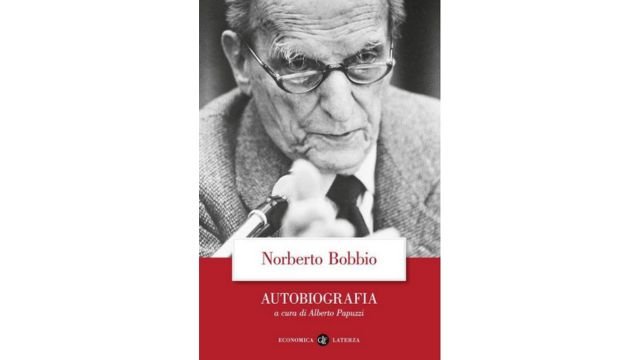
In other words, freedom of opinion and expression—via press freedom—, or the lack of it, characterizes the political dynamics of a collectivity. Therefore, the right to this freedom is a crucial element of the political sphere. This peculiar political liberty (i.e., the freedom to dissent) is essential to modern democracies. According to leading Italian political scientist Norberto Bobbio, freedom of opinion and expression (and of association) strongly influences political participation and decision-making processes. Free public debates between political actors are essential in the political life of a community. The possibility of dissent in any public political or mediatic confrontation is the core of a democratic system of governance.
This stresses once more that freedom of opinion and expression is a structural component of modern democracies. In one of the essays of his book “The Future of Democracy,” Bobbio writes: “A democratic system recognizes these [minority] movements and, within limits that vary from country to country, tolerates them, based on the two fundamental principles of freedom of association and freedom of opinion. These two principles are to be interpreted as the essential preconditions for the proper working of the rules of the game, particularly for the most basic rule defining democracy. It establishes that no collective decision taken is binding, or can be put into effect, unless its legality ultimately depends on a consensus that has expressed itself via the exercise of universal suffrage in periodic elections. Freedom of association and freedom of opinion are to be regarded as preconditions for the proper functioning of a democratic system. As it befits a system based on responding to demands expressed from below, and on the free choice of which policies should be adopted or which delegates should decide them, it puts the representatives in a position to formulate their own demands and to take decisions after due consideration and free debate. Obviously, neither freedom of association nor freedom of opinion can be completely unrestricted, which is true of any freedom. The shift in the limits one way or another determines the degree of democracy enjoyed in a system. Where the limits are extended, the democratic system undergoes modification. Where the two freedoms are suppressed, democracy ceases to exist altogether.”
This excerpt offers several political implications about freedom of opinion and expression. First, as already mentioned, these freedoms are “essential preconditions” for the “proper functioning of [any] democratic system.” This means that the suppression of these liberties is strictly connected to the potential collapse (or failure) of the democratic governance systems. A second implication relates to the media’s role in the community’s political life. Freedom of the press allows to “put the [political] representatives in a position to formulate their own demands and to take decisions after due consideration and free debate.” Media allows political actors to properly intervene in the public political and decision-making processes of the community. According to Bobbio, citizens may also take part in the political life of the community by manifesting their opinions—via the media. Again, this democratic process of participation allows the expression of the citizens’ dissent. According to Bobbio, the fact that both citizens and political actors can publicly manifest their dissent is the real “trial by fire” of any democratic system. Bobbio writes: “It is useless to delude ourselves: the acid test of a democratic system is the type of answer we give to these questions. I do not mean by this that democracy is a system founded on dissent rather than on consent. I mean that in a political system founded on a consensus that is not imposed from above, some form of dissent is inevitable. Only where dissent is free to express itself is consensus real. Furthermore, only where consensus is real can a system justly claim to be democratic.”
Therefore, the media plays a crucial role in the socio-political life of the collectivity. The media emphasizes and amplifies the opinions of political representatives and citizens—and their dissent. However, the way the media interact with the socio-political sphere of society and use the freedom of the press and of opinion is not always ethical. In other words, there are cases where the media misuse the freedom of the press and misrepresent the facts about specific events and citizens. In this sense, the campaign of persecution against the Tai Ji Men movement is emblematic.
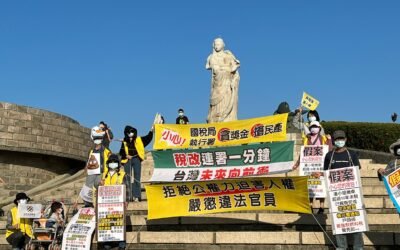
The Taiwan-based Tai Ji Men movement—more precisely, a “menpai” (similar to a “school”) of Qigong, self-cultivation, and martial arts—and his Zhang-men-ren or Shifu (“Grand Master”), Dr. Hong Tao-Tze, have suffered several public attacks and accusations from different Taiwanese institutions since the 1990s. Some accusations were peculiar and weird. On April 16, 1997, Prosecutor Hou Kuan-jen, of the Taipei District Prosecutors’ Office, disclosed the indictment against Dr. Hong and his dizi (disciples), whom he had been investigating since the previous year. The document accused Dr. Hong of “raising goblins.” Hou announced the accusation of raising goblins on television, which was met with both skepticism and ridicule. The magical practice of “raising goblins” may sometimes be found in Chinese and Asian folklore, but is foreign to Tai Ji Men culture and worldview.
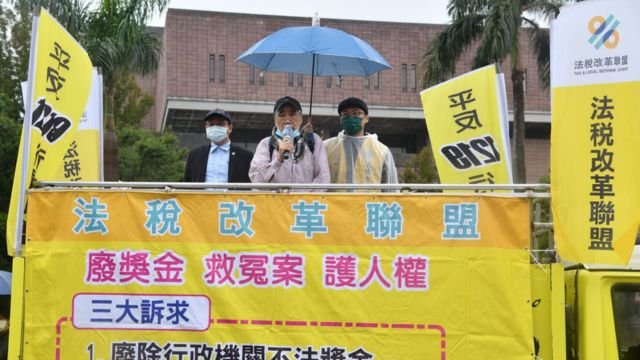
Besides these weird accusations, other media misrepresentations of the Tai Ji Men movement are connected to the false accusation of “tax evasion.” I guess we are all familiar by now with the fact that on July 13, 2007, the criminal division of the Supreme Court of Taiwan pronounced the final acquittal of Tai Ji Men defendants, declaring them innocent of all charges, including tax evasion. However, several years after that decision, the National Taxation Bureau (NTB) still maintained, based on a technicality, a tax bill for the year 1992. It insisted that the money Dr. Hong had received this year in the so-called “red envelopes” should not be considered as non-taxable gifts but as tuition fees for a so-called “cram school,” i.e., a school where pupils receive crash courses, normally in preparation for exams. Note that the NTB had agreed to reduce the tax bills to zero for all years other than 1992, and that the Taiwanese authorities in charge of overseeing cram schools had repeatedly declared that Tai Ji Men is not a cram school.
Prosecutor Hou and the NTB could not have continued with their fabricated accusations and tax bills without the support of several media outlets and their constant misrepresentation of Tai Ji Men. This was a peculiar case of misuse of press freedom in a democratic country.

Michele Olzi is currently teaching assistant to the chair of Political Theory and to the course of Religion and Media at the University of Insubria (Varese and Como). His interests include political theory, collective imaginaries, history of ideas, history of religions, religion & media, new religious movements, “technognosticism,” hyper-real Religions, religions and politics. He is a member of the organizing and scientific committee of the annual conference of Foro di Studi Avanzati Gaetano Massa. He edits the online journal La Rosa di Paracelso.