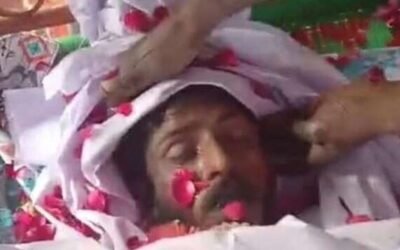
To offend Hindus even more deeply, the attack was carried out in the day celebrating the birth of Lord Krishna.
by Massimo Introvigne

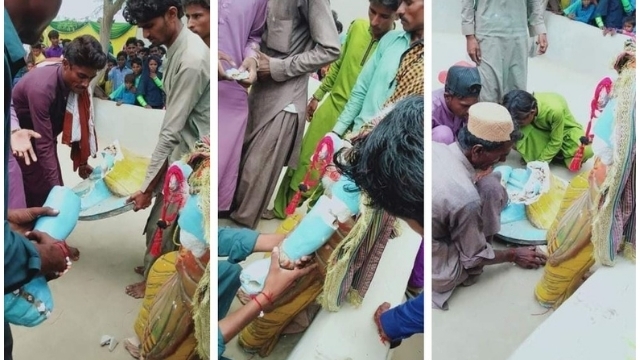
Hindu temples continue to be attacked in Pakistan. One was vandalized in Khipro in the Sanghar district of Pakistan’s Sindh province on August 30. The date is significant and especially offensive for the Hindus, as it coincides with the feast of Krishna Janmashtami, the celebration of the birth of Lord Krishna.
That offending the religious feeling of the Hindus was exactly what was intended is confirmed by the fact that a statue of Krishna was the main target of the attack.
A Christian who first denounced the attack on Twitter canceled his account from the social network in unclear circumstances.
However, local journalists went to Khipro, and shared on Twitter additional pictures of the attack and video interviews with eyewitnesses.
The incident is not isolated. Almost every week, Hindu and Sikh temples are vandalized in Pakistan. Minorities and human rights organizations blame Muslim ultra-fundamentalists and radical Islamic parties who thrive on hate speech against religious minorities.

Massimo Introvigne (born June 14, 1955 in Rome) is an Italian sociologist of religions. He is the founder and managing director of the Center for Studies on New Religions (CESNUR), an international network of scholars who study new religious movements. Introvigne is the author of some 70 books and more than 100 articles in the field of sociology of religion. He was the main author of the Enciclopedia delle religioni in Italia (Encyclopedia of Religions in Italy). He is a member of the editorial board for the Interdisciplinary Journal of Research on Religion and of the executive board of University of California Press’ Nova Religio. From January 5 to December 31, 2011, he has served as the “Representative on combating racism, xenophobia and discrimination, with a special focus on discrimination against Christians and members of other religions” of the Organization for Security and Co-operation in Europe (OSCE). From 2012 to 2015 he served as chairperson of the Observatory of Religious Liberty, instituted by the Italian Ministry of Foreign Affairs in order to monitor problems of religious liberty on a worldwide scale.