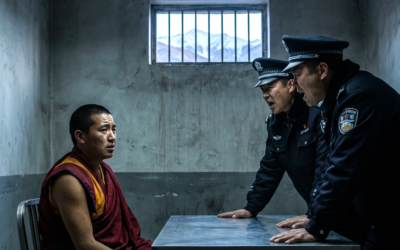
Activist who denounced atrocities in China should remain in jail at least until July 10, while heavy Chinese pressures in Kazakhstan continue.

Images of the court hearing
Massimo Introvigne
On June 7 the Justice Court of Nur-Sultan (formerly Almaty) ruled to keep Serikzhan Bilash under house arrest until July 10.
Bilash, the head of the Atajurt organization, was already under house arrest pending trial, after his arrest on March 10 for “inciting ethnic hatred.” Serikzhan gathered information through people in Kazakhstan about ethnic Kazakhs persecuted in China and released this information to international human rights organizations.
The prosecutor focused on Bilash’s alleged statements calling for “jihad against the Chinese,” and provided a video of an address he made to a public gathering in February. Bilash, however, claims the comments in the video are taken out of context.
Lead lawyer Aiman Umarova took part in the video court hearing in Almaty. She asked the court to release the defendant on bail. However, the judge rejected the request and decided to keep Serikzhan Bilash under house arrest at least for another month.
Protesters came to the court hearing with posters “China, Stop!” They asked the court to release the head of the organization, and claimed Chinese pressure are beyond the detention of Bilash.

Protests at the hearing

Massimo Introvigne (born June 14, 1955 in Rome) is an Italian sociologist of religions. He is the founder and managing director of the Center for Studies on New Religions (CESNUR), an international network of scholars who study new religious movements. Introvigne is the author of some 70 books and more than 100 articles in the field of sociology of religion. He was the main author of the Enciclopedia delle religioni in Italia (Encyclopedia of Religions in Italy). He is a member of the editorial board for the Interdisciplinary Journal of Research on Religion and of the executive board of University of California Press’ Nova Religio. From January 5 to December 31, 2011, he has served as the “Representative on combating racism, xenophobia and discrimination, with a special focus on discrimination against Christians and members of other religions” of the Organization for Security and Co-operation in Europe (OSCE). From 2012 to 2015 he served as chairperson of the Observatory of Religious Liberty, instituted by the Italian Ministry of Foreign Affairs in order to monitor problems of religious liberty on a worldwide scale.