A tabloid’s campaign led the Ministry of Churches to start a “supervision case” based on accusations already judged ill-founded almost everywhere in the world.
by Massimo Introvigne

“Something is rotten in the state of Denmark” is one of the most famous sentences in the history of theater. The Danish Prince Hamlet makes this statement in Shakespeare’s tragedy “Hamlet” after he has learned that his father, also named Hamlet and the previous king of the country, did not die of natural causes but was poisoned by his brother Claudius, who thus managed to succeed him on the throne. This incident happens in a context where the Danes are afraid a Norwegian invasion may be imminent.
It seems now that a sort of invasion of dubious legal behavior and misinformation from Norway has attacked Denmark. In Norway, in the last month of March a court decision presently under appeal upheld the decisions of the State Administrator of Oslo and Viken who denied the Jehovah’s Witnesses the state subsidies they had peacefully received for thirty years, and registration as a religious organization under the new Law 31 of 2020 based on a questionable interpretation of their practice of “shunning.”
The non-final Norwegian decision was promptly used by opponents of the Jehovah’s Witnesses in nearby countries to ask for investigations that may eventually lead to similar measures. In Denmark, a campaign was launched with great emphasis by the tabloid “Ekstra Bladet,” mobilizing in particular psychologist Susanne Benderfeldt, herself a former Jehovah’s Witnesses, and the opinions of professor of religious law Lisbet Christoffersen. Based on this campaign, the Ministry of Town, Country, and Churches (in short, the “Ministry of Churches”) told the same tabloid in writing that, “On the basis of the articles of ‘Ekstra Bladet,’ the Ministry has initiated a supervision case.” In a further interview by “Ekstra Bladet” with the Minister of Churches, Morten Dahlin, it was confirmed that the sources the Ministry relied on were those published by the tabloid.
Here, we already have something to which Prince Hamlet, had he lived in the 21st century, might have applied his famous comment. A minister takes action against a community of peaceful and law-abiding citizens that has been active in Denmark for more than 100 years on the basis of the articles of a tabloid. Surely this cannot be regarded as normal, also considering that “Ekstra Bladet” has been often criticized for promoting hate speech against religious minorities. In 2016, it had to pull an article falsely claiming that “Muslims were more than 200 times more likely to kidnap women for sex slavery than non-Muslims.” The article was published in the “People’s Voice” section of the tabloid (discontinued in 2018), to which citizens were invited to contribute. However, academics noted that articles in that section were published with the same layout as others in “Ekstra Bladet” and “were clearly mistaken as articles written by professional journalists,” thus “blurring boundaries of news and opinion, and journalism and user-generated content.”
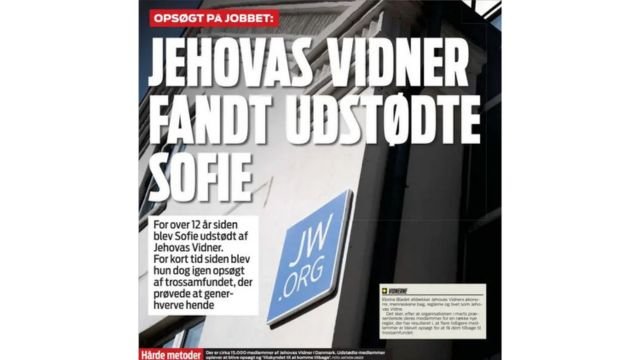
Since a “supervision case” has been started we should pay attention to the accusations raised against the Jehovah’s Witnesses, even if they come from a tabloid. They are of three different kinds.
The first argument coming from the sensational revelations of “Ekstra Bladet” is that when confronted with cases of child sexual abuse the Jehovah’s Witnesses according to a “secret Elders’ book” do not report the incidents to the police but deal with them through their internal ecclesiastical committees. It seems that there is here a usual confusion, I don’t know whether entertained in good faith or otherwise, or perhaps capitalizing on the Islamophobic moral panic about “shariah courts” where Muslims are frequently accused to take their cases rather than to secular justice. The Jehovah’s Witnesses do have an internal judicial system, as do Roman Catholics through their canon law tribunals, Jews with their rabbinical courts, and—yes—Muslims.
The aim of the judicial system of the Jehovah’s Witnesses is not to determine whether a member accused of child sexual abuse or other crimes is guilty and should go to jail. They do not have such power. The aim of the ecclesiastical justice, in all religions, is to establish whether a member should be disciplined or expelled. The criteria applied, even when judging the same facts, may differ from secular justice. But the existence of an internal ecclesiastical judicial system does not mean that a religious organization refuses to report cases of criminal behavior to the secular justice. The two systems run parallel and are not in competition. A Catholic priest or layman accused of pedophilia will be judged by secular courts and sent to jail if deemed guilty, and at the same time tried by a canonical tribunal. The latter may decide to excommunicate him, defrock him if he is a priest, or accept his repentance (which may be less relevant in a secular court) as sincere and impose lesser penalties. All this will have nothing to do with his fate in a secular criminal trial.
I am sorry to see Professor Christoffersen (who in 1999 included a chapter written by me critical of the European anti-cult movement in a book she co-edited with Jørgen Bæk Simonsen, Visioner for religionsfrihed, demokrati og etnisk ligestilling, Copenhagen: Nævnet for Etnik Ligestilling) disagree, but “confusion” is the appropriate name for what is being propagated. Yes, the Jehovah’s Witnesses do try members for various offenses in their ecclesiastical courts, as it happens in many other religions and is typically protected by freedom of religion or belief. No, that does not mean that in countries where reporting is mandatory (such as Denmark) they do not report cases of child sexual abuse and other crimes to the secular authorities. I am aware that this has happened in Denmark for decades.
It is not a new teaching. As early as 1993, the “Awake!” magazine recommended that, in case of rape, one should “call the police as soon as you are able to,” noting also that “reporting is not the same as prosecuting, but if you choose to prosecute later, your case will be weakened by a delayed report” (“How to Cope with Rape,” “Awake!,” March 8, 1993, 8–11 [11]). In 1997, the same “Awake!” magazine suggested to Jehovah’s Witnesses that “children should also be warned about—and urged to report to authorities—any person making improper advances toward them, including people they know” (“Sexual Exploitation of Children—A Worldwide Problem,” “Awake!,” April 8, 1997, 11–15 [14]). Also, in 1997, “The Watchtower” asked, “What if a baptized adult Christian sexually molests a child?” The answer was that “the molester may well have to serve a prison term or face other sanctions from the State. The congregation will not protect him from this” (“Let Us Abhor What Is Wicked,” “The Watchtower,” January 1, 1997, 26–29 [28–29]).
Second, backed by the apostate psychologist—“apostate” is not an insult, but a technical term used by sociologists to designate the minority among the ex-members who become militant opponents of the religion they have left—the Jehovah’s Witnesses are accused of “psychological violence” against children. According to Benderfeldt, “Children in Jehovah’s Witnesses are brought up to believe in Judgment Day, where everyone who does not believe in Jehovah dies. At the same time, they grow up with many restrictions and a twisted view of the world. If that’s not psychological violence, I don’t know what is… As a child of Jehovah’s Witnesses, you are subject to restrictions such as not celebrating Christmas, Fastelavn [the last day of Carnival, before Lent], or birthdays.”
The last comment betrays the inherently non-democratic idea that parents do not have the right to pass to their children a way of living different from the majority of the society. Jehovah’s Witnesses believe that celebrating Christmas, Carnival, or birthdays is against the Bible as they interpret it. But in fact, in a pluralistic society children (and adults) celebrate, or do not celebrate, different feasts. I remember having Jewish classmates in my school who did not celebrate Christian feasts when most of the class did. I grew up in the late 1950s and 1960s in Italy, where there was a strong Communist presence, and children from Communist families would not celebrate certain civil and religious feasts either. There were also Protestant children who did not share in the joyful celebrations of the feasts of the Virgin Mary, a typical feature of Italian culture. And so on. If the law should compel the Jehovah’s Witness children to celebrate birthdays and Christmas, it should also compel children from Jewish or atheist families to celebrate the birth of Jesus, which would be a serious violation of their freedom of religion or belief. A more reasonable solution is to teach minors that a pluralistic society includes women, men, and children of different beliefs and cultures, and all should be respected.
That “everybody who does not believe in Jehovah” dies at Armageddon, the end of the world as we know it in Jehovah’s Witness theology, is a gross over-simplification of a complex doctrine. In fact the answer they give to the question whether only Jehovah’s Witnesses will be saved is more nuanced: “Many millions who lived in centuries past and who weren’t Jehovah’s Witnesses will have an opportunity for salvation… Additionally, many now living may yet begin to serve God, and they too will gain salvation.” Most importantly, they teach that, “In any case, it’s not our job to judge who will or won’t be saved. That assignment rests squarely in Jesus’ hands.”
Again, the psychologist defines as “psychological abuse” sharing with children teachings found in many if not most religions, who do believe in a Judgement Day. The catechism for the youth most used in the Roman Catholic Church, called YOUCAT and introduced in 2021, teaches that there will be an “end of the world” accompanied by a “Last Judgment”: “The Last Judgment is … our day in court. Here it is decided whether we will rise to eternal life or be separated from God forever” (n.161). The same catechism explains to Catholic children that being “separated from God forever” means that at Judgement Day some will go to “hell… the ‘outer darkness’ (Matthew 8:12). Expressed in our terms, it is cold rather than hot. It is horrible to contemplate, a condition of complete rigidity and hopeless isolation from everything that could bring aid, relief, joy, and consolation into one’s life” (n. 53). Is this also “psychological abuse”?
The mention of “restrictions” seems to refer to the usual accusation by their critics that Jehovah’s Witnesses prevent their children from reading certain books and comics and watching some movies or TV shows. Contemporary popular culture includes much that many parents find objectionable for different reasons. Teaching children that certain products should be avoided may be a healthy attitude and is certainly part of the parents’ freedom of education. It is not “psychological abuse” to restrict children’s access to products of popular culture or entertainment media that are also criticized by many parents who are not Jehovah’s Witnesses as unhealthy or inappropriate, no matter how popular they are with the majority.

The third accusation deals with the same matter that is being litigated in Norway. It is alleged that by teaching and practicing “shunning,” i.e., counseling members not to associate with ex-members (except cohabiting relatives) who have been “disfellowshipped” (or “removed from the congregation,” which is the term now used) as guilty and unrepentant of serious transgressions, or have publicly disassociated themselves from the organization, the Jehovah’s Witnesses commit again “psychological abuse.”
It is added that the practice is even more “abusive” when “children” (meaning minors) are “disfellowshipped” and “shunned.” The Danish Ministry and its sources do not clarify whether any minor was ever “disfellowshipped” and “shunned” in Denmark. Cases of disfellowshipping of minors are indeed extremely rare.
This issue has been litigated in many countries, with verdicts favoring Jehovah’s Witnesses, except in Russia, hardly a model of religious liberty, and in the already mentioned non-final decision in Norway. Courts have noted that no one can be forced to associate with people they no longer wish to, and “shunning” occurs often due to various disagreements. Divorced individuals are frequently “shunned” by former spouses and relatives.
The Bible references shunning in passages like 1Corinthians 5:13 (“Expel the wicked person from among you”) and 5:11 (“Do not even eat with such people”), and 2 John:10–11 (“Do not take them into your house or welcome them. Anyone who welcomes them shares in their wicked work”: all quotes from the New International Version). Interpretation of these texts is a religious matter that secular states cannot adjudicate without violating freedom of religion.
I would recommend that the Ministry of Churches, rather than being led a merry chase by a tabloid, investigates some further interesting questions. Why are campaigns against the Jehovah’s Witnesses, using the same ill-founded arguments, conducted simultaneously in different countries of the world from Japan to Denmark? Who promotes them and why? Why they come after the European Court of Human Rights and other international institutions have condemned Russia for its “liquidation” of the Jehovah’s Witnesses in 2017? Is there some coordination of these international campaigns? And yes—is something rotten in the state of Denmark?

Massimo Introvigne (born June 14, 1955 in Rome) is an Italian sociologist of religions. He is the founder and managing director of the Center for Studies on New Religions (CESNUR), an international network of scholars who study new religious movements. Introvigne is the author of some 70 books and more than 100 articles in the field of sociology of religion. He was the main author of the Enciclopedia delle religioni in Italia (Encyclopedia of Religions in Italy). He is a member of the editorial board for the Interdisciplinary Journal of Research on Religion and of the executive board of University of California Press’ Nova Religio. From January 5 to December 31, 2011, he has served as the “Representative on combating racism, xenophobia and discrimination, with a special focus on discrimination against Christians and members of other religions” of the Organization for Security and Co-operation in Europe (OSCE). From 2012 to 2015 he served as chairperson of the Observatory of Religious Liberty, instituted by the Italian Ministry of Foreign Affairs in order to monitor problems of religious liberty on a worldwide scale.