Today, there would be no revival of African Indigenous Spirituality without the founder and leader of The Revelation Spiritual Home.
by Rosita Šorytė*
*A paper presented at the American launch of the book by Massimo Introvigne and Rosita Šorytė “The Revelation Spiritual Home: The Revival of African Indigenous Spirituality” (Cambridge: Cambridge University Press, 2025), and the Honorary Doctorate Ceremony for Inkosi yamaKhosi Omoya IMboni uZwi-Lezwe Radebe
New York, HJ International Graduate School for Peace and Public Leadership, January 17, 2025.
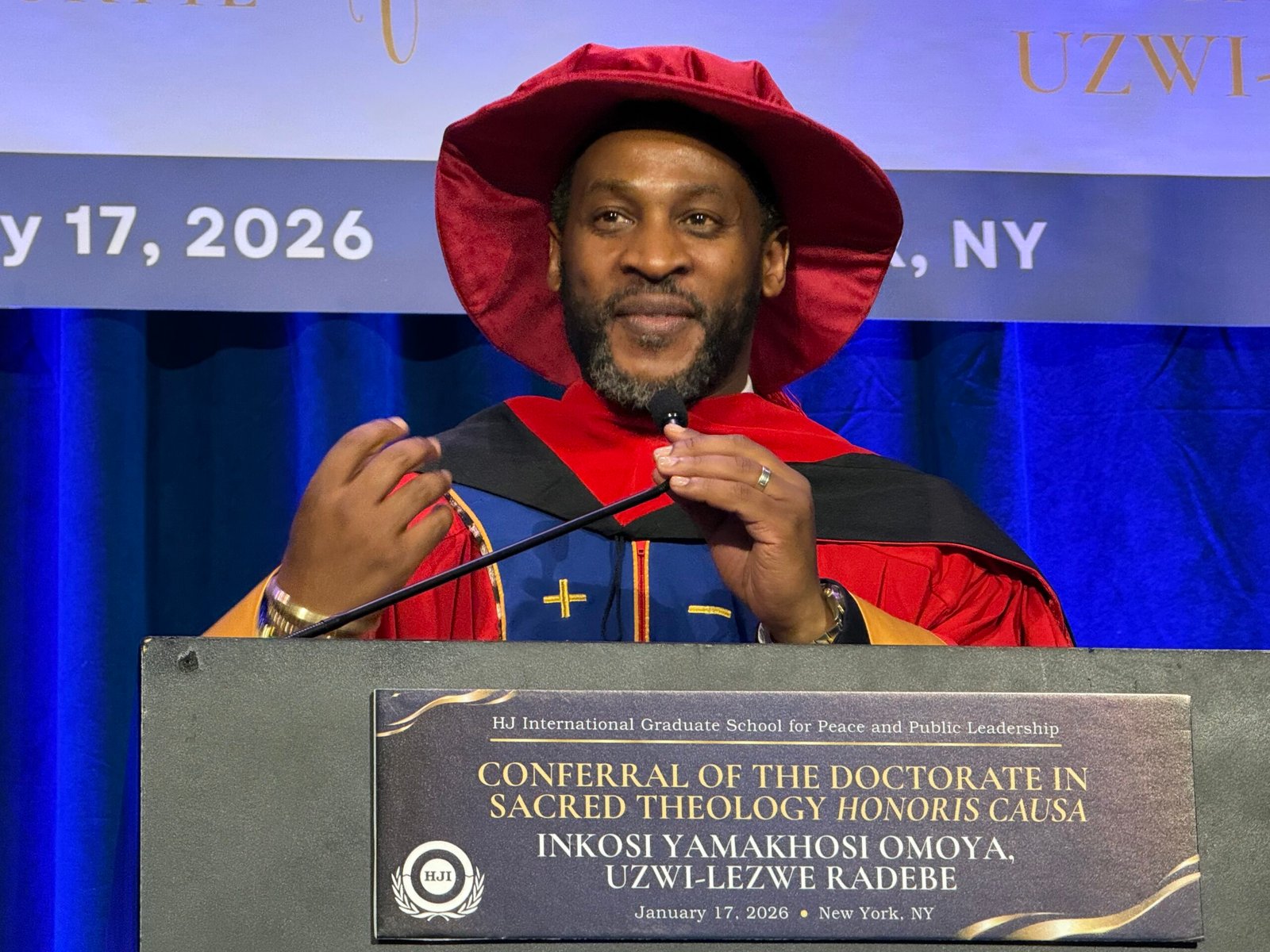
It is a profound privilege to stand before you this morning in New York, in the presence of so many distinguished scholars, spiritual leaders, and cultural figures, to launch a book and at the same time celebrate a moment of great significance: the conferral of an honorary doctorate upon a man whose life and work have already shaped the spiritual landscape of Southern Africa and whose influence is increasingly felt across the world—Inkosi yamaKhosi Omoya IMboni uZwi-Lezwe Radebe, whom I will call simply IMboni (although this name designates a function and there have been other IMboni before him) or Radebe, his clan name.
Tonight is a celebration of scholarship, of culture, of spirituality—but above all, it is a celebration of a life that has become a beacon for many. And so, allow me to take you on a journey through that life, drawing on the research that Massimo and I conducted, and on the rich documentation available, including the entry we just published in the World Religions and Spirituality Project, the most authoritative online academic encyclopedia of religions. The encyclopedia (now independent) was started at Virginia Commonwealth University and now has an entry on The Revelation Spiritual Home. I consider this encyclopedia entry, although shorter, no less important than the book. Ideally, after the British academia, with Cambridge University Press publishing our book, it is now the American academia that acknowledges the importance of IMboni’s institution through its most celebrated religious encyclopedia.
IMboni was born Samuel Mbiza on November 8, 1977, in Gugulethu, Western Cape, South Africa. Gugulethu is a place of hardship but also of resilience, a place where communities have learned to survive and to hope. It was in this environment that the young Samuel began to experience what those around him recognized as signs of a spiritual calling.
Between 1981 and 1983, as a very young child, he had visions and spiritual experiences that elders interpreted as manifestations of a divine vocation. Many spiritual leaders in African Indigenous Spirituality recount early experiences of this kind, but Samuel’s were not fleeting impressions. They were persistent, vivid, and transformative. They marked him as someone destined for a path different from that of his peers.
These early experiences reveal a pattern that would continue throughout his life: a receptiveness to the unseen, an openness to the ancestral world, and a capacity to interpret visions as messages meant for a community.

At the age of sixteen, in 1993, Samuel joined the Universal Church of the Kingdom of God, a Brazilian Pentecostal denomination, in Johannesburg. There, he quickly distinguished himself as a gifted preacher. His sermons carried a force that belied his youth. He became known as a “boy preacher,” someone whose charisma and spiritual authority were unmistakable even to those much older and more experienced.
This period is crucial for understanding his later work. It was in that Brazilian church that he learned the discipline of ministry, the structure of leadership, and the power of organized spiritual communities. But it was also there that he began to sense that his calling was not to remain within an imported and somewhat racist religious framework. Something deeper, something rooted in the land, in the ancestors, in African cosmology, was calling him.
The decisive moment came in 2006, at the Vaal River, near Johannesburg. There, Samuel experienced a revelation that would change the course of his life and, ultimately, the lives of millions.
He saw a golden lampstand with seven colored candles, and beings with abnormally large heads—a vision rich in symbolism, resonant with African spiritual imagery, and unmistakably powerful. In that moment, he understood that he was being called to establish a new African spiritual institution, one that would restore the dignity, depth, and authenticity of African Indigenous Spirituality.
This revelation is the foundational moment of The Revelation Spiritual Home. It is the moment when Samuel Mbiza became IMboni—the Seer, the Voice of the Nation, the one who listens to the ancestors and interprets their messages for the people.
Two years later, on December 5, 2008, he undertook a pilgrimage to the Blood River. This site is charged with historical and spiritual significance. It is a place where narratives of conflict, identity, and memory converge. For the Afrikaners, it is the place of their 1838 victory over the Zulus, which they attribute to the Christian God. Radebe went there accompanied by followers, which he initially referred to as the “Three Mighty.” He enacted a counter-covenant at the Blood River, dissolving what he regarded as a curse imposed on Africans. This act was seen by followers as a turning point in African history, marking the reclaiming of spiritual sovereignty from colonial powers.
African Indigenous Spirituality is deeply connected to land, rivers, mountains, and the places where ancestors walked. By going to the Blood River, Radebe was re-inscribing African spirituality into the geography of South Africa. He was reclaiming sacred space.
Shortly later, during a night vigil at one of the main branches of the Universal Church of the Kingdom of God, where Radebe was conducting a service, a young boy reportedly vomited a lion’s nail. A “spiritual presence” subsequently confirmed that this signified the dominion as a consequence of the Covenant Radebe had established at the Blood River.
On March 22, 2009, the first service after the separation from the Universal Church was held in a restaurant at Gandhi Square, Johannesburg. This was followed by services held in the basement of a building on Plein Street, during which Radebe temporarily named the institution the “African Church.”
These humble beginnings were quickly overshadowed by rapid growth. In April, during a large gathering at Johannesburg City Hall, Radebe and his followers adopted the name “The Revelation Church of God,” which he claimed he had received through revelation. Later, the name was changed to “The Revelation Spiritual Home” to emphasize that it is not a church, religion, or religious movement. Radebe insists that Africans do not have a religion. They have spirituality. The Revelation Spiritual Home prefers to be called an “institution,” to avoid religious references it perceives as non-African and colonial.
In May and June 2012, Radebe reported a spiritual revelation instructing his followers to enter into the Covenant with him and his Deity.
In 2014, Radebe acquired a mountain near Clocolan, in South Africa’s Free State. He concluded there a Covenant that was not new but a reaffirmation of the one at the Blood River.
In February 2015, Radebe announced the revelation designating this pact as “the Covenant of Restoration.” In June 2015, Radebe’s followers undertook their first pilgrimage to the mountain to renew their commitment to the Covenant of Restoration. This is their annual pilgrimage, even as its date and location shifted over time.
It is through this spiritual mountain that the revelations about the corrupted faith began to unfold in successive phases, guiding the restoration of African Indigenous Spirituality and African identity.
The institution insists that although the formal process of restoring African Indigenous Spirituality emerged during the 2010s, Radebe’s spiritual gifts had been present since birth, long before the institution’s founding. They explain that, like other IMboni, Radebe grew up in a Christian environment. Nevertheless, he carried an inherent spiritual destiny that pointed toward a different purpose. This inner calling distinguished him and ultimately led to the restoration work he later embodied.
The significance of this restoration lies in the recognition that African Indigenous Spirituality had always been present within him, even as it found fuller expression through progressive divine revelation and institutional formation. In fact, Radebe’s institution has consistently practiced African Indigenous Spirituality, while initially incorporating selected elements of Christianity, reflecting the historical and spiritual realities of African spirituality and religious experience.
And now, what began as a small gathering has grown into what may well be the largest African Indigenous Spirituality institution, with more than three million members and seventy branches across Southern Africa, plus one in Atlanta, Georgia, and one in Ireland.
Massimo and I were struck, during our fieldwork, by the extraordinary richness of the institution’s ritual life: the choreography, the music, the dress codes, the symbolism, the cosmology. Everything is intentional. Everything is meaningful. Everything is rooted in African Indigenous Spirituality.
To understand the institution, one must understand its founder. Dr. Radebe. He is a visionary, a strategist, a teacher, and a custodian of African wisdom.
He is also a man of remarkable discipline. Those who know him speak of his tireless work ethic, his commitment to spiritual practice, and his insistence on excellence. He is demanding, but he is also compassionate. He listens. He guides. He inspires.
In our research, we encountered countless testimonies from women and men who spoke of how their lives had been transformed—how they had found purpose, healing, identity, and community through the teachings of IMboni.
One of the most striking aspects of his leadership is his pan-African vision. His institution is not confined to South Africa. It is expanding across the continent, and its message resonates with Africans everywhere: reclaim your spirituality, reclaim your identity, reclaim your dignity.
It is a call to remember that Africa has its own sacred traditions, cosmologies, and ways of connecting with the divine. A call that stands as a powerful affirmation of African spiritual sovereignty.
Dr. Radebe’s influence is not limited to Africa. He has traveled internationally, participated in global spiritual events, and brought African Indigenous Spirituality to audiences who had never encountered it before. He has supported the cause of religious liberty internationally. I want to remember here his moving visit last year to Mother Han in the Korean jail where she is unjustly detained. The visit moved me deeply, particularly because I, too, went there to pray with the believers for the liberation of Mother Han during a memorable Korean night.
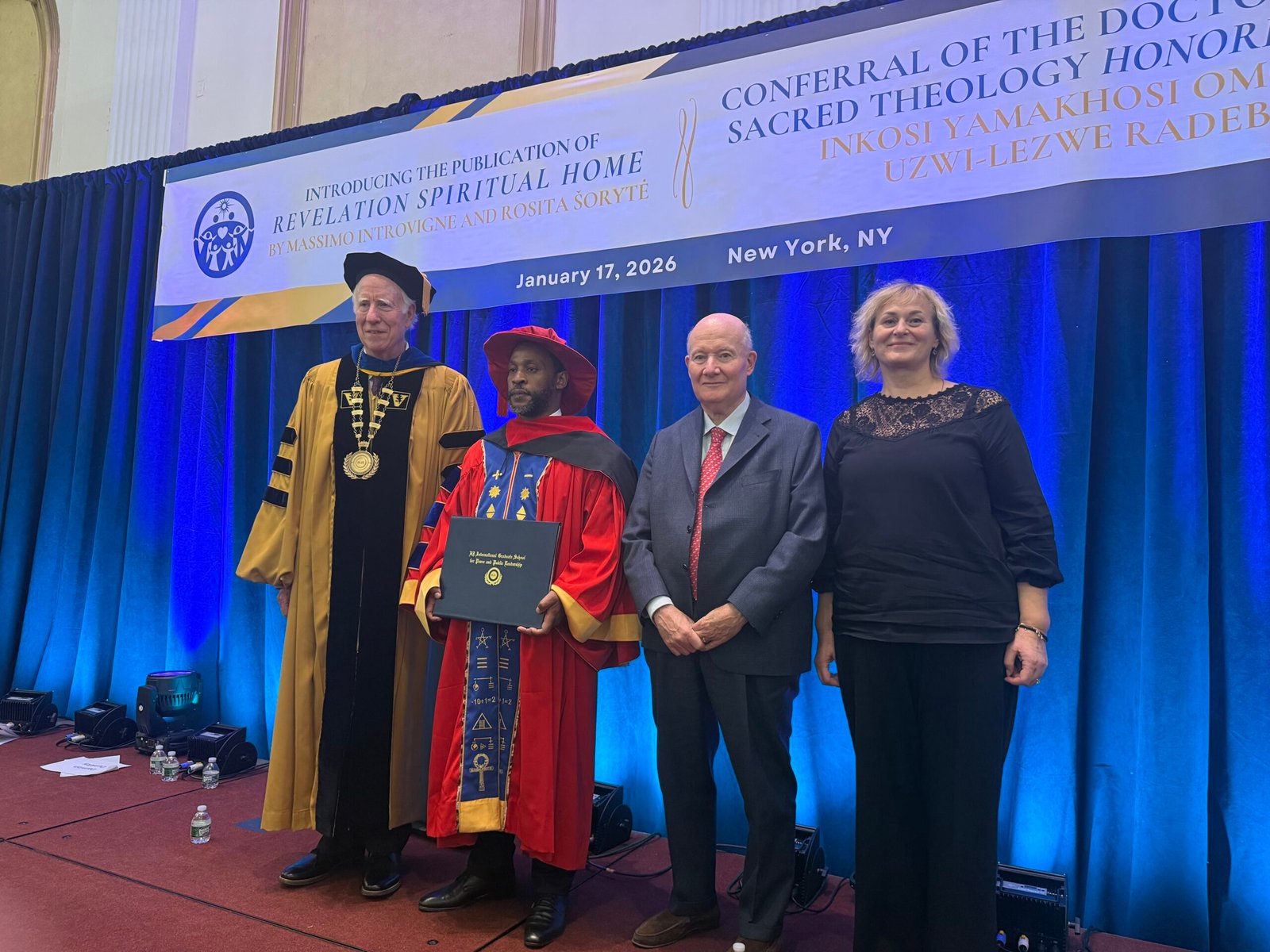
And now, here in New York, we witness another milestone: the conferral of an honorary doctorate. Although he is not an academic in the conventional sense, IMboni is a scholar of the spirit. His teachings are profound, systematic, and intellectually rich. They draw on African cosmology, ancestral wisdom, symbolic interpretation, and ritual knowledge.
African Indigenous Spirituality has long been marginalized, misunderstood, or dismissed—first by colonial powers, then by missionary religions, and finally by modern secularism. IMboni tells us it is not a relic of the past. It is a living, evolving, dynamic spiritual tradition.
IMboni is the most crucial figure in the contemporary revival of African Indigenous Spirituality. He is making ancient spirituality accessible to new generations. He is demonstrating that African Indigenous Spirituality has something vital to offer to the modern world: a holistic understanding of human beings, a deep respect for ancestors, and a profound connection to nature.
Our world is marked by fragmentation, by loss of meaning, by spiritual disorientation. Many people feel disconnected—from their communities, from their roots, from themselves.
Leaders like IMboni are essential. They remind us that spirituality is not an escape from the world but a way of engaging in it. That identity is not imposed from outside.
Our book is the first academic monograph dedicated to The Revelation Spiritual Home. It is based on extensive fieldwork, interviews, participant observation, and analysis of teachings, rituals, and organizational structure.
Our goal was not to impose external categories, but to listen to the categories that the institution itself uses.
The book is, in many ways, a tribute to the richness of African Indigenous Spirituality. But it is also a tribute to the man who has done more than anyone else to bring African Indigenous Spirituality into the 21st century with dignity, coherence, and vitality. In fact, the book shows that today there would be no revival of African Indigenous Spirituality without IMboni.
If you will allow me to conclude with a personal reflection, writing this book was not only an academic project. It was a journey. A journey into a world of beauty, of depth, of meaning. A journey into a spiritual universe that is both ancient and new. A trip inside the wisdom and power of IMboni.
I am grateful for that journey. And I am thankful to be here tonight, celebrating a man whose life has touched so many.
As we honor IMboni tonight, we are not only reflecting on past achievements. We are celebrating a future—a future in which African Indigenous Spirituality continues to flourish, in which The Revelation Spiritual Home continues to grow, in which IMboni’s message of restoration, dignity, and spiritual sovereignty continues to inspire.
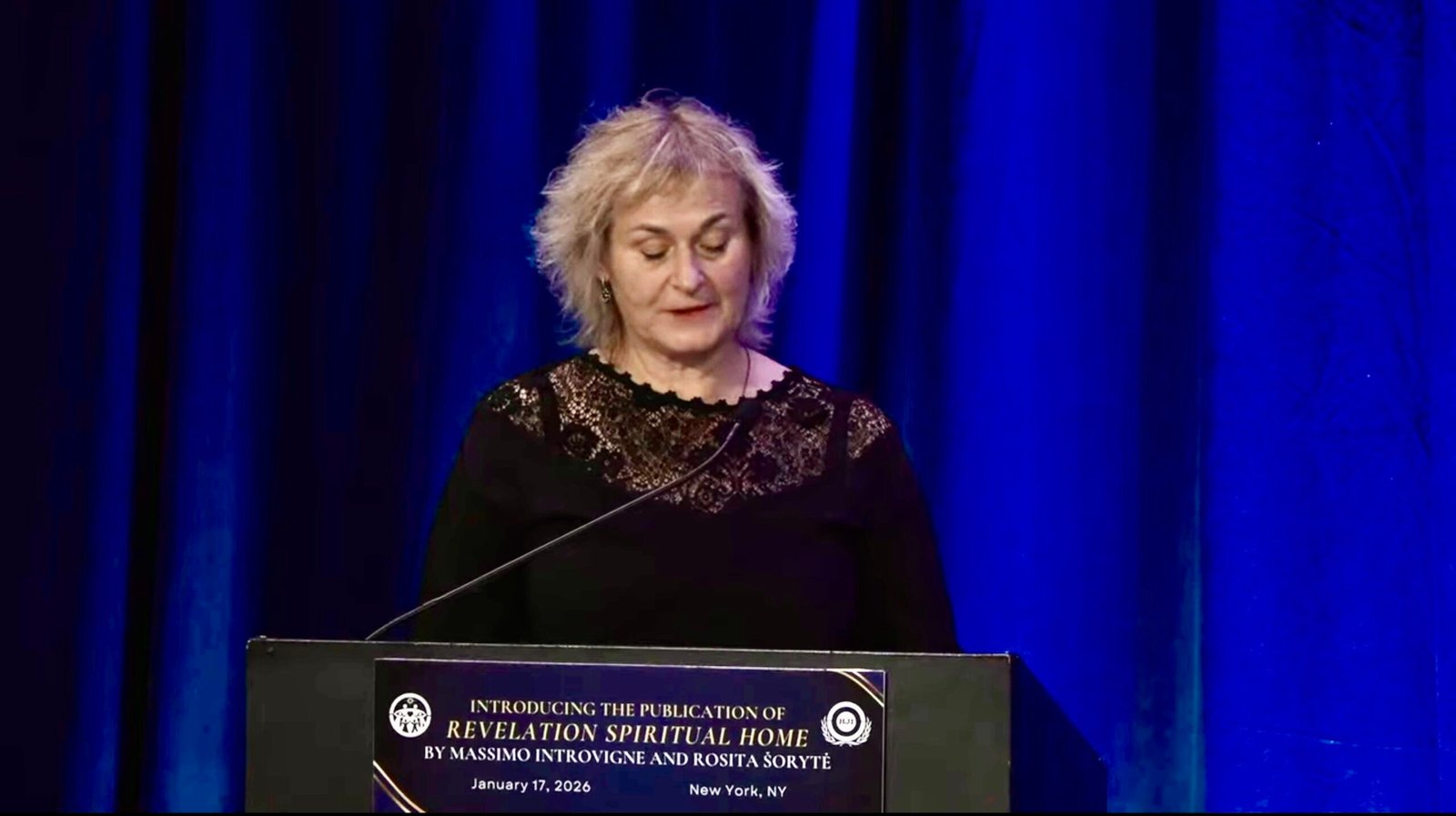
Ladies and gentlemen, it is my honor to introduce the book “The Revelation Spiritual Home,” and it is my even greater honor to pay tribute to the man at its center.
Please join me in celebrating Inkosi yamaKhosi Omoya IMboni uZwi-Lezwe Radebe, a visionary, a teacher, a restorer of African spirituality, and now—rightly—a recipient of an honorary doctorate.

Rosita Šorytė was born on September 2, 1965 in Lithuania. In 1988, she graduated from the University of Vilnius in French Language and Literature. In 1994, she got her diploma in international relations from the Institut International d’Administration Publique in Paris.
In 1992, Rosita Šorytė joined the Ministry of Foreign Affairs of Lithuania. She has been posted to the Permanent Mission of Lithuania to UNESCO (Paris, 1994-1996), to the Permanent Mission of Lithuania to the Council of Europe (Strasbourg, 1996-1998), and was Minister Counselor at the Permanent Mission of Lithuania to the United Nations in 2014-2017, where she had already worked in 2003-2006. In 2011, she worked as the representative of the Lithuanian Chairmanship of the OSCE (Organization for Security and Cooperation in Europe) at the Office for Democratic Institutions and Human Rights (Warsaw). In 2013, she chaired the European Union Working Group on Humanitarian Aid on behalf of the Lithuanian pro tempore presidency of the European Union. As a diplomat, she specialized in disarmament, humanitarian aid and peacekeeping issues, with a special interest in the Middle East and religious persecution and discrimination in the area. She also served in elections observation missions in Bosnia and Herzegovina, Georgia, Belarus, Burundi, and Senegal.
Her personal interests, outside of international relations and humanitarian aid, include spirituality, world religions, and art. She takes a special interest in refugees escaping their countries due to religious persecution and is co-founder and President of ORLIR, the International Observatory of Religious Liberty of Refugees. She is the author, inter alia, of “Religious Persecution, Refugees, and Right of Asylum,” The Journal of CESNUR, 2(1), 2018, 78–99.
Languages (fluent): Lithuanian, English, French, Russian.