What has been done so far to solve the Tai Ji Men case? What can be done in the future?
by Alessandro Amicarelli*
*A paper presented at the webinar “The Tai Ji Men Case: Tragedy and Triumph,” co-organized by CESNUR and Human Rights Without Frontiers for the 18th anniversary of Taiwan’s 2007 Supreme Court decision in favor of Tai Ji Men, July 13, 2025.

Today we commemorate a legal milestone: the 18th Anniversary of the Supreme Court ruling in the Tai Ji Men case. On July 13, 2007, as previously recalled, Taiwan’s highest court declared that no laws had been broken, no tax evasion had occurred, and the red envelopes offered by the Tai Ji Men dizi (disciples) to their Shifu (Grand Master) included gifts, not taxable income.
It was a moment of truth and vindication for Tai Ji Men; unfortunately, it was not the end of this sad story.
The Supreme Court Victory Was Also a Democratic Test for Taiwan
The 2007 ruling should have closed the case once and forever. It was clear, final, and it unanimously stated:
– No fraud
– No tax evasion
– No violation of the Tax Collection Act
– Compensation was awarded (in 2009) for the previous wrongful detention.
It could not have been clearer that Tai Ji Men had been right, and the prosecutor wrong, for all that time. Nonetheless, eighteen years later, the consequences of that ruling remain unfulfilled. Why?
The National Taxation Bureau (NTB) refused to revoke the 1992 tax bill, even though parallel bills for other years were corrected to zero. In 2020, the government seized, unsuccessfully auctioned, and nationalized sacred land belonging to Tai Ji Men, which was meant for spiritual practice and educational activities.
As we saw during our seminars, and repeated abundantly over the last few years, this is not just bureaucratic oversight. It is a constitutional crisis in miniature: the rule of law is scrapped when administrative agencies defy judicial authority.
The Cost of Injustice for Tai Ji Men and Taiwan
The injustice experienced by Tai Ji Men and what it cost them has been profound, meaning, for instance:
– Spiritual harm from the desecration of their sacred land
– Emotional trauma from decades of false accusations
– Social stigma that remains, to some extent, despite legal discharge.
The cost of this injustice has been equally serious for Taiwan, meaning, for instance:
– A mark on its democratic records
– A contradiction between its international image and the actual domestic reality
– A missed opportunity to lead on transitional justice and freedom of religion or belief (FoRB).
As Massimo Introvigne has noted, this case is not just about tax law but about conscience, dignity, and the soul of democracy.

Taiwan in the Global Scene: A Moment of Reckoning
Taiwan is rightly celebrated for its vibrant democracy and civil liberties.
We are friends of Taiwan and have visited the island many times. I also had the honour of teaching human rights there. We have always praised Taiwan for its bravery, openness to change, and willingness to improve and ensure full equality for all.
Taiwan is also a key ally of the United States, which places FoRB at the heart of its foreign policy.
Despite this pleasant and colorful general reality, the Tai Ji Men case raises puzzling questions for Taiwan as a country that upholds democratic values and human rights, such as:
– Can Taiwan claim to uphold FoRB while ignoring its own Supreme Court final ruling?
– Can it promote transitional justice while leaving this critical case de facto and unresolved?
– Can it be a model of democracy while tolerating such bureaucratic impunity?
As our friend Willy Fautré of Human Rights Without Frontiers said, “This is not just a tax case. It is a human rights case with global implications.”
Let’s See What Has Been Done So Far
Let’s acknowledge the progress made so far by Tai Ji Men with international NGOs’ and scholars’ help:
– Tai Ji Men has partnered with CESNUR, Human Rights Without Frontiers, and other NGOs
– The case has been presented at the IRF Summits, UN side events, and academic conferences
– Scholars like Massimo Introvigne, Rosita Šorytė, Marco Respinti, and Eileen Barker, among many others, and I have published extensively on the case
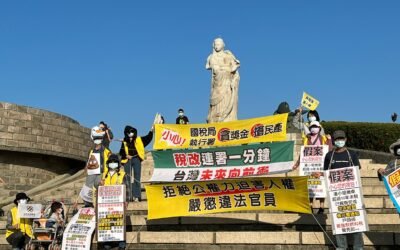
– Dizi have taken to the streets, the courts, and the global stage to demand justice.
All these actions made a robust impact internationally, countering the negative propaganda available on the internet until a few years ago.
This is undoubtedly a remarkable achievement if we consider it a grassroots movement that has become a global cause, shaking consciences worldwide. Tai Ji Men’s worldwide number of friends has increased dramatically over the last five years.
The reality of facts makes us aware that, however amazing this sounds, it is not enough.
Yes, it is not enough. Although advocacy has proven helpful for Tai Ji Men, we need a fundamental transformation.

Next Steps Are Needed: Moving from Advocacy to Transformation
1. Continue and Deepen International Partnerships
– Maintain strong ties with CESNUR, HRWF, FOB, CAP-LC, and other NGOs
– Expand outreach to academic institutions, legal clinics, and human rights law centres
– Engage with UN Special Rapporteurs on FoRB and transitional justice.
2. Academic Integration: From Case Study to Curriculum
The Tai Ji Men case is rich with academic potential:
– A bachelor’s or master’s degree final thesis in law, philosophy, religious studies, or political science could potentially cover the case of Tai Ji Men from different perspectives.
– Even a PhD dissertation could cover topics of interest relating to Tai Ji Men, such as elaborating on:
– -Transitional justice in post-authoritarian democracies
– – The misuse of tax law against spiritual minorities
– – The sociology of conscience and state power.
– Encourage universities to include the Tai Ji Men case in:
– – Human rights law courses
– – Comparative religion seminars
– – Public administration and ethics modules.
This is not just about awareness; it is about making the case of Tai Ji Men a pilot test to be used as a reference not only by intellectuals but also by the future leaders of Taiwan and elsewhere. Knowing past mistakes is the way to avoid them in the future.
3. Legal and Policy Advocacy
– Petition Taiwan’s Legislative Yuan to:
– – Reopen the case under transitional justice mechanisms
– – Revoke the 1992 tax bill
– – Return the confiscated land.
– Encourage U.S. and EU lawmakers to:
– – Raise the case in bilateral dialogues
– – Include it in FoRB reports and resolutions.
4. Media and Cultural Diplomacy (in this light, certainly expanding on the already successful work, like for instance the excellent performances presented internationally by dizi at various events)
– Produce short documentaries, podcasts, and social media campaigns
– Highlight personal stories of dizi affected by the injustice
– Use art, music, and performance to convey the message of conscience and peace.
5. Reclaiming Sacred Space
– Advocate for the return of the confiscated land.
– Reimagine it as a Centre for Conscience and Justice, using it as a place for
– – Interfaith dialogue
– – Peace education
– – Cultural exchanges, including students from outside Taiwan visiting the Centre.
By doing so, a site that has become disgracefully a symbol of injustice can become a beacon of healing and peace.

Why the Tai Ji Men Case Matters to All of Us
As several presentations on the Tai Ji Men case have shown over the years, the case of Tai Ji Men is not just a local issue of a beautiful Asian island.
It is a universal story about:
– The fragility of justice
– The resilience of conscience
– The power of ordinary people to challenge extraordinary wrongs.
It also reminds us that freedom of religion or belief is not just about doctrine but dignity, identity, and the right to live without fear.
As Dr. Hong Tao-Tze said, “Conscience is the compass of the world. Without it, even the law loses its way.” The Tai Ji Men case shows that the compass needs to be fixed, and we are all here to ensure it happens without further delay.
Conclusion, Toward the 19th Year
Let this 18th Anniversary be more than a remembrance.
Let it be a renewal of purpose.
Let Taiwan:
– Honour the Supreme Court’s final ruling of 2007
– Uphold its democratic values, as Taiwan repeatedly stated it is willing to be bound to
– Lead the world in conscience-driven justice.
Let Tai Ji Men:
– Continue to inspire thousands worldwide
– Continue to educate and uplift
– Continue to shine and be a bridge between peoples.
And let all of us—scholars, activists, citizens—stand together to ensure that justice delayed is no longer justice denied.

Alessandro Amicarelli is a solicitor of the Senior Courts of England and Wales, and a barrister of Italy, specializing in International and Human Rights Law and Immigration and Refugee Law. He has lectured extensively on human rights, and taught courses inter alia at Carlo Bo University in Urbino, Italy, and Soochow University in Taipei, Taiwan (ROC). He is the current chairman and spokesperson of the European Federation for Freedom of Belief (FOB).