While the protest against the substitution of Mongolian with Chinese as the primary education language continues, authorities propose the same “Five No Changes” that were part of the reform since it was launched in August.
by Massimo Introvigne

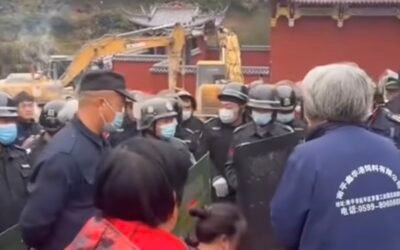
The unrest in Inner Mongolia, which local Mongols prefer to call Southern Mongolia, about the school reform making Chinese the main language of education, and confining Mongolian to the status of a subject, continues. Reportedly, some 5,000 Mongolian-speaking students, parents, and activists have been arrested. Students continue to escape from their schools where they were confined. Nine Mongols protested by committing suicide. Those arrested are sent to so-called Legal Education Centers. Introduced as centers where citizens learn Chinese law, they are in fact a more secretive variant of the transformation through education camps, nicknamed “black jails” by their victims.
While mercilessly cracking down on the protest, the CCP claims that it has offered the “Five No Changes” (五个不变) as a compromise solution. Some international media have interpreted this development as evidence that the protests persuaded the CCP to back off. In fact, this is not accurate. The “Five No Changes” were part of the school reform, and were announced by Shi Taifeng, the secretary of the CCP branch of the Inner Mongolia Autonomous Region, on August 29, before the reform was implemented, and the protest started, on September 1.
The “Five No Changes” promise that there will be no changes in the curriculum, textbooks, schedules, language, and model of instruction except for three subjects, language and literature, morality and law, and history. The latter three subjects will switch to Chinese, starting from language and literature in September 2020, followed by morality and law in 2021, and history in 2022. The subjects not affected by the reform, if the “Five No Changes” will be respected, will be mathematics, sciences, art, music, and physical education. Obviously, the three subjects affected by the reform include most of the humanities, and courses are already switching from teaching Mongolian to Chinese language and literature as the main subject.
However, there is more. Mongol parents and students claim that the promise of the “Five No Changes” is not being respected in several schools, where students are not allowed to speak in Mongolian at all, and books written in Mongolian language have been taken off the shelves. In the regional capital Hohhot reportedly printing shops refuse clients who want to have texts in Mongolian printed. Even photocopying texts in Mongolian is forbidden.
There are no “concessions,” and both the protests and the crackdown continue.

Massimo Introvigne (born June 14, 1955 in Rome) is an Italian sociologist of religions. He is the founder and managing director of the Center for Studies on New Religions (CESNUR), an international network of scholars who study new religious movements. Introvigne is the author of some 70 books and more than 100 articles in the field of sociology of religion. He was the main author of the Enciclopedia delle religioni in Italia (Encyclopedia of Religions in Italy). He is a member of the editorial board for the Interdisciplinary Journal of Research on Religion and of the executive board of University of California Press’ Nova Religio. From January 5 to December 31, 2011, he has served as the “Representative on combating racism, xenophobia and discrimination, with a special focus on discrimination against Christians and members of other religions” of the Organization for Security and Co-operation in Europe (OSCE). From 2012 to 2015 he served as chairperson of the Observatory of Religious Liberty, instituted by the Italian Ministry of Foreign Affairs in order to monitor problems of religious liberty on a worldwide scale.