In Syzran they were accused of holding an unauthorized procession. In fact, authorities believed they might convert Orthodox Christians.
by Massimo Introvigne

There is considerable literature on how the Soviet Union persecuted the Hare Krishna. Some of them ended up in psychiatric hospitals, as documented by scholar Rasa Pranskevičiūtė-Amoson for the case of Lithuania.
Although accused of operating a “cult” by anti-cultists, instances of detention become rarer in post-Soviet Russia. However, the religious situation is quickly deteriorating there. Religious minorities are only tolerated if they do not try to convert members of the hegemonic Russian Orthodox Church (ROC). Theoretically, Russia is a secular state. In practice, the Putin regime functions through an unwritten but strictly enforced pact with the ROC. The ROC supports the regime, including in the Ukrainian war, and the regime protects the ROC against competition.
On June 11, Hare Krishna—as they normally do throughout the world—marched in the streets of the city of Syzran, in Samara Oblast, chanting as usual. They were noticed by activists of the “Ambulance Youth Aid,” an organization whose aim is to protect “healthy lifestyle” against (inter alia) “the danger of the cults.” They came to the spot and called the police (with which they frequently cooperate). The agents arrived and detained some of the Krishna devotees.

They told the media that the Hare Krishna will be charged both for holding an unauthorized demonstration (a serious crime in Russia) and for violating the laws against proselytization by distributing flyers. They quoted the opinion of Russia’s leading anti-cultist Alexander Dvorkin that the Hare Krishna are “a dangerous criminal organization.”
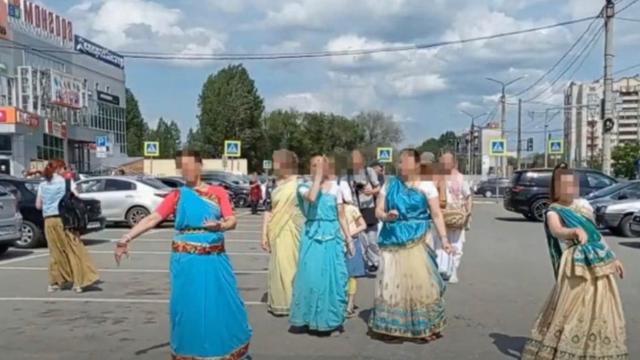
In fact, beyond the administrative pretexts, what the police raid was all about was expressed to local media by one of those who protested against their march: “Russia has always been an Orthodox country and will remain Orthodox!”

Massimo Introvigne (born June 14, 1955 in Rome) is an Italian sociologist of religions. He is the founder and managing director of the Center for Studies on New Religions (CESNUR), an international network of scholars who study new religious movements. Introvigne is the author of some 70 books and more than 100 articles in the field of sociology of religion. He was the main author of the Enciclopedia delle religioni in Italia (Encyclopedia of Religions in Italy). He is a member of the editorial board for the Interdisciplinary Journal of Research on Religion and of the executive board of University of California Press’ Nova Religio. From January 5 to December 31, 2011, he has served as the “Representative on combating racism, xenophobia and discrimination, with a special focus on discrimination against Christians and members of other religions” of the Organization for Security and Co-operation in Europe (OSCE). From 2012 to 2015 he served as chairperson of the Observatory of Religious Liberty, instituted by the Italian Ministry of Foreign Affairs in order to monitor problems of religious liberty on a worldwide scale.