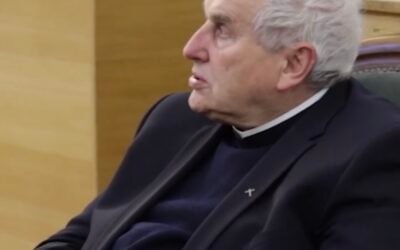
A conservative Catholic congregation is accused of “abuse of weakness,” i.e., of “brainwashing.” Its Superior can go to jail.
by Massimo Introvigne

The trial for “abuse of weakness” of the Missionary Family of Notre-Dame (Famille Missionnaire de Notre-Dame, FMND) and its Superior Father Bernard Domini (civil name Gérard Pinède) opened on July 4 in the court of the French city of Privas and was adjourned to August 1. The “abuse of weakness” (abus de faiblesse) allegedly practiced by “cults” is one of the incarnations of the discredited and pseudo-scientific theory of “brainwashing.” It is however unusual that anti-cult laws are enforced against a Catholic congregation.
The origins of the FMND date back to World War II and to the 1944 vow of several women from the village of Saint-Pierre-de-Colombier to erect a statue to the Virgin Mary under the title of Our Lady of Snows, if she would protect them from the violence of the German troops in retreat. The statue was erected in 1946 with the authorization of the diocesan bishop, who also authorized the local parish priest Father Lucien-Marie Dorne (1914–2006) and a woman called Augusta Bernard (1907–1963) to create a religious community. In 2005, the FMND was canonically recognized by the Catholic Church as a religious order at the diocesan level. In 2006, Father Dorne died and was succeeded by Father Bernard Pinède as Superior General. The FMND gradually expanded and created some fifteen branches in France, Germany, and Italy.
Even before the death of Father Dorne, the FMND was involved in two main controversies. The first concerned its conservative views, which had become those of a minority in the French Catholic Church, on issues such as abortion and homosexuality. The second was about its project of building a large church of Our Lady of Snows in Saint-Pierre-de-Colombier, which was opposed by local ecologists and also by leftist militants opposed to the FMND’s political views. This controversy made national headlines in October 2023, when the video showing a FMND nun tackling and knocking down an ecologist militant went viral on social media—although the community lamented that previous violences by anti-FMND protesters were not shown.

The confrontation followed the surprise announcement in May 2023 by the governmental French Office for Biodiversity that an extremely rare plant, the reseda of Jacquin, had been discovered in the proposed location for the church and that it should be protected by blocking the church’s construction works. The matter is still being litigated in French courts.
The accusations of “cultic deviances” and “abuse of weakness” should be understood within this highly politicized context. They were first raised by private anti-cult associations in 2007. Within the peculiar French context, Catholic Bishops are very sensitive to these accusations, and the FMND was also unpopular within the Church for its political views. In 2019 the Vatican sent a canonical visit to the FMND, which found several problems and led to the appointment in 2021 of the retired former Bishop of Metz, Jean-Christophe Lagleize, as “apostolic assistant” of the FMND. He indicated that his mandate was to help putting the old constitutions of the FMND in line with the present-day Catholic Church through a dialogue with the community, and should not be regarded as a punishment. Father Bernard remained in charge and the FMND continued its normal activities.
Anti-cultists, however, were not satisfied by these developments and managed to have the FMND included in the 2021 report of the government anti-cult agency MIVILUDES as a groups suspected of “cultic deviances.” Eventually, Father Bernard was investigated and incriminated for “abuse of weakness.”

At the trial, based on reports by the MIVILUDES and anti-cult “experts,” Father Bernard was accused of using psychological techniques to subjugate and control the FMND members including by exciting their feelings of guilt through frequent confessions and “a drastic limitation of contacts between members and the outside world and even with their own families”—which is of course typical of most conservative Catholic religious congregations. As reported by the FMND, they were also accused of producing “anxiety” by teachings novices about the existence of the Devil and Hell.
The FMND also notes the suspicious presence in the courtroom of ecologist and political militants, rejects as deprived of any evidence the claims that some of its members attempted to commit suicide, and raises some doubts on the motivations of the complainants who started the case. “As for the five complainants, one has never been a member of the religious community; the other stayed for ten days and was asked to leave because she was not cut out for religious life; the third was refused membership by unanimous decision of the Council and had previous problems in other communities; the fourth failed to understand that the vows of poverty, chastity, and obedience were vows she was making to God himself, and that they were binding on her; and the fifth left behind a local branch in great suffering, due to his brutal ways of acting as its leader. This objectively puts into perspective the statements made by the plaintiffs, who also largely contradict each other.”
The lawyer for FMND has contested the constitutionality of the law against the “cults” and of the provisions against “abuse of weakness.” While it is not probable that these objections will be accepted in the present French context, the trial in Privas shows how pretty much everybody can be accused of “brainwashing” by disgruntled ex-members. It is well possible that the FMND is in need of somewhat “modernizing” its structures and theology if it wants to remain part of the Roman Catholic Church, and it seems that it has accepted to cooperate with Bishop Lagleize to this effect. But these are internal problems of the Roman Catholic Church, not matters to be decided by secular courts of law that threaten to send the Superior of a Catholic congregation to jail for several years for imaginary crimes of “brainwashing.”
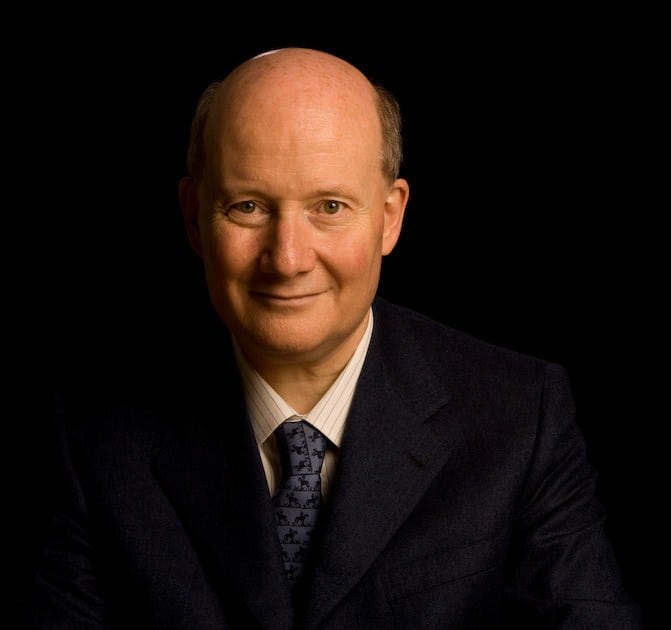
Massimo Introvigne (born June 14, 1955 in Rome) is an Italian sociologist of religions. He is the founder and managing director of the Center for Studies on New Religions (CESNUR), an international network of scholars who study new religious movements. Introvigne is the author of some 70 books and more than 100 articles in the field of sociology of religion. He was the main author of the Enciclopedia delle religioni in Italia (Encyclopedia of Religions in Italy). He is a member of the editorial board for the Interdisciplinary Journal of Research on Religion and of the executive board of University of California Press’ Nova Religio. From January 5 to December 31, 2011, he has served as the “Representative on combating racism, xenophobia and discrimination, with a special focus on discrimination against Christians and members of other religions” of the Organization for Security and Co-operation in Europe (OSCE). From 2012 to 2015 he served as chairperson of the Observatory of Religious Liberty, instituted by the Italian Ministry of Foreign Affairs in order to monitor problems of religious liberty on a worldwide scale.