To understand what is happening to Chinese Daoism, it is essential to explain how the concept of “Sinicization” was developed by Xi Jinping.
by Karine Martin*
*An adapted pre-publication excerpt from “Monastic Daoism Transformed: The Fate of the Thunder Drum Lineage” (2025), available from Three Pines Press.
Article 1 of 4.
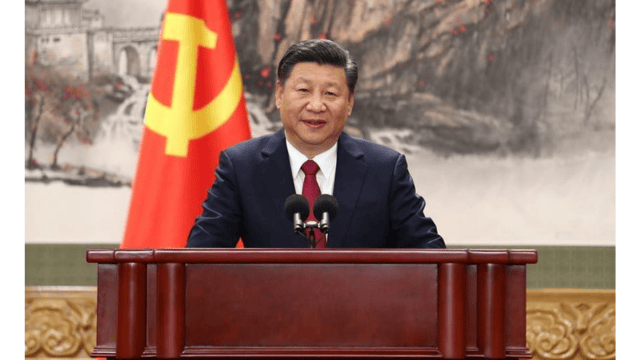
A few years ago, the Chinese government moved away from its dominant vision known as the China Dream and replaced it with a new policy called Sinicization (zhonguo hua中國化). Xi Jinping adopted the slogan for the first time in 2015. At the National Conference on Religious Work in 2016, he asserted that all religions must move toward Sinicization and ultimately sealed it as the main characteristic of his religious policy at the 19th Congress of the CCP in 2017.
Characteristic of Xi Jinping’s reign, Sinicizationis distinct from his predecessors’ “mutual adaptation” and “harmonious society” philosophies, aiming at complete political domestication and submission to the Communist party-state. It is, in the words of Yang Fenggang, a strategy “to comprehensively reshape religions to be consistent with the dominant ideology and promote loyalty to the CCP.”
The idea of “Chineseness” in this context is redefined, as Hannah Theaker says, “to explicitly link loyalty to the Party with being Chinese and a sharp move toward assimilationist policies directed strongly at non-Han ethnic and religious minorities.” While used to justify the intensified suppression of Tibetans and Uyghurs, it also applies to Han Chinese religious practitioners of Islam and Christianity but is not limited to them: even Chinese Buddhists and Daoists have to adjust their teachings and practices.
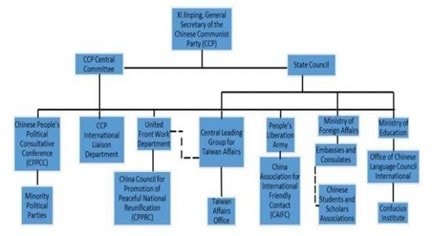
Sinicization is administered by the United Front Work Department (Zhongyang tongyi zhanxian gongzuo bu 中央统一戰線工作部), an official entity directly under the CCP Central Committee (as shown in the chart above). As Gerry Groot outlines in his book, “Managing Transitions: The Chinese Communist Party, United Front Work, Corporatism and Hegemony” (2004), it was created in the 1920s and came to be active in the early years of communist rule to train and reform intellectuals. Shut down during the Cultural Revolution, it was revived in 1979 but remained low-key until 2012, when Xi Jinping expanded and intensified it. Its so-called united front work, as described by Annie Marie Brady, consists of gathering intelligence on, managing relations with, and gaining influence over entities outside the CCP that hold political, commercial, or academic influence, ensuring that they are supportive of, and useful to, CCP interests.
In 2018, as Taotao Zhao and James Leibold explain (“Ethnic Governance under Xi Jinping: The Centrality of the United Front Work Department and Its Implications,” “Journal of Contemporary China” 29.124: 487-502), the United Front Work Department was put in charge of the various religions of China, absorbing the State Administration of Religious Affairs and the Overseas Chinese Affairs Office, whose names, structures, and employees it retained yet consolidated. It also assumed control of the National Ethnic Affairs Commission and thus became the main agency to oversee all ethnic, religious, and overseas Chinese affairs.
The agency has over 40,000 personnel and directs eight minor political parties as well as the All-China Federation of Industry and Commerce. Below its General Office, it consists of twelve major bureaus, among which the eleventh and twelfth focus particularly on religion, while the second deals with minorities and the sixth and seventh work on Tibetans and Uyghurs. Its methods consist mainly of outreach through large-scale events, training sessions, media tours, and similar activities, but it also has powers of incarceration, confiscation, and demolition.
Sinicization requires all religious organizations to modify their doctrines and activities so that they match Han Chinese culture. In concrete terms, it manifests in various dimensions. The most visible involves architecture, which now has to be entirely Chinese in style: authorities have removed crosses from churches and demolished the domes and minarets of mosques.
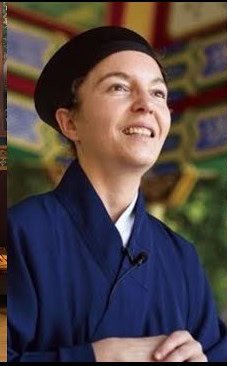
Karine Martin holds doctorates in both Pharmaceutical Sciences (1997) and Religious Studies (2015). While working in neuroscience research in London, she came in contact with Daoism of the Thunder Drum lineage and entered its training. From 2001 to 2016, she lived in Daoist temples of various regions. She is the founder and director of the French Daoist Association, which organizes lectures, workshops, and training courses. A major representative of Daoism in the West, she presents at international conferences, has a strong internet presence, and is interviewed frequently.