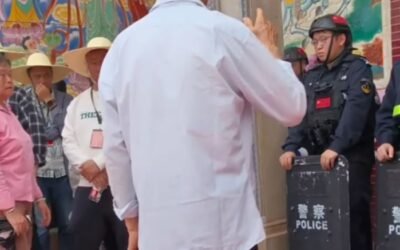
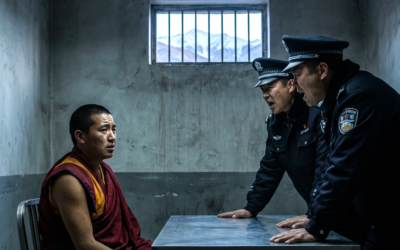
Chinese police took writer Lhamjab Borjigin from his residence in Ulaanbaatar and deported him back to China.
by Massimo Introvigne

On May 3, 2023, two vehicles of the Chinese police arrived at a private residence and arrested a dissident writer. These are daily occurrences in China but this time the incident did not happen within Chinese borders. Lhamjab Borjigin was arrested in Ulaanbaatar, the capital of the independent country of Mongolia, and promptly taken to China by his captors.
Borjigin is a writer well-known in Southern Mongolia, which Chinese call Inner Mongolia and try to “Sinicize” by suppressing its Mongolian identity. In 2019, Borjigin was sentenced to two years in jail for having published a book on the Cultural Revolution including oral testimonies of Southern Mongolian survivors of that bloody era that did not please the CCP.
Having served his sentence, he was placed under indefinite “residential surveillance,” a form of house arrest.
On March 6, 2023, Borjigin managed to escape to independent Mongolia, where he announced he will publish a three-volume history of the suppression of Mongolian identity by the CCP in Southern Mongolia.
One week after his arrest, Borjigin called the New-York-based Southern Mongolian Human Rights Information Center (SMHRIC), telling them that he had been warned that Chinese police were coming to Ulaanbaatar with his daughter to kidnap him and bring him back to China. The SMHRIC alerted the office of the U.N. High Commissioner for Refugees (UNHCR), but they could not prevent the kidnapping of Borjigin, which happened on May 3, obviously with the complicity or at least the tacit consent of Mongolian authorities.
This is the fifth case of a Southern Mongolian dissident kidnapped from Chinese police in Mongolia. One of them, called Batzangaa, was arrested in front of the UNHCR office building in Ulaanbaatar.
The Chinese police, however, were not able to recover the manuscript of Borjigin’s book. It is in the safe hands of Mongolian friends, who plan to go on with the publication. But not even this is sure now, with the Mongolian government increasingly subservient to Beijing.
On March 3, the Dalai Lama announced that the Jebtsundamba Khutughtu, the leader of Mongolian Tibetan Buddhists and the third highest authority in the tradition after the Dalai Lama himself and the Panchen Lama, had reincarnated as a Mongolian boy born in the United States. However, the Mongolian government has been warned by China that it should not recognize the new Jebtsundamba Khutughtu nor allow him to travel to Mongolia.
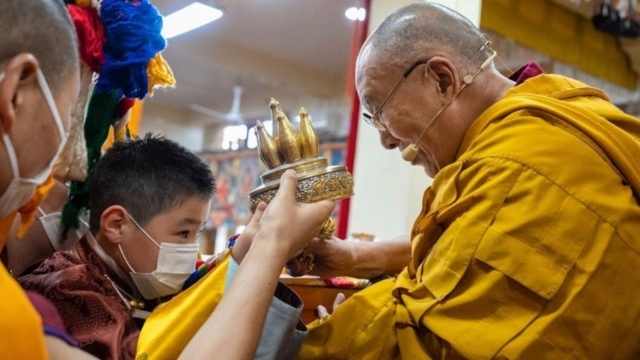
The 10th Jebtsundamba Khutughtu identified by the Dalai Lama should be formally enthroned by Mongolian Buddhist clergy, but this can only happen with the authorization of the Mongolian government. So far, there is no indication that Mongolia is willing to resist Chinese diktats.

Massimo Introvigne (born June 14, 1955 in Rome) is an Italian sociologist of religions. He is the founder and managing director of the Center for Studies on New Religions (CESNUR), an international network of scholars who study new religious movements. Introvigne is the author of some 70 books and more than 100 articles in the field of sociology of religion. He was the main author of the Enciclopedia delle religioni in Italia (Encyclopedia of Religions in Italy). He is a member of the editorial board for the Interdisciplinary Journal of Research on Religion and of the executive board of University of California Press’ Nova Religio. From January 5 to December 31, 2011, he has served as the “Representative on combating racism, xenophobia and discrimination, with a special focus on discrimination against Christians and members of other religions” of the Organization for Security and Co-operation in Europe (OSCE). From 2012 to 2015 he served as chairperson of the Observatory of Religious Liberty, instituted by the Italian Ministry of Foreign Affairs in order to monitor problems of religious liberty on a worldwide scale.